The Demise of Shoe Repair
Seinfeld: S6, E8 “The Mom & Pop Store”
Supply and Demand: Creative Destruction
Ever the crusader for the cause of small businesses, Kramer bemoans the struggles of a local mom-and-pop shoe repair store.
“Jerry, you know that shoe repair place at the end of the block? If they don’t get some business, they’re gonna have to shut down and make way for one of those gourmet coffee or cookie stores.”
He emphasizes that the store is a mainstay in the neighborhood. It’s been there for 48 years. He coaxes Jerry into letting him take a box of Jerry’s sneakers to the store for cleaning, since Jerry truly has no need for the store’s primary money-making service.
Kramer: “You gotta have a pair of shoes in need of a cobbler.”
Jerry: “I really don’t wear the kind of shoes that have to be cobbled.”
When Kramer hauls the box of sneakers to the store for cleaning, the owner admits that without Kramer’s demand for their services, they would be out of business. What led to the downfall of this store and so many other shoe repair stores?
A leading candidate is a decrease in the price of new shoes brought about by advances in manufacturing processes that save on production cost.11 Another possible explanation is a greater reliance on cheaper, imported shoes, particularly from Asia in the 1990s. This had the same economic effect as technological improvements: more abundant new shoes at lower prices. International trade and technological advancements often end up producing similar effects on markets. This process can be modeled by supply and demand in the market for new sneakers below:
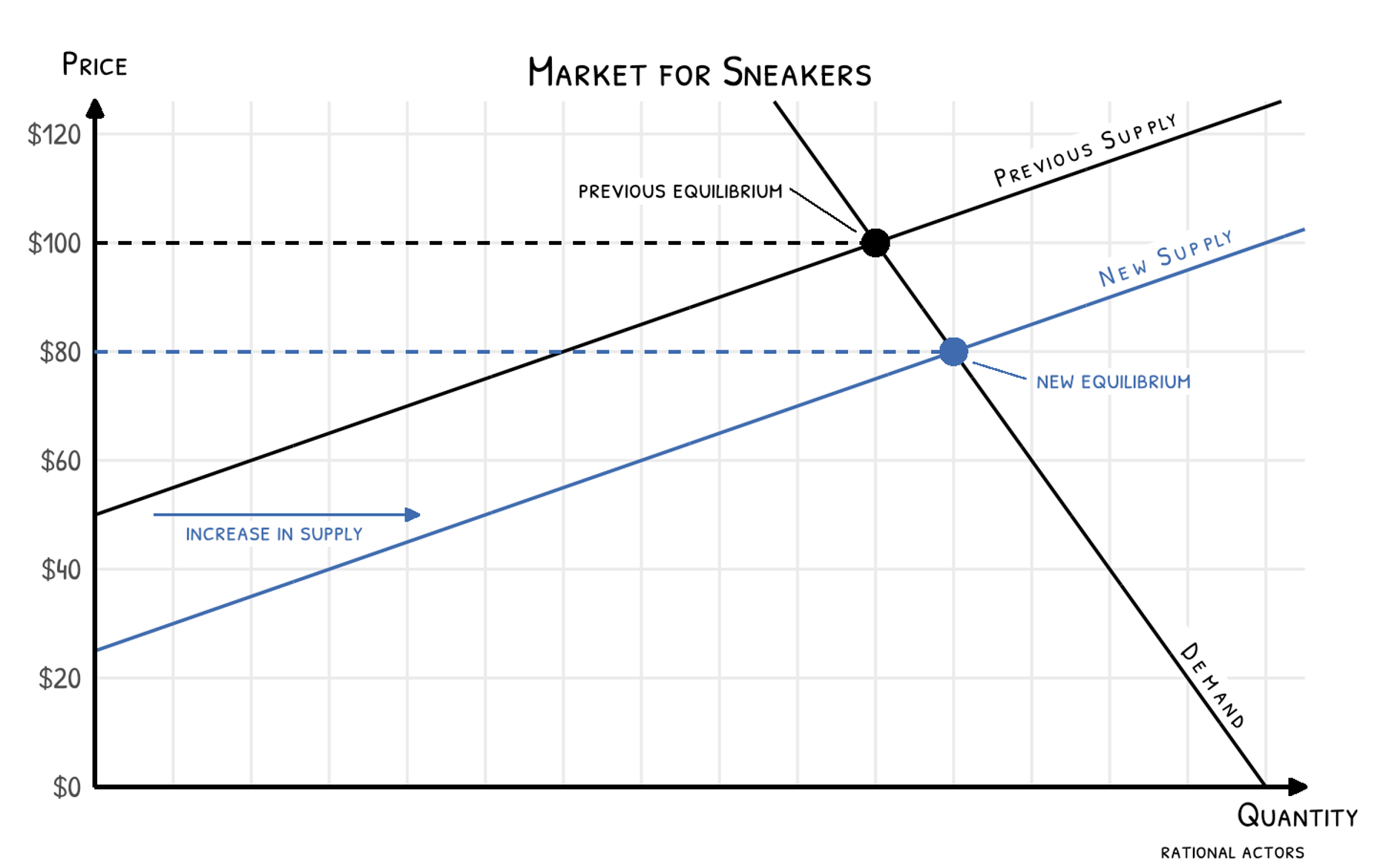
As producers take advantage of their new production processes, they flood markets with greater and greater quantities of new shoes. This change shows up as an increase in supply, where for any given price of sneakers, manufacturers produce greater quantities than before. Stores would prefer to keep selling the sneakers at $100, but the only way to get the glut of shoes off the shelves is to start lowering prices.
And this really did happen. In November of 1994 (the date this episode aired), the year-over-year inflation rate for footwear was -1.3%.22 Source: https://fred.stlouisfed.org/series/CUSR0000SEAE A pair of shoes priced at $100 in 1993 was (on average) priced at $98.70 in 1994. The overall inflation rate was 2.6% at the time, so new shoes took up a decreasing share of consumer budgets.33 Source: https://fred.stlouisfed.org/series/CPIAUCSL This moment was a preview of things to come. Between November 1993 and November 2003, footwear prices fell by 5.6% despite a 26.7% increase in overall price levels over the 10-year span.
This impacts Mom and Pop directly. Shoe repair services and new shoes are substitutes: goods or services where consumers typically buy one or the other, not both. When the price of one goes down, the demand for the other decreases. Now when the soles comes off someone’s favorite sneakers, they are a little more likely to simply buy a new pair rather than have them repaired.
This decreases the demand for shoe repair services. Bad news for mom-and-pop shoe repair stores. The consequences of this change can be seen below:
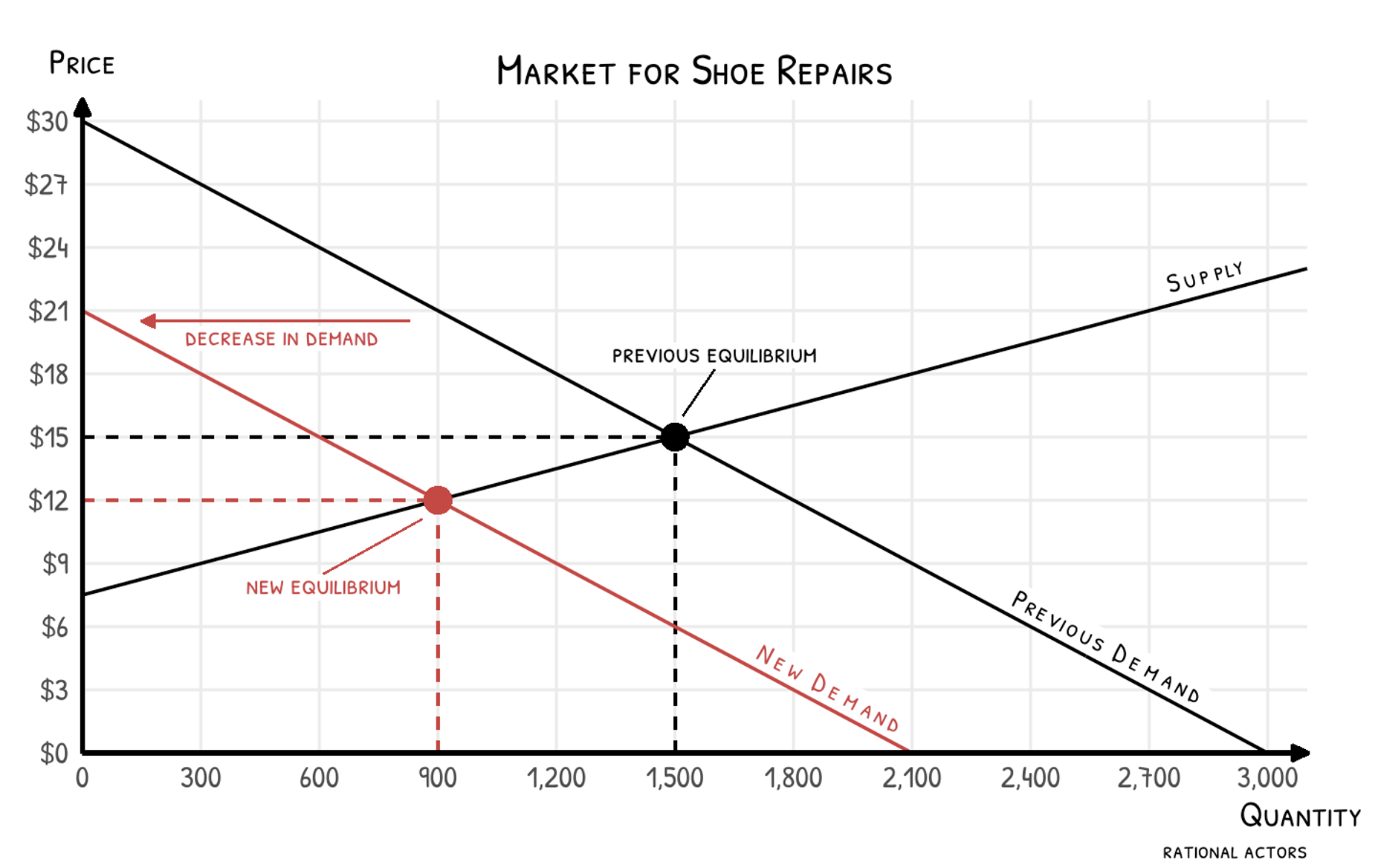
Competition between shoe repair stores for a decreasing number of customers drives the price of shoe repair services down and leaves them with fewer customers than they had a year ago. This puts serious pressure on profits. The shoe repair store brings in less revenue than before but still must cover its costs, which include rent and store maintenance.44 Negative demand shocks are especially damaging for business with high fixed costs and relatively low variables costs, like a shoe repair store in Manhattan. As fewer customers trickle in, revenue drops sharply while costs stay stubbornly high.
So, when Kramer unwittingly uncovers a $4,000 expense for the local shoe repair store, they are forced to shut down their business. Out with shoe repair. In with coffee and cookies. It must be that those stores get enough customers to be profitable.
“Well, I saw Mom and Pop this morning, but when I went by the store on my way home, the place was empty. Everything is gone. Mom and Pop – pfft – vanished.”
The disappearance of the shoe repair store is a textbook case of what economist Joseph Schumpeter famously termed creative destruction: an outcome of free markets where new ideas and innovations push out old businesses. As shoe manufacturers found creative, cost-cutting ways to ramp up shoe production, their innovations led to the demise of the shoe repair industry. The light bulb did the same to the candle industry. Video streaming did the same to movie rental stores.
This process is messy and is certainly painful for Mom and Pop. But the broader story is more hopeful. Consumers as a whole benefit by getting more affordable access to the goods they really want: shoes in good working order. In free markets, businesses survive by serving the needs of the consumer better than their competitors. Shoe repair vanished as an industry because consumers voted, with their wallets, for new shoes instead. And for coffee and cookies.
George: “Well, what’s so great about a mom-and-pop store? Let me tell you something. If my Mom and Pop ran a store, I wouldn’t shop there.”
¹ Another possible explanation is a greater reliance on cheaper, imported shoes, particularly from Asia in the 1990s. This had the same economic effect as technological improvements: more abundant new shoes at lower prices. International trade and technological advancements often end up producing similar effects on markets.
² Source: https://fred.stlouisfed.org/series/CUSR0000SEAE
³ Source: https://fred.stlouisfed.org/series/CPIAUCSL
4 Negative demand shocks are especially damaging for business with high fixed costs and relatively low variables costs, like a shoe repair store in Manhattan. As fewer customers trickle in, revenue drops sharply while costs stay stubbornly high.