A Place to Park
Seinfeld: S3, E21 “The Parking Space”
Supply and Demand: “Free” Goods
George and Elaine are on their way back to Jerry’s apartment from the flea market, when the realities of New York City street parking create problems.
George: “Alright, start looking for spaces.”
Elaine: “Oh, you're never gonna find a space on Jerry's block, just put it in a garage.”
While this exchange seems benign to anyone familiar with big-city parking, there’s something odd at work here. Can you imagine someone telling you that you would never find bread at that bakery, so just buy a bagel? You would wonder how a bakery runs out of bread so predictably. And why is Elaine so sure there will be a spot in the garage? The answer: bread and garage parking are priced. Curb parking is free.
To see the full consequences of free curb parking, let’s model the supply and demand for curb parking spots in Jerry’s neighborhood on the Upper West Side.
- All curb parking spots are owned by the city government, which sets the price. There are enough streets to feasibly provide 200 curb spots. It’s not possible to provide more. Thus, the supply of curb spots is perfectly inelastic.1
- With free parking, 400 drivers want curb parking. Each time the price increases by a dollar an hour, 100 drivers are scared off.2
- Each person who parks leaves their car in the spot for eight hours.3
The city gives away parking spots for free. That sounds great but has many consequences. The immediate result is a large shortage of spots. They run out quickly.

At least there’s lots of consumer surplus for the 200 who find spots, right? Even the driver with the lowest willingness to pay among those who find spots (the marginal parker) values the spot at $2 per hour and gets it for free. That gap is the consumer surplus.4 But the pursuit of that surplus will induce fierce competition for spots.
George: “Look, I have my system. First, I look for the dream spot right in front of the door, then I slowly expand out in concentric circles.”
People like George will cruise around nearby streets looking for a spot. Other drivers will show up to the neighborhood earlier than they would otherwise plan to. They’ll tail people leaving coffee shops to see if they might vacate a spot. They’ll be willing to sacrifice their valuable time for that sweet consumer surplus.
How much sacrifice? Here, the marginal parker’s consumer surplus is $16 in the free spot. How long would they be willing to cruise around to find such a spot? If they value their time at $20 an hour, then they would be willing to circle around for up to 48 minutes. Competition among drivers pushes search time to that amount: any less and more drivers would start circling too. So, each driver can expect to circle around for long enough to burn up $16 of their consumer surplus.5 The spots are no longer free once you factor in search costs.

Elaine: “Oh, come on, George, please put it in a garage. I don't want to spend an hour looking for a space.”
A step in the right direction would be for the city to charge the equilibrium price for parking: $2 per hour. At that price, 200 people will want to park and there are 200 spots.6 The higher price cuts into consumer surplus, just like cruising time does, but the reduction in consumer surplus is no longer a complete loss.
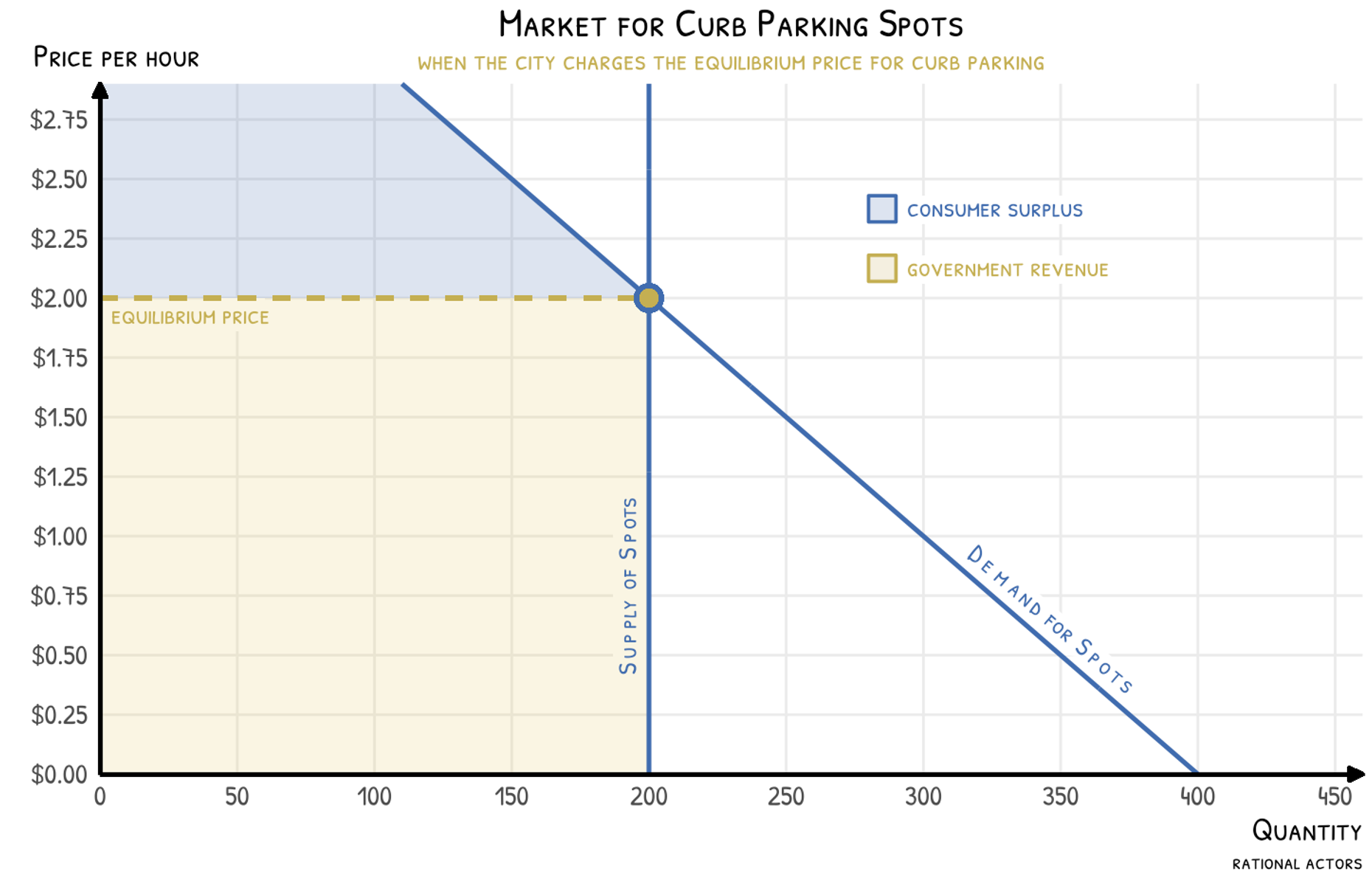
Now, rather than burn up that value in cruise time, the government collects that value in revenue: $400 every hour. That money can fund government services or reduce taxes elsewhere.7 As a positive side effect, neighborhood traffic becomes less congested and carbon emissions fall. There may even be fewer situations where drivers literally fight for scarce spots.
Prices are a tried-and-true way to allocate scarce resources. If those resources are offered for free, consumers often compete for them before they run out in ways that reduce the value of getting it for free in the first place. It’s often better to just charge for it instead, especially in cases where supply constraints are unforgiving.
“The problem is car manufacturers are building hundreds of thousands of new cars every year, they're not making any new spaces. That's what they should be working on. Wouldn't that be great? You go to the Auto Show, they got that big revolving turntable, and there's nothing on it. New from Chrysler, a space.”
1 As a function, QS = 200. There’s a more sophisticated version of this model that accounts for the fact that the city is a monopoly seller of curb spots, but that model is more fitting for a profit-maximizing seller. Given its provision of free parking, the city seems to have other goals.
2 This describes a demand function that would be written as QD = 400 – 100P. If you plug in QD = 0 and solve for P, you find the choke price of demand at which nobody would want to park in this neighborhood: $4 per hour.
3 This simplifies the story quite a bit. In reality, length of stay in the spot would be closely related to the price and vary a lot from person to person. But this assumption allows us to focus on who is getting spots and what actions they might take to get them.
4 This assumes that the 200 spots somehow get allocated to the 200 drivers with the highest willingness to pay, which is unrealistic. In reality, the consumer surplus from free parking is much smaller than this optimistic scenario. Some drivers willing to pay $0.10 an hour will get a spot while those desperate will not.
5 This conclusion does not depend on whether time is valued at $20 an hour or $200 an hour. The value of time used here only generates different predictions about how long people will be willing to cruise for a spot. The conclusion remains: expected cruise time will be high enough to burn up the consumer surplus of the marginal parker and other cruisers will (on average) suffer the same loss in consumer surplus, though they may have some consumer surplus left over. This phenomenon is called rent dissipation. It also occurs when concert-goers camp out overnight for tickets and shoppers wait in long lines outside Best Buy on Black Friday.
6 The biggest champion for this policy recommendation is the late Donald Shoup, who authored The High Cost of Free Parking (2005). Shoup’s rule is to set the price a little higher than equilibrium to keep roughly one space open per block, freely adjusting prices by time and location. Exact equilibrium pricing wouldn’t perfectly remove cruising, since drivers arrive and depart at random times.
7 Or pay down debts so that future people get more government services or lower taxes.

More from Seinfeld:
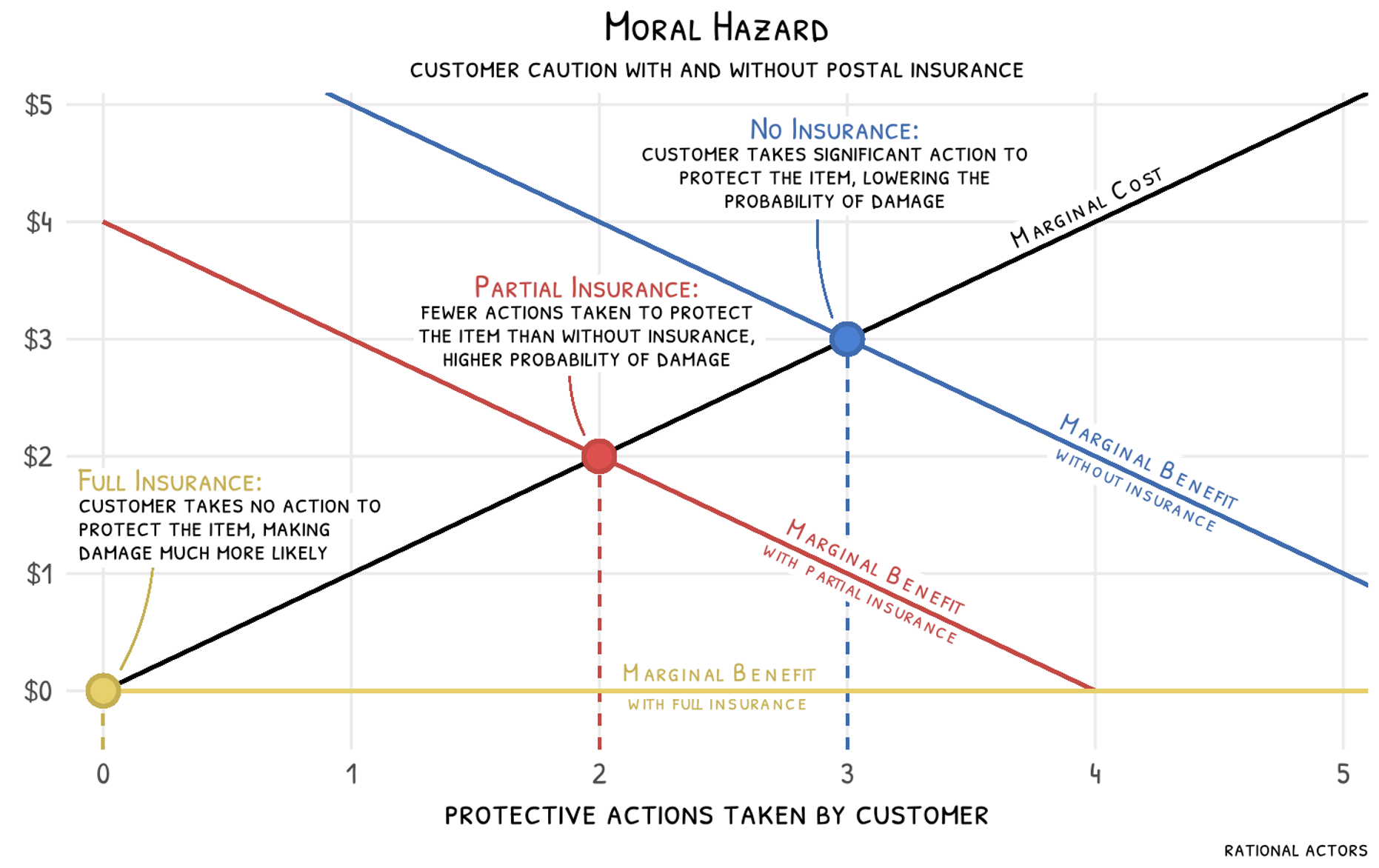

1 Do people really behave this way? Largely, yes! You could drive your car very slowly. But going a little faster has benefits (time savings) that are greater than the costs (of lower safety). And yet you don’t drive 120 miles per hour. The expected costs of doing so (higher crash probability, higher probability of fines, etc.) are much higher than the benefits. You stop accelerating where you perceive marginal benefit equals marginal costs.
2 This describes a demand function that would be written as QD = 400 – 100P. If you plug in QD = 0 and solve for P, you find the choke price of demand at which nobody would want to park in this neighborhood: $4 per hour.
3 This simplifies the story quite a bit. In reality, length of stay in the spot would be closely related to the price and vary a lot from person to person. But this assumption allows us to focus on who is getting spots and what actions they might take to get them.
4 This assumes that the 200 spots somehow get allocated to the 200 drivers with the highest willingness to pay, which is unrealistic. In reality, the consumer surplus from free parking is much smaller than this optimistic scenario. Some drivers willing to pay $0.10 an hour will get a spot while those desperate will not.
5 This conclusion does not depend on whether time is valued at $20 an hour or $200 an hour. The value of time used here only generates different predictions about how long people will be willing to cruise for a spot. The conclusion remains: expected cruise time will be high enough to burn up the consumer surplus of the marginal parker and other cruisers will (on average) suffer the same loss in consumer surplus, though they may have some consumer surplus left over. This phenomenon is called rent dissipation. It also occurs when concert-goers camp out overnight for tickets and shoppers wait in long lines outside Best Buy on Black Friday.
6 The biggest champion for this policy recommendation is the late Donald Shoup, who authored The High Cost of Free Parking (2005). Shoup’s rule is to set the price a little higher than equilibrium to keep roughly one space open per block, freely adjusting prices by time and location. Exact equilibrium pricing wouldn’t perfectly remove cruising, since drivers arrive and depart at random times.
7 Or pay down debts so that future people get more government services or lower taxes.