Mail Fraud
Seinfeld: S8, E5 “The Package”
Asymmetric Information: Moral Hazard
Jerry’s stereo is busted. Even though it’s out of warranty, Kramer claims he can still get Jerry a refund. Kramer collects the stereo, packages it, and sends it in the mail back to Jerry. Once Jerry opens the package, something is amiss.
Jerry: “Hey, what happened to my stereo? It’s all smashed up.”
Kramer: “That’s right. Now it looks like it was broken during shipping. And I insured it for $400.”
Jerry: “But you were supposed to get me a refund.”
Kramer: “You can’t get a refund. Your warranty expired two years ago.”
This appears to be a classic case of insurance fraud, but it illustrates important principles at play in markets for insurance.
The postal service, which sells insurance for packages sent in the mail, cannot observe the actions taken by its customers to protect their items. The seller has less information than the buyer, creating a case of asymmetric information. The insurance provider may be particularly concerned with moral hazard: the customer’s behavior (which can’t be perfectly monitored) makes unfavorable outcomes (like a damaged package) more likely. And damage leads to payouts.
Kramer’s scheme is an extreme example of moral hazard: fraud. But moral hazard in postal insurance affects the actions of honest customers as well. To see why, model the shipping of a fragile item with the following assumptions of the customer’s behavior if their item is uninsured:
- The customer can take a range of actions to ensure their item doesn’t break in the box. Add foam. Add bubble wrap. Reinforce the inside of the box with a sturdier material.
- Taking just a single action reduces the probability of a broken item significantly. The customer doesn’t want their item to break, so the action is beneficial. But each additional action taken is less beneficial than the last, because the object is already quite safe. In technical terms, the marginal benefit of actions is decreasing as more actions are taken.
- Adding some padding around the item, perhaps with old newspapers, is cheap. Bubble wrap is a bit more expensive. Reinforcing the entire box even more expensive yet. Each additional action taken is more costly than the last. In technical terms, the marginal cost of actions is increasing as more actions are taken.
- The optimal number of actions for the customer occurs where marginal benefit equals marginal cost. Additional actions beyond that number, while beneficial in reducing the probability of damage, are too costly to be worthwhile.11 Do people really behave this way? Largely, yes! You could drive your car very slowly. But going a little faster has benefits (time savings) that are greater than the costs (of lower safety). And yet you don’t drive 120 miles per hour. The expected costs of doing so (higher crash probability, higher probability of fines, etc.) are much higher than the benefits. You stop accelerating where you perceive marginal benefit equals marginal costs.
Now, consider two possible insurance options: (1) the item is partially insured such that the customer is reimbursed a fraction of its value if damage occurs and (2) the item is fully insured such that the customer is reimbursed the item’s full value if damage occurs.
Under partial insurance, the customer’s incentives to protect the item are reduced. Actions taken to reduce the probability of damage are less beneficial, since damage is partially reimbursed now. Under full insurance, incentives to protect the item are gone. Either the item ships without issue or it’s damaged and the customer is fully reimbursed.22 This assumes that the reimbursement for a damaged item is costless, which is unlikely to be the case entirely. A customer may still bear costs due to the hassle of filing claims, the wait for a replacement, and potential loss of sentimental value of the original item. Full insurance still greatly reduces the benefits of protective actions. And this is why real insurance contracts often include a deductible or coinsurance rates to preserve the incentive for the insured to take protective actions. In some cases, the customer may even prefer the cash value of the object to the object itself.
The figure below displays the consequences that insurance has on the actions taken by the insured customer, given the way that insurance affects the marginal benefits of protective actions.
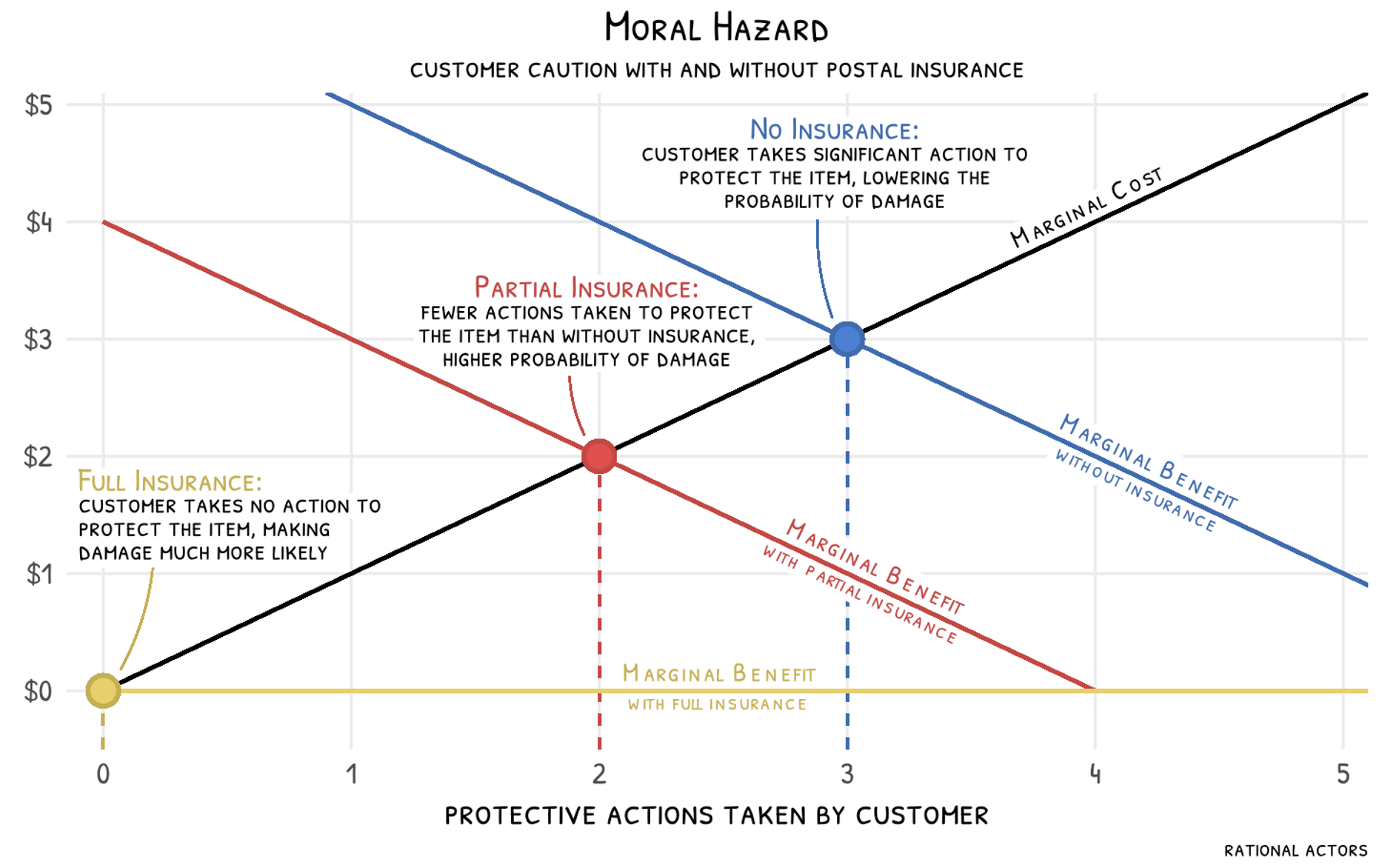
When the customer considers both the marginal benefits of actions taken to protect their item and the marginal costs, insurance affects their actions.
- With no insurance: 3 actions and a well-protected item
- With partial insurance: 2 actions and a moderately protected item
- With full insurance: no actions to protect the item and high risk of damage
Does the typical customer (unlike Kramer with the stereo) want their item to be damaged just because it’s insured? Of course not. But taking actions to prevent that are costly and a reasonable customer will only take those actions if they are beneficial.
Is your laptop fully insured? If so, you may be more likely to drink coffee without a lid right next to it. You don’t want to spill coffee on your laptop, but adding a lid can be a hassle. More arduous yet to always plug the hole in the lid with a green stopper. Even more inconvenient to just never place a drink near your laptop.
This customer calculus has important consequences for the insurer, the postal service in this case. Offering insurance leads to bigger payouts than expected, because customers change their behavior. And the more generous the insurance, the higher the likelihood of even larger payouts. Who pays for this?
Jerry: “So, we’re gonna make the post office pay for my new stereo now?”
Kramer: “It’s a write-off for them.”
Jerry: “How is it a write-off?”
Kramer: “They just write it off.”
Jerry: “Write it off what?”
Kramer: “Jerry, all these big companies, they write off everything.”
Jerry: “You don’t even know what a write-off is.”
Kramer: “Do you?”
Jerry: “No. I don’t.”
Kramer: “But they do, and they’re the ones writing it off.”
Kramer’s idea that the postal service can simply wave away these payouts with an accounting trick is appealing. A free lunch for customers. But free lunches are rare.
Moral hazard leads to more damaged packages, which leads to more payouts. The insurer quickly learns that each customer is more costly to insure than expected. Like any seller facing higher costs per customer, the insurance seller raises prices. The postal service isn’t paying for Jerry’s new stereo. Nor is it covered by some magical write-off. Other postal service insurance customers are paying for the new stereo in the form of higher prices.
In fact, when Kramer purchased postal insurance, he helped other customers replace their broken items. With rampant enough moral hazard, insurance turns into a system where insured customers end up transferring money to each other to replace their broken items. And because the rate of damage is so high, the customers collectively would have been better off if they had all just properly protected their items instead.
That’s the trouble with insurance. It changes the customer’s incentives, because they can push their costs onto someone else. Unless the insurer addresses this incentive problem, moral hazard will continue to create inefficiencies. Postal service workers may even start to detect that something is off.
Newman: “Don’t you find it interesting that your friend had the foresight to purchase postal insurance for your stereo? Huh? Parcels are rarely damaged during shipping.”
Jerry: “Define rarely.”
Newman: “Frequently.”
1 Do people really behave this way? Largely, yes! You could drive your car very slowly. But going a little faster has benefits (time savings) that are greater than the costs (of lower safety). And yet you don’t drive 120 miles per hour. The expected costs of doing so (higher crash probability, higher probability of fines, etc.) are much higher than the benefits. You stop accelerating where you perceive marginal benefit equals marginal costs.
2 This assumes that the reimbursement for a damaged item is costless, which is unlikely to be the case entirely. A customer may still bear costs due to the hassle of filing claims, the wait for a replacement, and potential loss of sentimental value of the original item. Full insurance still greatly reduces the benefits of protective actions. And this is why real insurance contracts often include a deductible or coinsurance rates to preserve the incentive for the insured to take protective actions.