Del Boca Vista
Seinfeld: S7, E16 “The Shower Head”
Game Theory: Sequential Games
Jerry and George need a buffer zone between them and their parents, who are currently in New York. George claims his parents are ruining his life and he needs a solution.
Elaine: “Georgie, how come your parents never moved to Florida?”
George: “Yeah, that is odd, isn’t it?”
Jerry: “Yeah it is.”
George: “I mean, they’re retired.”
Jerry: “There’s no economic reason for them to be here.”
George is all in on the idea. With pamphlet in hand, he’s ready to pitch his parents on moving to Del Boca Vista.
“I read some place, the life expectancy in Florida is 81. And in Queens, 73.”
The obstacle? Jerry’s parents, the Seinfelds, have tentative plans to move to Del Boca Vista as well. When Frank Costanza, George’s dad, floats the idea of moving to Florida to Morty Seinfeld, it becomes clear that these two do not belong in the same place. Maybe so much so that those life expectancy estimates would take a real hit if they were around to stress each other out.
So, where will each set of parents choose to live? This situation can be analyzed using concepts from game theory. Assume the following:
- The game has two players: the Costanzas and the Seinfelds.
- Each player chooses one of two strategies: move to Del Boca Vista or stay in New York.
- The outcomes can be quantified by the life expectancy each couple receives.
- As a baseline, both couples will have a life expectancy of 73 if both stay in New York.
- If one couple moves to Del Boca Vista, the moving couple lives an extra eight years. The staying couple, due to the reduced stress, lives an additional three years.
- If both couples move to Del Boca Vista, both live an additional two years relative to the baseline outcome. The warm weather has that effect, but the strife remains.
Assume, for now, that both players choose simultaneously. The game can then be visualized in matrix form.1

Nash equilibria exist where the chosen action of each couple is the best choice they can make given the action of the other couple. These can be found by identifying each player’s best responses to the actions of the other.
Costanzas:
- If the Seinfelds move to Del Boca Vista, best response: stay in New York (76 years > 75 years)
- If the Seinfelds stay in New York, best response: move to Del Boca Vista (81 years > 73 years)
Seinfelds:
- If the Costanzas move to Del Boca Vista, best response: stay in New York (76 years > 75 years)
- If the Costanzas stay in New York, best response: move to Del Boca Vista (81 years > 73 years)2
As a result, this game has two Nash equilibria: (1) the Costanzas move to Del Boca Vista and the Seinfelds stay in New York (2) the Costanzas stay in New York and the Seinfelds move to Del Boca Vista.3 This makes it hard to predict what will happen. Both outcomes are possible but complete opposites.
But the two couples won’t necessarily choose simultaneously. It’s more likely that one of them chooses first, leaving the other to choose in response. Suppose the Costanzas choose first. This leads to two questions:
- What will the Costanzas choose to achieve the longest life expectancy, knowing their life expectancy depends on the location of the Seinfelds, who haven’t chosen yet?
- Will the Costanzas benefit from choosing first? Or would it be better to choose second?
To model this sequentially, we can build a decision tree where the Costanzas choose first at node A.4 Because the Costanzas have two options, there are two possible situations the Seinfelds could face when it’s their turn to choose. Either they see the Costanzas have moved to Del Boca Vista (node B), or they see the Costanzas are staying in New York (node C). Then the Seinfelds choose.
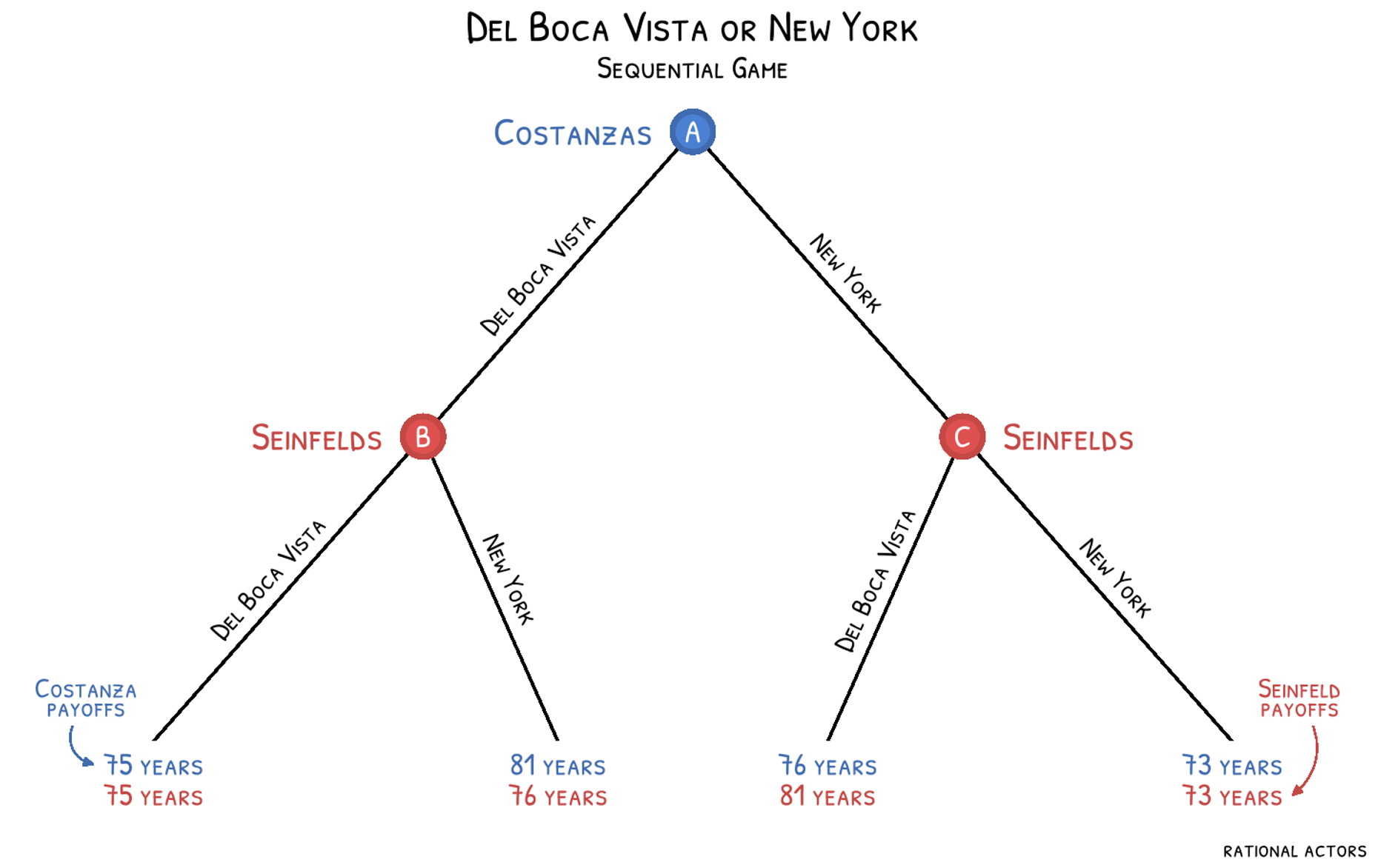
Frank makes the first move and declares the Costanzas are headed to Florida. And he is not shy about why that is.
“It’s because of the Seinfelds. They don’t want us there, so we’re going. We’re moving right into Del Boca Vistaaaa.”
But has Frank made the right move in terms of maximizing his life expectancy? Or has spite clouded his judgment? The best way for Frank to make an initial decision is through backward induction. In other words, he will project what the Seinfelds would decide at nodes B and C. Then, taking those responses as given, decide what to do at node A.5 Start at the end of the tree and work backward.
If the Seinfelds are at node B, they will prefer to stay in New York. Therefore, the outcome where both couples end up in Del Boca Vista is off the table. And if the Seinfelds are at node C, they will move to Del Boca Vista. Therefore, the outcome where both couples stay in New York is off the table.
When the Costanzas make their decision at node A, they only need to consider the potential outcomes that would result from the Seinfelds’ projected responses. So, their two options boil down to: (1) move to Del Boca Vista, after which the Seinfelds will stay in New York, and the Costanzas live to be 81 years old (2) stay in New York, after which the Seinfelds will move to Del Boca Vista, and the Costanzas live to be 76. Best to move!6
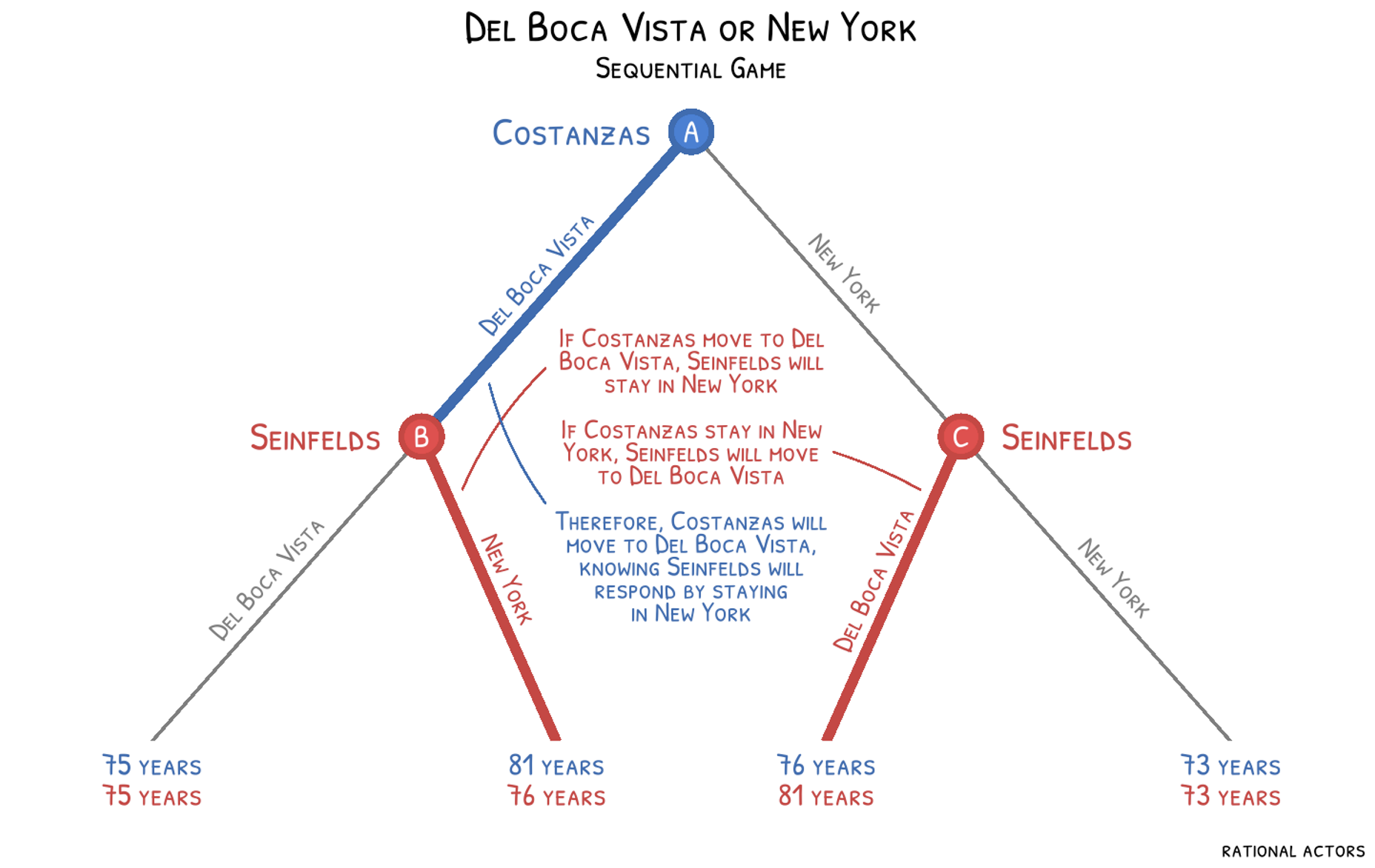
But would Frank have been better off waiting and allowing the Seinfelds to take the first action?7 Or does moving first have an advantage?
In this game, the first mover benefits from doing so. As played, the Costanzas move to Del Boca Vista and the Seinfelds stay in New York. The Costanzas live to 81 and the Seinfelds live to 76. But if the roles had been reversed and the Seinfelds acted first, they would be in Florida instead while the Costanzas remained. In that outcome, the Seinfelds live to 81. So, moving second is clearly a disadvantage.8 Moving first is the only way the Costanzas could attain the best outcome for them: living to 81 in Del Boca Vista.
But in the episode’s very last minute, the Costanzas change their mind and stay in New York. Apparently, proximity to George is also a factor in life expectancy and overall happiness. What did the Seinfelds do when they learned the Costanzas were staying? They left for Del Boca Vista, of course.
“No one tells Frank Costanza what to do!”
1 In game theory models, this is also called normal form.
2 The best responses here are identical because this is a symmetric game.
3 This game is an example of an anti-coordination game. In anti-coordination games, Nash equilibria exist where the players take opposite actions.
4 In game theory models, this is also called extensive form.
5 Note that our current model and the payoffs quantified do not reflect Frank’s preference for spite. One could enrich the model by having the Costanzas’ payoffs be higher if the Seinfelds’ are lower.
6 In sequential (or dynamic games), this is a description of a subgame perfect Nash equilibrium. A group of strategies (a description of what each player does at each possible node) is a subgame perfect Nash equilibrium if at each node, the players’ actions represent a Nash equilibrium from that point onward. It’s also clear from this logic that if one incorporates Frank’s preference for spite into the model, the same outcome is predicted. To not move to Del Boca Vista means the Seinfelds have it all to themselves.
7 In the episode, you could make the case that it was actually the Seinfelds who acted first by declaring that they were moving to Del Boca Vista before the Costanzas knew anything about it. The issue is that their declaration was not credible to Frank, especially because they hadn’t actually moved yet.
8 This is not always the case in sequential games. Imagine a sequential game of rock, paper, scissors. One player throws and then the second player throws. In this game, the second player will always win (if they know the rules of rock, paper, scissors). Not much fun, which is why rock, paper, scissors is always played simultaneously.

More from Seinfeld:


1 In game theory models, this is also called normal form.
2 The best responses here are identical because this is a symmetric game.
3 This game is an example of an anti-coordination game. In anti-coordination games, Nash equilibria exist where the players take opposite actions.
4 In game theory models, this is also called extensive form.
5 Note that our current model and the payoffs quantified do not reflect Frank’s preference for spite. One could enrich the model by having the Costanzas’ payoffs be higher if the Seinfelds’ are lower.
6 In sequential (or dynamic games), this is a description of a subgame perfect Nash equilibrium. A group of strategies (a description of what each player does at each possible node) is a subgame perfect Nash equilibrium if at each node, the players’ actions represent a Nash equilibrium from that point onward. It’s also clear from this logic that if one incorporates Frank’s preference for spite into the model, the same outcome is predicted. To not move to Del Boca Vista means the Seinfelds have it all to themselves.
7 In the episode, you could make the case that it was actually the Seinfelds who acted first by declaring that they were moving to Del Boca Vista before the Costanzas knew anything about it. The issue is that their declaration was not credible to Frank, especially because they hadn’t actually moved yet.
8 This is not always the case in sequential games. Imagine a sequential game of rock, paper, scissors. One player throws and then the second player throws. In this game, the second player will always win (if they know the rules of rock, paper, scissors). Not much fun, which is why rock, paper, scissors is always played simultaneously.