Airport Tuna
Seinfeld: S3, E18 “The Limo”
Pricing Strategies: Segmenting Price Discrimination
Jerry Seinfeld is a comedian who specializes in observational humor. His latest observation? Inflated prices in airport stores.
“Do you think that the people at the airport that run the stores have any idea what the prices are every place else in the world? Or do you think they just feel they have their own little country out there and they can charge anything they want? You're hungry? Tuna sandwich is nine dollars. You don't like it? Go back to your own country.”
This is an example of price discrimination:1 a seller charges different prices for the exact same product to different consumers based on their willingness to pay. More specifically, the airport tuna sandwich gets a high price due to segmenting: a form of price discrimination where the seller charges different prices to different groups of consumers.2 Segmenting price discrimination is very common: student discounts, senior discounts, and airline tickets for early and last-minute buyers. Insulin even has different prices whether it’s for dogs or humans.
What explains these strategies? Consider a sandwich shop with airport and non-airport locations. It can often increase profit by segmenting because two things are true:
- It has market power. There are no other sandwich shops that sell identical sandwiches with identical service quality. Or there are barriers to entry for new sandwich shops that would try to replicate its product.
- Resale of sandwiches is very difficult. If resale was easy, entrepreneurial customers could buy up large quantities of cheap outside sandwiches and resell them inside the airport, undercutting the inflated airport prices. As a result, the shop would collect the high price from very few customers.3
But why do the airport sandwiches get the higher price? Let’s build a model of airport customers and outside customers to discover why.
- Airport demand (per day): QD = 500 – 25P
- Outside demand (per day): QD = 700 – 50P
These straight-line demand curves are simple, but they capture two distinct differences between the two markets: (1) there are a lot more people outside the airport, so at low enough prices, more sandwiches are demanded on the outside (2) as hypothetical prices increase, the outside stores lose customers quicker than the airport stores.
Now assume the following:
- Each additional sandwich costs $4 to make, given the costs of ingredients and labor. This leads to a constant marginal cost.
- The shop chooses separate prices in each location to maximize profit.
Given these demand curves and the rule that profits are maximized where marginal revenue equals marginal cost, the sandwich shop discovers the following profit-maximizing prices.
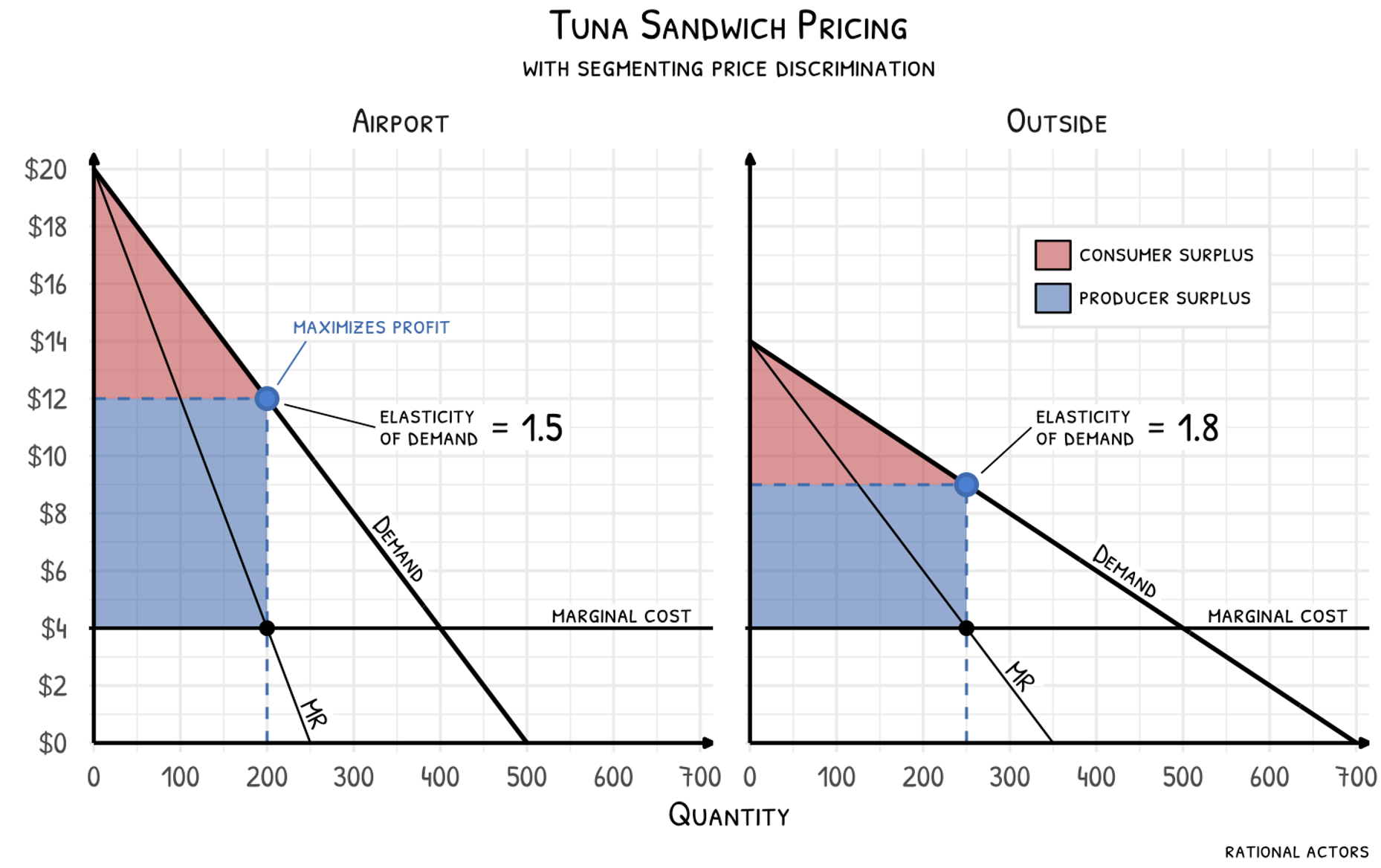
The shop charges $12 for the tuna in the airport and $9 in its outside stores, even those just down the street from the airport. The price difference emerges due to the difference in elasticity of demand. At the profit-maximizing price in the airport, the elasticity of demand is 1.5 and on the outside it’s 1.8.4
- Airport: ED = -25 × (12 / 200) = 1.5 (in absolute value, removing the minus sign)
- Outside: ED = -50 × (9 / 250) = 1.8
Imagine this shop increases its price $1 in each location. The elasticity differences imply that potential airport customers are less likely to respond to the higher price by pursuing other options.
The shop, discovering this truth about its airport customers, can raise prices further without scaring off too many customers. Or equivalently, fickle customers on the outside lead the outside shop to charge relatively low prices.5
But these elasticity measures are a result of the modeled demand curves above. Why are they modeled as such? Airport diners have fewer options. There are fewer restaurants to choose from. And unlike outside customers, eating at home is not an option. They are also often in a hurry and have little time to search for better options. These differences create less elastic demand. And less elastic demand leads to higher prices.
For the shop, preventing resale is almost trivial. TSA would likely frown upon a suitcase full of low-price, outside sandwiches being brought into the airport for profitable resale. And even if allowed, airport eaters may think twice before buying secondhand sandwiches.
Is segmenting price discrimination desirable? If so, for whom? And relative to what? To answer this question, economists rely heavily on two measures: consumer surplus and producer surplus. When the shop segments its customers, the following values emerge:
- In the airport, consumer surplus equals $800 and producer surplus equals $1,600.
- Outside, consumer surplus equals $625 and producer surplus equals $1,250.
- Total consumer surplus = $1,425
- Total producer surplus = $2,850
- Total surplus = $4,275 with 450 sandwiches sold and eaten
Suppose instead that the sandwich shop decided (or were forced, by law) to price their sandwiches identically in all locations. What would they charge and how would that affect consumer surplus and total surplus?6

The figure above measures the resulting consumer surplus, producer surplus, and total surplus for the realistic range of hypothetical tuna sandwich prices the shop could charge with uniform pricing.
In a world of identical prices in all stores, the shop maximizes its producer surplus (and profit) by charging $10 per sandwich. This leads to the following notable conclusions:
- The shop now charges outside customers more for a sandwich, while predictably charging airport customers less.
- The same number of sandwiches are transacted: 450.7
- Airport consumer surplus has more than doubled to $1,250 and outside consumer surplus falls to $400.
- Total consumer surplus = $1,650 (a 16% increase compared to the consumer surplus with segmenting)8
- Total producer surplus = $2,700 (a 5% decrease compared to producer surplus with segmenting)
- Total surplus = $4,350 (a 2% increase compared to total surplus with segmenting)9
In this setting, the effects of segmented pricing vs. uniform pricing are mostly distributional. Segmented pricing makes things worse for airport eaters but better for eaters on the outside. It makes things slightly worse for eaters on the whole but better for the sandwich shop (and those who benefit from its higher profits).
But if it’s better for the seller, it will continue to charge higher prices in the airport than on the outside. The shop is simply responding to predictable differences in the behavior of potential customers inside and airport and out. It’s hardly a grand conspiracy.
“I think the whole airport airline complex is a huge scam just to sell the tuna sandwiches. I think that profit is what's supporting the whole air travel industry. I mean think about it; the terminals, the airplanes, it's all just a distraction so that you don't notice the beating that you're taking on the tuna.”
1 The word discrimination is applied here because sellers are treating customers differently based on something. It does not necessarily carry a negative connotation like other common uses.
2 Here, the groups are defined by geographic location. In other examples of segmenting, groups are formed based on individual characteristics like income, gender, or race. Segmenting is also commonly called third-degree price discrimination.
3 Segmenting typically has a third requirement: that the seller can clearly identify which customers belong to which segment. It’s trivial in this case. A person walking through the airport is clearly in the airport segment.
4 Note here that at the profit-maximizing point on the airport demand curve, elasticity would be classified as “elastic” because elasticity of demand is greater than one. But the pricing patterns observed here depend on the differences in elasticity across segments rather than on whether any specific segment has “elastic”, “unit elastic”, or “inelastic” demand.
5 The Lerner index formalizes this intuition: (P – MC)/P = -1/ε where ε is the elasticity of demand. At the airport, the markup is 1/1.5 = 67% of price, while outside it’s 1/1.8 = 56% of price.
6 I don’t ask how it would affect producer surplus, because it’s a given that producer surplus will decrease with uniform pricing. It was always a possibility for the shop to charge both segments the same price. That outcome did not emerge, because that would decrease profit and producer surplus.
7 This result is specific to this example and will not hold generally. In other examples, segmenting price discrimination can either increase transactions or decrease them relative to uniform pricing.
8 In some cases, uniform pricing may decrease consumer surplus relative to segmenting. This is often the result if the uniform price is much closer to the price in the lower elasticity segment, such that uniform pricing ends up pricing the higher elasticity segment out of the product entirely.
9 In the cases where uniform pricing decreases consumer surplus, it trivially decreases total surplus.

More from Seinfeld:

1 The word discrimination is applied here because sellers are treating customers differently based on something. It does not necessarily carry a negative connotation like other common uses.
2 Here, the groups are defined by geographic location. In other examples of segmenting, groups are formed based on individual characteristics like income, gender, or race. Segmenting is also commonly called third-degree price discrimination.
3 Segmenting typically has a third requirement: that the seller can clearly identify which customers belong to which segment. It’s trivial in this case. A person walking through the airport is clearly in the airport segment.
4 Note here that at the profit-maximizing point on the airport demand curve, elasticity would be classified as “elastic” because elasticity of demand is greater than one. But the pricing patterns observed here depend on the differences in elasticity across segments rather than on whether any specific segment has “elastic”, “unit elastic”, or “inelastic” demand.
5 The Lerner index formalizes this intuition: (P – MC)/P = -1/ε where ε is the elasticity of demand. At the airport, the markup is 1/1.5 = 67% of price, while outside it’s 1/1.8 = 56% of price.
6 I don’t ask how it would affect producer surplus, because it’s a given that producer surplus will decrease with uniform pricing. It was always a possibility for the shop to charge both segments the same price. That outcome did not emerge, because that would decrease profit and producer surplus.
7 This result is specific to this example and will not hold generally. In other examples, segmenting price discrimination can either increase transactions or decrease them relative to uniform pricing.
8 In some cases, uniform pricing may decrease consumer surplus relative to segmenting. This is often the result if the uniform price is much closer to the price in the lower elasticity segment, such that uniform pricing ends up pricing the higher elasticity segment out of the product entirely.
9 In the cases where uniform pricing decreases consumer surplus, it trivially decreases total surplus.