The Rye Shortage
Seinfeld: S7, E11 “The Rye”
Supply and Demand: Shortages
George Costanza is introducing his irritable parents to his future in-laws, the Ross family, over dinner. The Costanzas bring the ever-popular marble rye bread from Schnitzer’s. But when the hosts forget to set out the rye, the Costanzas take the rye back home with them. The Rosses discover that the rye is missing, further worsening the poor first impression the Costanzas made.
George is appalled by his parents’ behavior and foresees relationship trouble ahead.
“Now because of the stupid rye bread I gotta keep them all separated for the rest of my life.”
But Jerry and George develop a plan to save the day. While Kramer takes the Rosses for a ride in a hansom cab, Jerry will deliver a newly bought rye that George can slip into their apartment. The Rosses will find the rye and be none the wiser about its sudden reappearance.
The plan goes awry when Jerry arrives at Schnitzer’s only to find that the last rye of the day went to customer number 53. Schnitzer’s is out of marble ryes. There is a shortage: customers want to buy more than what’s available. And the economic implications of a shortage go beyond the possibility that Jerry may fail to retrieve a rye.
We can visualize the market for marble ryes, which evidently has a shortage, using supply and demand.

At the current price of $6, customers demand 14 ryes each day. And at that price, Schnitzer’s is sufficiently motivated to produce and shelve eight ryes.1 As a result, there will be six ryes that customers wish to purchase during the day only to find no more ryes on the shelf. But given the supply and demand curves for marble ryes, Schnitzer’s could easily sell more ryes and for a higher price. That’s a win-win for their profitability.
But aren’t customers fortunate that, at least for the time being, ryes are going for $6 instead of $8? A typical way to answer such a question is to compute what economists call consumer surplus: the good fortune consumers receive from making a purchase at a given price even though they would have been willing to pay more.
During shortages, such as the one experienced in the market for ryes, the resulting consumer surplus depends crucially on which customers get their hands on a precious rye before the ryes run out. The bakery’s customers demand 14 ryes but Schnitzer’s only bakes eight. In the best-case scenario (at least as measured by consumer surplus), the scarce ryes would end up with the customers who value them the most.
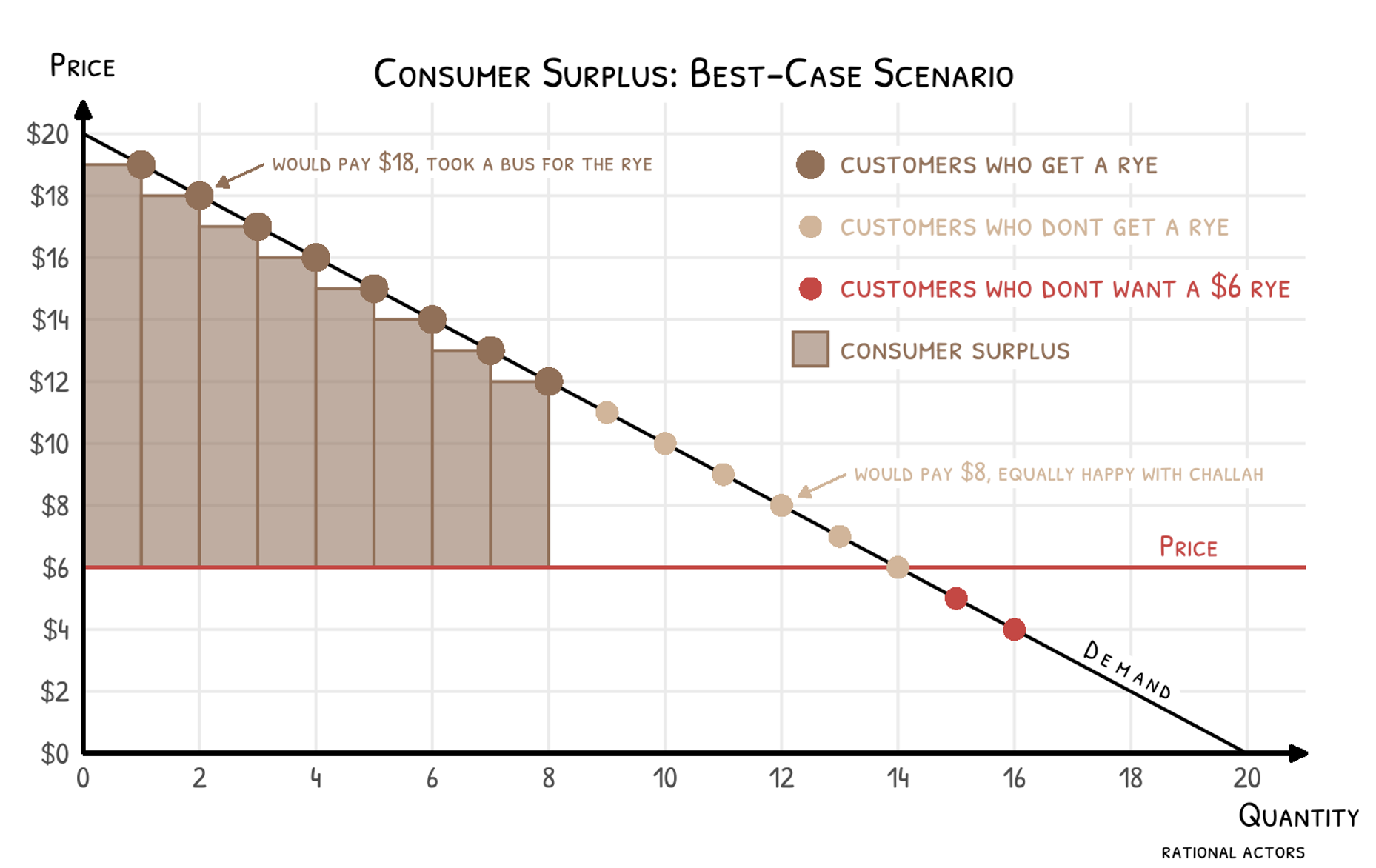
In this outcome, consumer surplus adds up to $76.2 If Schnitzer’s instead sold 12 ryes at $8, consumer surplus would be $66, so the underpriced ryes may indeed prove beneficial for buyers. However, there is no feasible way for Schnitzer’s to ensure that the eight underpriced ryes end up in the hands of these desperate customers.
The following outcome seems just as likely.

If the eight ryes go to customers willing to pay the $6 price but who otherwise have the lowest values for ryes, consumer surplus totals a pitiful $28. Consumers as a whole are worse off with this result than they would be with $8 ryes.
But this outcome is even worse than it first appears. The customer desperate for a rye, who would pay $18 for a rye and took a bus just to get to Schnitzer’s, ends up wasting bus fare and their time only to leave the store without a rye. With appropriately priced ryes, no customers endure the costs of searching for the precious rye only to leave empty-handed.
What’s the most likely outcome? Suppose that each of the 14 customers are equally likely to end up getting one of the eight ryes. In this case, the expected consumer surplus totals $52.3 Randomly allocated ryes at $6 still create less consumer surplus than higher priced ryes.
How do the scarce Schnitzer’s ryes get allocated in the episode? Jerry discovers the mechanism after he pleads with customer 53.
“I have to have that rye. It’s a long story, but a person’s whole future may depend on it.” – Jerry
“Well, I’m sorry but you should have got here earlier.” – Customer 53
All goods will be allocated to customers in some way. Perhaps it’s based on willingness to pay a price that creates a match between the amount customers want and the amount sellers provide. But with shortages, it might be based on ability to get to the store first. Or perhaps, as customer 53 learned after Jerry wrestles away her rye, it might be based on physical strength. Either way, there will be something that separates rye recipients and those who get nothing.
“Schnitzer’s!”
¹ A market supply curve typically represents the supply of a product from many sellers rather than just one. Perhaps a more sophisticated model would help explain why Schnitzer’s produces eight ryes at a $6 price. But the rest of the analysis depends only on the reality that Schnitzer’s produces fewer ryes than customers wish to purchase and sells them for $6.
² The first rye is valued at $19 but gets purchased for $6, giving that customer $13 in consumer surplus. The second rye is valued at $18, giving that customer $12 in consumer surplus. This continues for eight ryes. It’s common to calculate consumer surplus as the area under the demand curve for ease of calculation instead of using this method. Imagine calculating the consumer surplus of Netflix by adding up the area of millions of rectangles.
³ The first rye has a $12 consumer surplus, but that customer has only an 8/14 chance of getting a rye, leaving the customer with an expected consumer surplus of $7.43. Repeat for each of the 14 customers and sum the expected consumer surpluses.

More from Seinfeld:


¹ A market supply curve typically represents the supply of a product from many sellers rather than just one. Perhaps a more sophisticated model would help explain why Schnitzer’s produces eight ryes at a $6 price. But the rest of the analysis depends only on the reality that Schnitzer’s produces fewer ryes than customers wish to purchase and sells them for $6.
² The first rye is valued at $19 but gets purchased for $6, giving that customer $13 in consumer surplus. The second rye is valued at $18, giving that customer $12 in consumer surplus. This continues for eight ryes. It’s common to calculate consumer surplus as the area under the demand curve for ease of calculation instead of using this method. Imagine calculating the consumer surplus of Netflix by adding up the area of millions of rectangles.
³ The first rye has a $12 consumer surplus, but that customer has only an 8/14 chance of getting a rye, leaving the customer with an expected consumer surplus of $7.43. Repeat for each of the 14 customers and sum the expected consumer surpluses.