Tasting Menu
The Bear: S2, E2 “Pasta”
Pricing Strategies: Bundling
While the renovation is underway to turn The Beef into The Bear, Carmen and Sydney are in the research and development phase of the new menu. What dishes should they go with?
Sydney: “Just thinking like, beef, uh, smoke, cherry, that sort of world.”
Carmen: “I like that.”
Sydney: “Still thinking chaos menu?”
Carmen: “Yeah, chaos menu, but, um… thoughtful.”
Back when they found the funds for this restaurant, Carmen and Sydney immediately decided it would have a tasting menu. Guests would taste various small dishes priced as a single meal rather than order individual dishes from a traditional menu. That choice will greatly affect what counts as thoughtful.
For simplicity, suppose The Bear will serve two dishes: beef tenderloin and Hamachi crudo. Each beef tenderloin plate costs $6 to prepare and each Hamachi crudo plate costs $4.11 These are marginal costs that do not reflect the restaurant’s fixed costs: loan repayment, cookware, insurance premiums, and equipment leases. For further simplicity, suppose that the restaurant has six potential customers. Each customer has a willingness to pay for each dish reflecting their preferences. If The Bear charges a price less than or equal to the customer’s willingness to pay for that dish, the customer orders it.
The table below characterizes these six potential customers accordingly:
Customer Willingness to Pay
|
|
Beef Tenderloin
|
Hamachi Crudo
|
|---|---|---|
|
Customer A
|
$4
|
$10
|
|
Customer B
|
$6
|
$22
|
|
Customer C
|
$12
|
$14
|
|
Customer D
|
$20
|
$16
|
|
Customer E
|
$22
|
$8
|
|
Customer F
|
$28
|
$6
|
Assuming The Bear has market power in the sale of these dishes, perhaps because the dishes are truly unique to this restaurant, they can realistically choose prices.22 This assumption has already shown up in the customers’ willingness to pay values. If The Bear sells beef tenderloin in a perfectly competitive market, each customer’s willingness to pay for The Bear’s beef tenderloin would be exactly equal to the market price for the dish. To start, suppose The Bear didn’t use a tasting menu and instead priced each item individually.
À La Carte Pricing
Here, as The Bear chooses prices for individual dishes, it weighs important trade-offs. To get more customers to order each dish, it must lower the price, lowering revenue per customer. And more orders increases costs. Keep the following in mind:
- Revenue = Price × Number of Orders
- Variable Costs = Marginal Cost × Number of Orders33 Here, we are assuming marginal costs are constant for each dish.
- Producer Surplus = Revenue – Variable Costs44 Producer surplus can also be thought of as the sum of individual markups, where the markup on any one dish is the price minus marginal cost.
The most profitable price for each dish is one that maximizes producer surplus.55 Maximizing profit is equivalent to maximizing producer surplus. Profit is producer surplus minus fixed costs. Over the space of different prices The Bear can choose and the resulting number of orders it must fulfill, fixed costs do not vary. For these six customers, the results of possible prices for beef tenderloin are summarized as follows:66 Here, we need only consider prices equal to a customer’s willingness to pay. A price of $27 instead of $28 is trivially worse for The Bear’s profitability. Price decreases can only be helpful if they lead to additional orders.
Beef Tenderloin Pricing
|
Price
|
Orders
|
Revenue
|
Variable Costs
|
Producer Surplus
|
|---|---|---|---|---|
|
$28
|
1
|
$28
|
$6
|
$22
|
|
$22
|
2
|
$44
|
$12
|
$32
|
|
$20
|
3
|
$60
|
$18
|
$42
|
|
$12
|
4
|
$48
|
$24
|
$24
|
|
$6
|
5
|
$30
|
$30
|
$0
|
|
$4
|
6
|
$24
|
$36
|
-$12
|
The Bear maximizes producer surplus by charging $20 for the beef tenderloin. Only three people order it, but getting additional orders requires price decreases that undercut revenue. Following the same steps, producer surplus is maximized when the Hamachi crudo sells for $14.
Hamachi Crudo Pricing
|
Price
|
Orders
|
Revenue
|
Variable Costs
|
Producer Surplus
|
|---|---|---|---|---|
|
$22
|
1
|
$22
|
$4
|
$18
|
|
$16
|
2
|
$32
|
$8
|
$24
|
|
$14
|
3
|
$42
|
$12
|
$30
|
|
$10
|
4
|
$40
|
$16
|
$24
|
|
$8
|
5
|
$40
|
$20
|
$20
|
|
$6
|
6
|
$36
|
$24
|
$12
|
Overall, The Bear would collect $72 in producer surplus from its six customers by pricing its dishes separately. Its kitchen prepares three orders of the Hamachi crudo and three orders of the beef tenderloin. One of the six customers orders both dishes, four order one dish, and one orders nothing. The figure below summarizes how à la carte pricing leads to this outcome.

But Carmen and Sydney decided long ago to use a tasting menu. This pricing strategy is an example of bundling: two or more distinct products or services are sold together at a single price.77 Microsoft does this by selling access to Word, Excel, Outlook, and additional software in a bundle. TV service providers bundle many channels together. A gym bundles access to a fitness room and access to a pool. What will each customer be willing to pay for the tasting menu? A simple assumption is that a customer values the tasting menu at the sum of what they would pay for each individual dish.88 This assumes that consumers’ preferences are additively separable. It rules out the possibility that one dish complements the other dish in a way that makes the tasting menu more enjoyable than the sum of each individual dish. It also rules out the possibility that after having one dish, a consumer is partially satiated and enjoys subsequent dishes less than they would otherwise.
Customer Willingness to Pay
|
|
Beef Tenderloin
|
Hamachi Crudo
|
Tasting Menu
|
|---|---|---|---|
|
Customer A
|
$4
|
$10
|
$14
|
|
Customer B
|
$6
|
$22
|
$28
|
|
Customer C
|
$12
|
$14
|
$26
|
|
Customer D
|
$20
|
$16
|
$36
|
|
Customer E
|
$22
|
$8
|
$30
|
|
Customer F
|
$28
|
$6
|
$34
|
Tasting Menu Pricing
The pricing model works the same way with the tasting menu, except each customer would now be served both dishes at a marginal cost of $10.99 Bundling for a restaurant may be helpful from a cost perspective because it makes preparation more predictable. Each customer needs the same dishes prepared.
|
Price
|
Orders
|
Revenue
|
Variable Costs
|
Producer Surplus
|
|---|---|---|---|---|
|
$36
|
1
|
$36
|
$10
|
$26
|
|
$34
|
2
|
$68
|
$20
|
$48
|
|
$30
|
3
|
$90
|
$30
|
$60
|
|
$28
|
4
|
$112
|
$40
|
$72
|
|
$26
|
5
|
$130
|
$50
|
$80
|
|
$14
|
6
|
$84
|
$60
|
$24
|
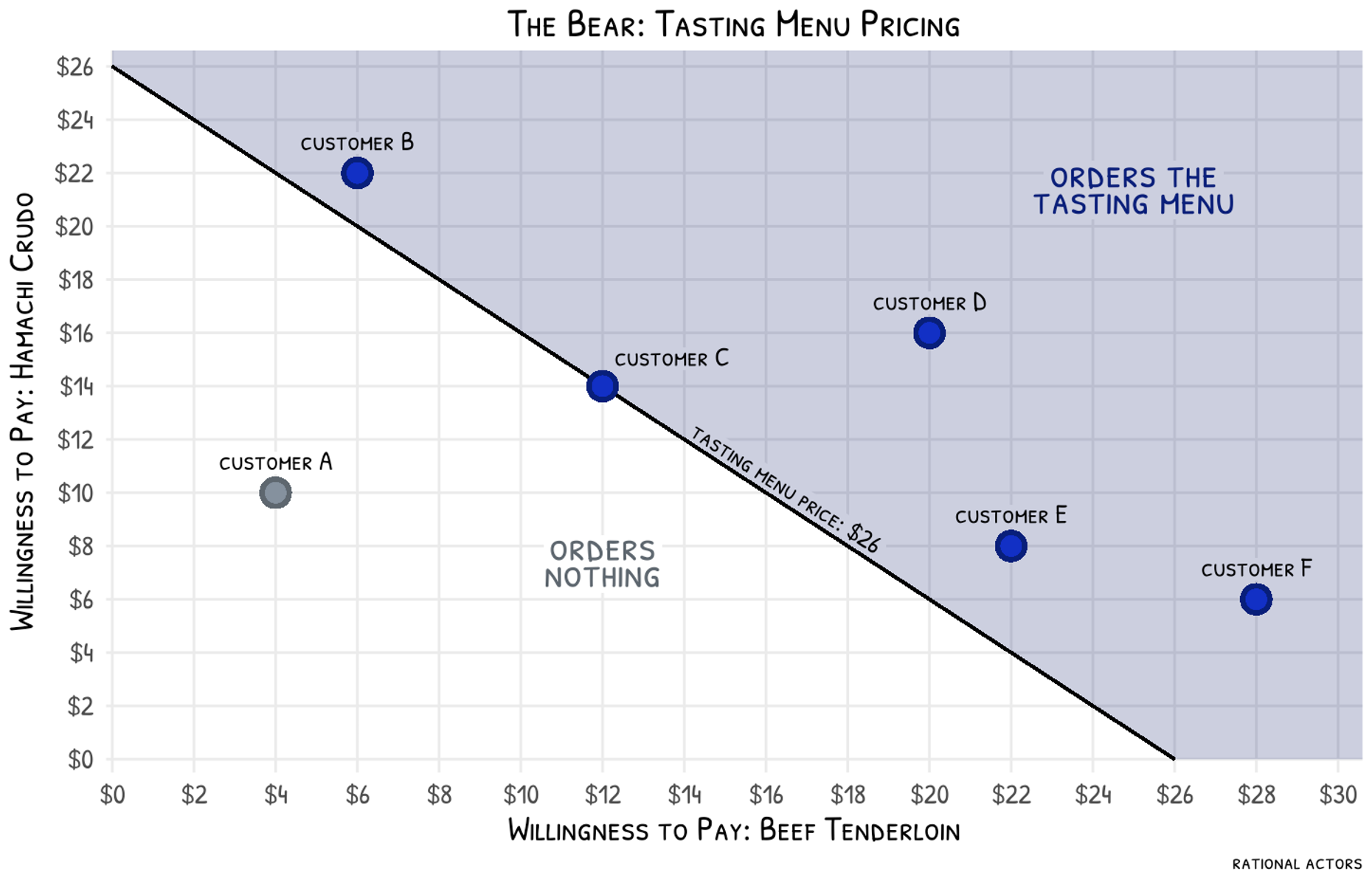
With a tasting menu, The Bear gets five paying customers while charging $26 for the dining experience. Most importantly, the restaurant collects $80 in producer surplus, an 11% increase over à la carte pricing. In an industry with razor-thin profit margins, that’s a big deal. The results of the $26 tasting menu are visualized below.
What makes bundling effective for The Bear? A thoughtful chaos menu!
The Hamachi crudo and the beef tenderloin pair very well on a tasting menu because consumers tend to like one or the other. Diners who tend to love the crudo aren’t as excited about the tenderloin, and vice versa. Consumer willingness to pay is negatively correlated across dishes. With a tasting menu, The Bear can get additional orders with relatively small price decreases.1010 This happens because with negatively correlated valuations, the distribution of willingness to pay values for the bundle are more compressed. This makes demand for the tasting menu less elastic. Therefore, price increases do not scare off customers as quickly. Its tasting menu has something for almost everyone.
Suppose Carmen and Sydney were less thoughtful and paired the crudo with a sea bass carpaccio. The customers willing to pay high prices for the crudo would likely be the same customers excited by the sea bass. Both dishes appeal to the same diners. Consumer willingness to pay would be positively correlated. And bundling could lead to lower producer surplus in this case.
Now the two chefs need to keep building their tasting menu. If maximally thoughtful, they would find additional dishes to add that the customers who don’t love Hamachi crudo or beef tenderloin would be excited by. Maybe frozen grapes or smoked bone marrow. Once the menu is decided, the focus will need to turn to the quality of the dishes and dining experience.
Carmen: “Hey, um, can I ask you something? You can tell me to f-ck off.”
Sydney: “Yeah?”
Carmen: “You really want one of these bullsh-t stars?”
1 These are marginal costs that do not reflect the restaurant’s fixed costs: loan repayment, cookware, insurance premiums, and equipment leases.
2 This assumption has already shown up in the customers’ willingness to pay values. If The Bear sells beef tenderloin in a perfectly competitive market, each customer’s willingness to pay for The Bear’s beef tenderloin would be exactly equal to the market price for the dish.
3 Here, we are assuming marginal costs are constant for each dish.
4 Producer surplus can also be thought of as the sum of individual markups, where the markup on any one dish is the price minus marginal cost.
5 Maximizing profit is equivalent to maximizing producer surplus. Profit is producer surplus minus fixed costs. Over the space of different prices The Bear can choose and the resulting number of orders it must fulfill, fixed costs do not vary.
6 Here, we need only consider prices equal to a customer’s willingness to pay. A price of $27 instead of $28 is trivially worse for The Bear’s profitability. Price decreases can only be helpful if they lead to additional orders.
7 Microsoft does this by selling access to Word, Excel, Outlook, and additional software in a bundle. TV service providers bundle many channels together. A gym bundles access to a fitness room and access to a pool.
8 This assumes that consumers’ preferences are additively separable. It rules out the possibility that one dish complements the other dish in a way that makes the tasting menu more enjoyable than the sum of each individual dish. It also rules out the possibility that after having one dish, a consumer is partially satiated and enjoys subsequent dishes less than they would otherwise.
9 Bundling for a restaurant may be helpful from a cost perspective because it makes preparation more predictable. Each customer needs the same dishes prepared.
10 This happens because with negatively correlated valuations, the distribution of willingness to pay values for the bundle are more compressed. This makes demand for the tasting menu less elastic. Therefore, price increases do not scare off customers as quickly.