Richie’s Comparative Advantage
The Bear: S2, E5 “Pop” and S2, E8 “Bolognese”
Comparative Advantage and Trade: Production Possibilities
The restaurant staff are busy transforming The Original Beef, an Italian beef sandwich shop, into The Bear, an upscale restaurant. But they encounter numerous issues in the process, and Natalie does not know how to get contributions from Richie.
“Richie has no skills or abilities to speak of.”
She even goes so far as to tell him to stop helping with the renovation work. But is this really a good idea? They need to open the new restaurant in six weeks. Time is of the essence. And Uncle Jimmy, who has lent Carmen and the staff hundreds of thousands of dollars, stresses the efficiency of their operation.
“I think it’s just in all of our best interests if we have a maximally efficient place of business.”
Can Richie, given his lack of skills, help them be maximally efficient? To answer this question, we can model the way the staff completes tasks in their renovation, using a production possibilities frontier (PPF): a model that shows all combinations of tasks the staff can complete given available resources and time.
Assume that the staff consists of Richie and Natalie.¹ Both will work 240 hours over the next six weeks.² Further, assume their tasks fall into two categories: (1) big jobs, like scheduling contractors and (2) little jobs, like caulking. Natalie completes both types of jobs more skillfully than Richie does in the following way:
- Natalie: 3 hours of work to finish a big job and 1 hour of work to finish a little job
- Richie: 12 hours of work to finish a big job and 2 hours of work to finish a little job
We can map out the combinations of jobs the staff can complete given the total hours of work they have left and the time it takes each to finish a job. First, suppose that Richie and Natalie have the same job description. Whatever combination of big jobs and small jobs that Natalie does, Richie also does.
If both put all their time toward big jobs, as a team they can complete 100 of them over the course of the six weeks. If all their time goes toward little jobs instead, they can complete 360 of those. If they wish to complete a combination of big and little jobs, they simply allocate their time accordingly. For example, if each spends 50 percent of their time on big jobs and 50 percent on little jobs, they can complete 50 big jobs and 180 little jobs.
We map those points in the graph below, which shows all production possibilities under this arrangement.

The solid blue line is the frontier. For any combination on the frontier, the only way to complete more of one type of job is to give up on a certain number of the other type of job. Many combinations, like 150 little jobs and 70 big jobs, are beyond reach.
But this arrangement, where Richie and Natalie have identical shares of job types, is not maximally efficient. It fails to take advantage of the fact that Richie and Natalie have different skills. To fully compare the two workers, we calculate opportunity costs: when the worker completes this job, how many of that job are given up?
For Richie, completing a big job takes 12 hours of his time. In those 12 hours, he could have finished 6 little jobs. That’s Richie’s opportunity cost of completing a big job. And for Natalie, the opportunity cost of completing a big job is 3 little jobs. So, Natalie is comparatively better than Richie at big jobs: her opportunity cost is lower.
But isn’t Natalie better at little jobs too? Not once we consider opportunity costs! Each time Natalie completes a little job, she loses an hour of her precious time, which could have been used to finish a third of a big job. But for Richie, completing a little job only takes away the opportunity to complete a sixth of a big job. Richie is comparatively better at little jobs. When it comes to little jobs, he has the comparative advantage: the ability to produce a good or service at a lower opportunity cost.
As a result, to the extent that it’s possible, the staff can maximize their productive potential by having Richie complete little jobs and having Natalie complete big jobs. This is an example of specialization: assigning tasks according to who can complete them with the lowest opportunity cost.
The production possibilities frontier for Richie and Natalie while specializing can be seen below.
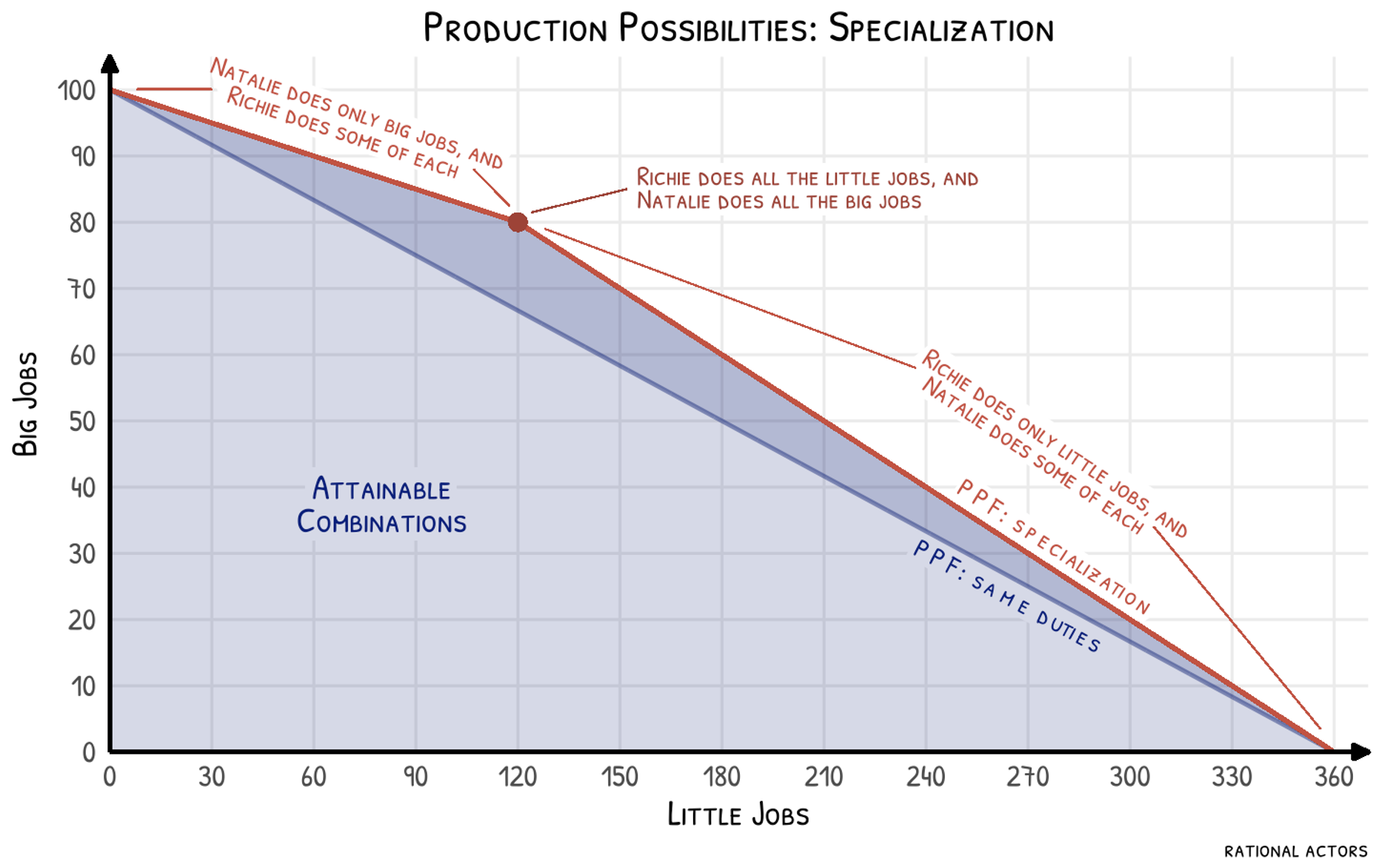
It’s still possible for the staff to complete 100 big jobs and 0 little jobs. But as soon as some little jobs need to be completed, by assigning those exclusively to Richie, the entire staff takes on a smaller opportunity cost. With specialization, it’s now possible for the pair to complete 120 little jobs and 80 big jobs, a combination they couldn’t previously reach. And there are many more combinations like that.³
If they need to complete some combination of little and big jobs, specialization allows the pair to get more work done in the same amount of time. And time is their big constraint. The new restaurant must open soon.
Three episodes later, Richie learns this valuable economics lesson while shining forks at Ever, a fine dining restaurant. He returns to The Bear in a suit and ready to convince Natalie of how useful he can be.
“I actually do think that we could fit good together. I could be good at things that you don’t really wanna do, and you’re obviously really great at a whole bunch of stuff that I don’t know how to do.”
And he’s correct! By doing little jobs, Richie can free up Natalie to focus on the kinds of jobs she is best at. Richie may be the least skilled member of the restaurant staff. He may have a grating personality. And he may cause trouble from time to time. He won’t be the star of the show. But he can still be helpful if given the jobs that he is comparatively better at.
“I’m not like this cause I’m in Van Halen. I’m in Van Halen because I’m like this.”
¹ This is an extreme simplification, but the conclusion does not depend entirely on this assumption.
² In the episode, Natalie claims to be working only part-time. The model could be easily adapted to account for her different hours, but the take-home point would remain the same.
³ The PPF with specialization can be adapted to include a larger staff. With two workers, it has one kink. With three workers, it has two kinks. And so on. In the limit, as the size of the staff expands to infinitely large, the PPF with specialization becomes a smooth arc that bows out from the origin. Such PPF’s are commonly used to model production from an entire country of workers.

More from The Bear:



¹ This is an extreme simplification, but the conclusion does not depend entirely on this assumption.
² In the episode, Natalie claims to be working only part-time. The model could be easily adapted to account for her different hours, but the take-home point would remain the same.
³ The PPF with specialization can be adapted to include a larger staff. With two workers, it has one kink. With three workers, it has two kinks. And so on. In the limit, as the size of the staff expands to infinitely large, the PPF with specialization becomes a smooth arc that bows out from the origin. Such PPF’s are commonly used to model production from an entire country of workers.