Tina's Job Search
The Bear: S3, E6 “Napkins”
Labor Markets: Job Search
Tina Marrero has worked in human resources at Long Grove Confectionery Co. for 15 years when she learns that she is being laid off. That night, she is immediately on the job hunt.
“I’m gonna find another job tomorrow. Everything will be okay.”
But how should Tina go about searching for a job? Should she take the first job she can find? Should she be picky? These are fitting questions for a search model.
For simplicity, assume the following features of Tina’s job search:
- Tina will receive one wage offer (w) each week from a distribution of potential wage offers.
- With each offer, Tina knows only the wage in front of her, not what any future offers may be.
- Tina has two options: (1) accept the offer and earn that wage in that job forever or (2) reject the offer, collect unemployment benefits for the week, and receive a new wage offer again next week.
- Unemployment benefits (b) can be collected forever. Her eligibility for them doesn’t run out.11 In real-world unemployment insurance programs, benefits typically run out after a certain eligibility period. The model could be enriched by adding this feature in. But we have enough complexity here for now.
- Future income has a discount factor (β), with 0 < β < 1. A lower discount factor means that Tina values present income a lot more than she values future income.
- Future searches also come with a search cost (c). This cost is known to Tina and is predictable, capturing both financial costs of searching and the psychological strain of unemployment for another week.
Given these parameters, Tina would reject any offer that pays less than the unemployment benefit. She would also accept an offer that pays a $1 million every hour. Passing on such an offer would mean a huge loss in income this week and probably futures losses as well since such offers don’t come around often.
Therefore, there must exist an in-between wage offer that makes Tina perfectly indifferent between rejecting the offer or accepting. And therefore, any offer made above this threshold she would accept, and any offer made below this threshold she would reject. This threshold is called the reservation wage.
We can find Tina’s reservation wage by comparing the income streams that result from her accept / reject decision of a received offer (w):
Accept: Value = w + βw + β2w + β3w + β4w + …
Reject: Value = b – k + β(value of restarting the search next week)
We can see this graphically by noting two things:
- The value of acceptance simplifies to a straight line function:22 This is the sum of an infinite geometric series where each term is multiplied by the discount factor β. Math! Value = w / (1-β). As expected, the value of acceptance increases as wage offer (w) increases.
- The value of rejecting the offer does not depend on the wage offered. No matter what the offer was, she gets her unemployment benefit and searches again next week.
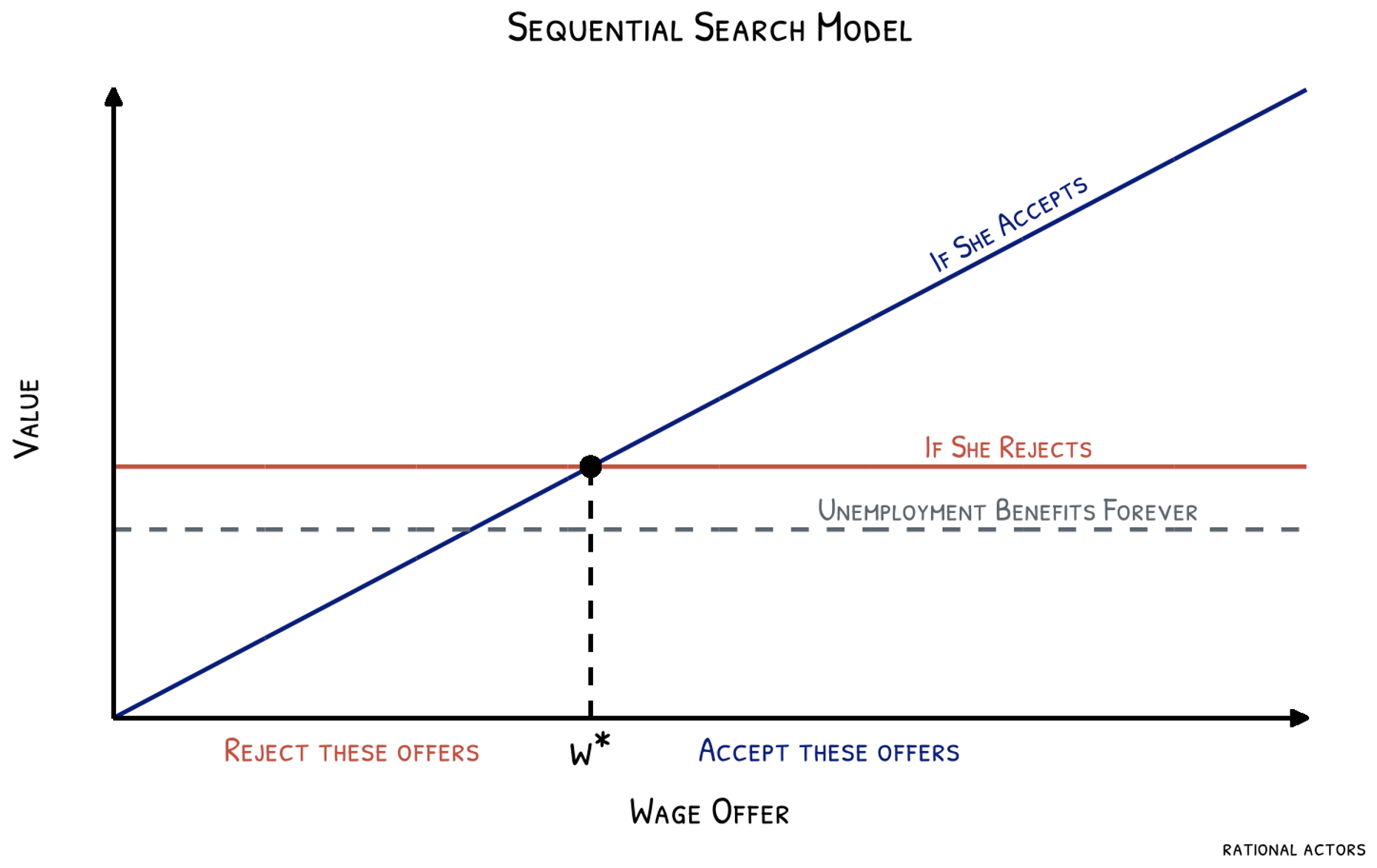
The reservation wage, w*, occurs where these two lines cross. To maximize the value of her job search, Tina accepts any offer above w* (ending her search) and rejects any offer below w* (continuing her search).
Note that if search is not too costly (c is not too high), Tina will even reject some offers that are above the unemployment benefit amount. Rejecting a job offer comes with the allure of drawing another new wage next week, so some level of patience is called for.
And Tina does reject an offer! She visits a NutriFlex seminar only to quickly realize it’s a pyramid scheme. The implied wage of such a position was much too low. But an offer to become a line cook at The Beef must have been high enough: she accepts.
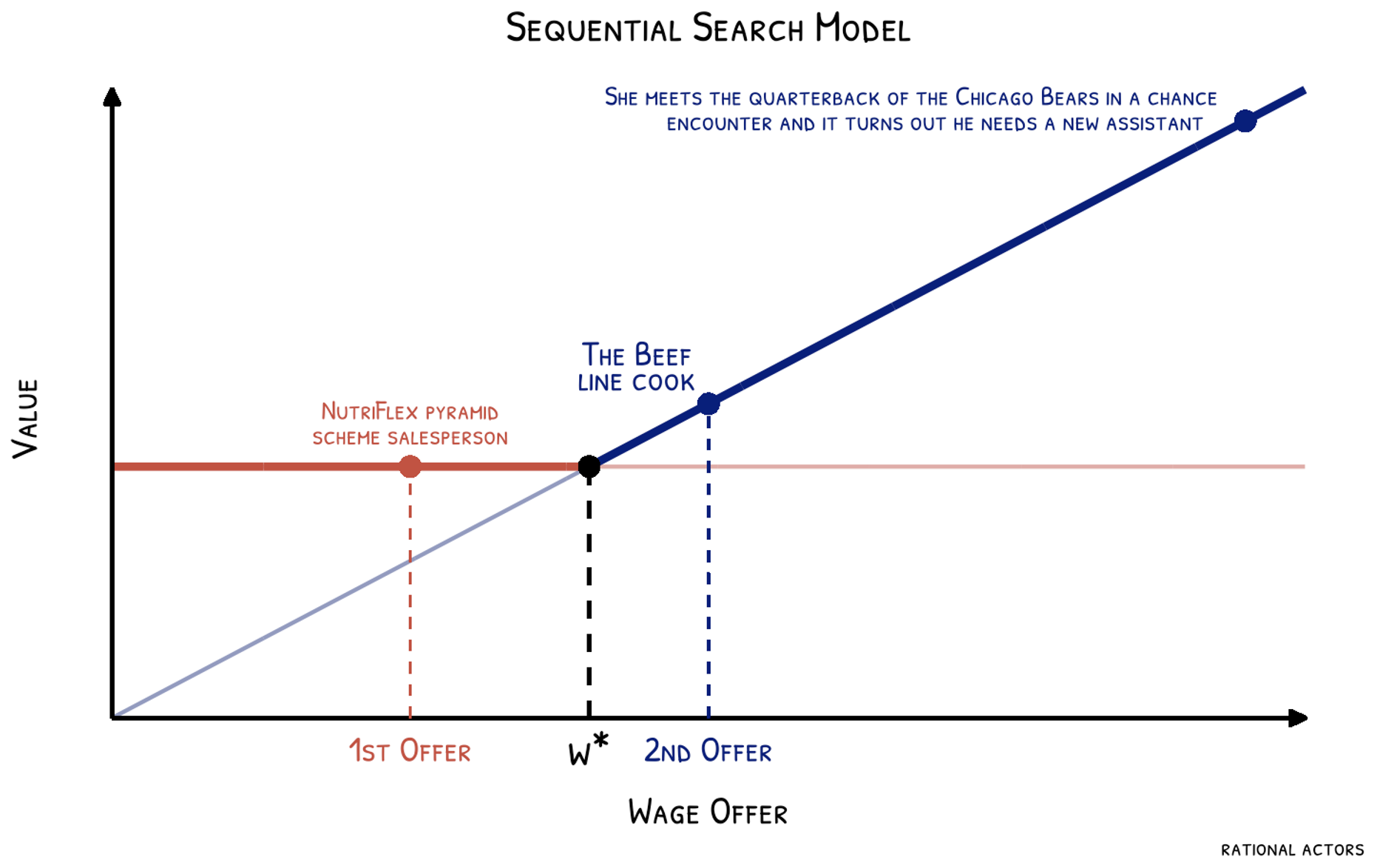
Michael reveals to Tina that the job is unpleasant and doesn’t pay well. She still accepts, revealing that her reservation wage is relatively low, perhaps even close to the unemployment benefit.
“I’ll clean a dish. I’ll wash a floor. I’ll sell some bullsh*t, you know? I gotta cover this ass, right? I don’t need to be inspired. I don’t need to be impassioned. I don’t need to make magic. I don’t need to save the world, you know? I just want to feed my kid. Just give me a routine. I’m in.”
What makes Tina’s reservation wage so low?
- Her landlord recently raised her rent and her husband’s promotion will never come. They are somewhat desperate to cover their rent payments and not be evicted. She doesn’t have time to wait for a high wage offer with an uncertain arrival date. Her discount factor is low! As the discount factor decreases, the value of rejecting an offer goes down, because future search is less valuable.33 A lower discount factor also makes accepting an offer less attractive as well, because it decreases the present value of one’s lifetime income stream. But think of extremes. A worker with a discount factor of 0 puts no value on next week’s income (or any future income). Clearly then, they will accept an offer that is a penny higher than their unemployment benefit. Their reservation wage is as low as it could ever be. But as the discount factor approaches 1, the worker puts almost as much value on income 30 years from now as they do this week’s income. Therefore, they would have a very high bar for what kinds of offers they would accept. In the extreme they would never accept any offer for fear of missing out on an even higher offer in the distant future.
- Tina refers to herself as a “washed up old lady.” She doesn’t have a college degree. And most of her work experience is at a single company. The distribution of potential wage offers she foresees receiving is quite depressed. That lowers the expected value of future search.
- Searching seems quite costly to Tina. She’s spending money on bus and train fares, but even more importantly, she doesn’t enjoy unemployment. This reduces the value of rejecting an offer.
“I sit on my ass every day not contributing sh*t. I’m not this way. I like working. I like routine.”
Tina’s search reveals a broader truth about job search. Individuals with urgent financial need or pessimistic views of future job opportunities are likely to accept low wage offers, even if it means missing out on better jobs that patience affords. But there is good news for Tina: she doesn’t end up earning that pitiful wage at The Beef forever. A promotion is on the way!
“Do you think Diego’s cousin is handing out any more work? Maybe something for a washed-up old lady?”
¹ In real-world unemployment insurance programs, benefits typically run out after a certain eligibility period. The model could be enriched by adding this feature in. But we have enough complexity here for now.
² This is the sum of an infinite geometric series where each term is multiplied by the discount factor β. Math!
³ A lower discount factor also makes accepting an offer less attractive as well, because it decreases the present value of one’s lifetime income stream. But think of extremes. A worker with a discount factor of 0 puts no value on next week’s income (or any future income). Clearly then, they will accept an offer that is a penny higher than their unemployment benefit. Their reservation wage is as low as it could ever be. But as the discount factor approaches 1, the worker puts almost as much value on income 30 years from now as they do this week’s income. Therefore, they would have a very high bar for what kinds of offers they would accept. In the extreme they would never accept any offer for fear of missing out on an even higher offer in the distant future.