The Tipping Issue
The Bear: S3, E2 “Next”
Market Power: Monopolistic Competition
Tensions are high in the kitchen of The Bear as Carmen provides a list of “nonnegotiables.” He has lofty goals and high standards for the new restaurant. But they haven’t gotten to a big potential sticking point yet. How will server compensation work?
“We also have to resolve the tipping issue, Carm.” – Sugar
“What’s the tipping issue?” – Richie
“Service charge or added tip.” – Sydney
But Carmen appears to have thought about this already. He has a very quick response and reveals the price of high-end dining experience.
“It’s nine courses. So, 175 bucks plus tip.” – Carmen
In other words, customers will be on the hook for compensating the servers.1 Most restaurants reach the same conclusion. The alternative is that the restaurant provides its servers their full compensation and tips are not asked for.
By having their servers depend on tips, are restaurants like The Bear taking advantage of their customers? Shouldn’t the restaurant fully compensate its employees, as most other employers do?
Let’s investigate by modeling how The Bear sets its prices. Begin with these assumptions:
- The Bear operates in monopolistic competition: a market where many restaurants compete with comparable dining experiences, but each is a bit different in menu, ambiance, and service quality.
- Given its differentiated product and service, The Bear’s nine-course meal has a downward sloping demand curve. To get one more customer through the door, it would need to lower its price. And since it sells to all diners at the same price, these price decreases make enticing additional customers less and less beneficial as its customer base grows. The marginal revenue curve quantifies this.
- Due to its high-cost ingredients, The Bear incurs significant marginal cost for each meal served. And due to congestion in its tight spaces, marginal costs increase as it serves more customers each night.
- If tips are part of The Bear’s pricing, each customer will tip $25.2
Given these features, The Bear will choose a profit-maximizing price for a meal and receive an associated number of nightly customers. The sweet spot occurs where marginal revenue equals marginal cost.

The Bear charges $175 per meal and serves 150 visitors each night. Given the $25 tip, each customer parts with $200. Not only do customers pay a markup on their meal, they also pay the servers in tips.
What if The Bear took on full responsibility for server compensation instead? The picture changes in two ways. First, demand for a meal at The Bear will increase. If 150 customers show up for a $175 meal knowing they will also tip $25, then the same number must be willing to show up for a $200 meal when no tips are required. Either way, it’s $200 for a fine-dining experience. Second, now that the restaurant is on the hook for server compensation, marginal cost for each meal increases by $25.3
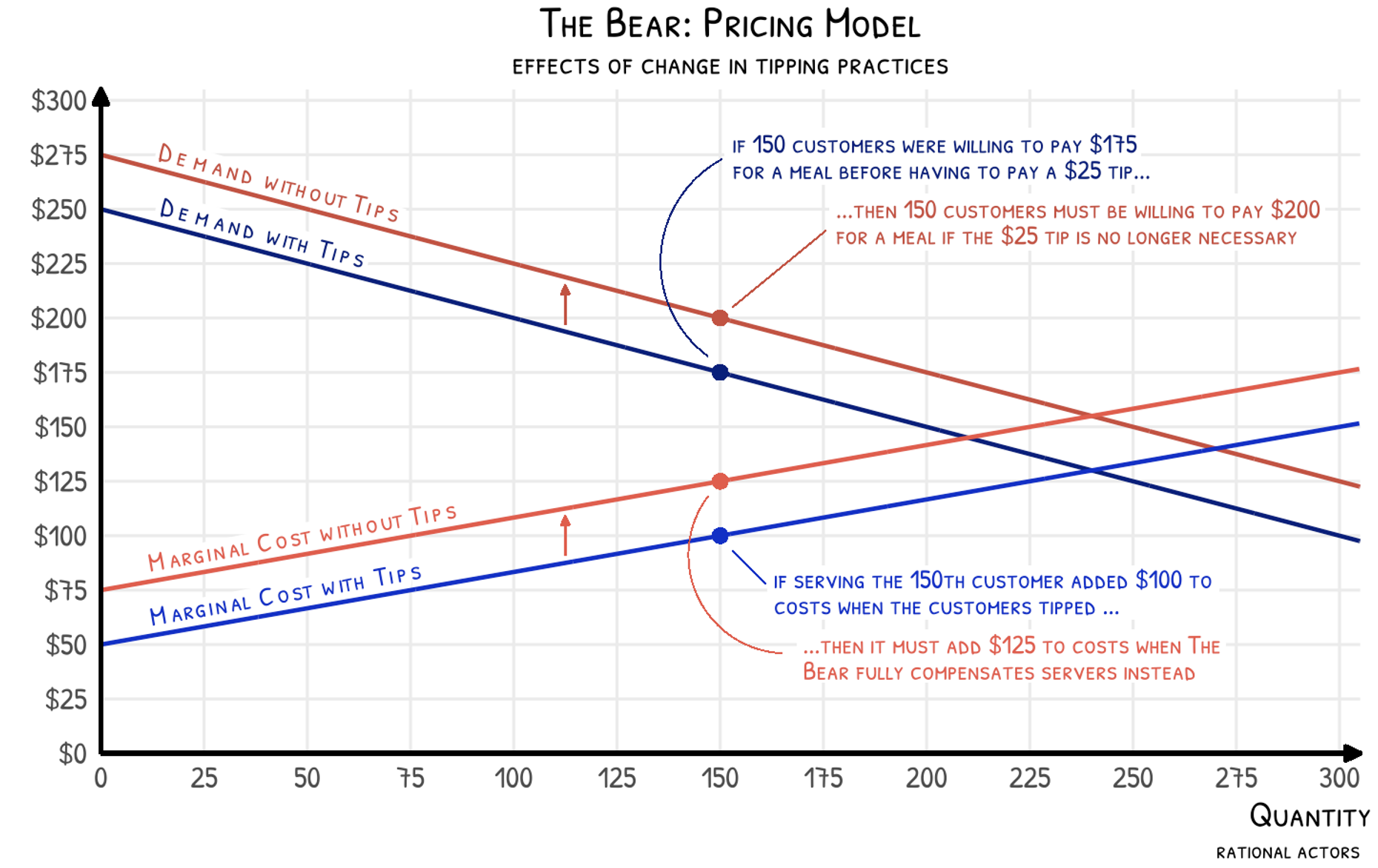
As a result, going to a no-tip system changes the demand and marginal cost curves for The Bear. And if the demand curve changes, so does the associated marginal revenue curve. How do these changes translate into price changes on the menu?
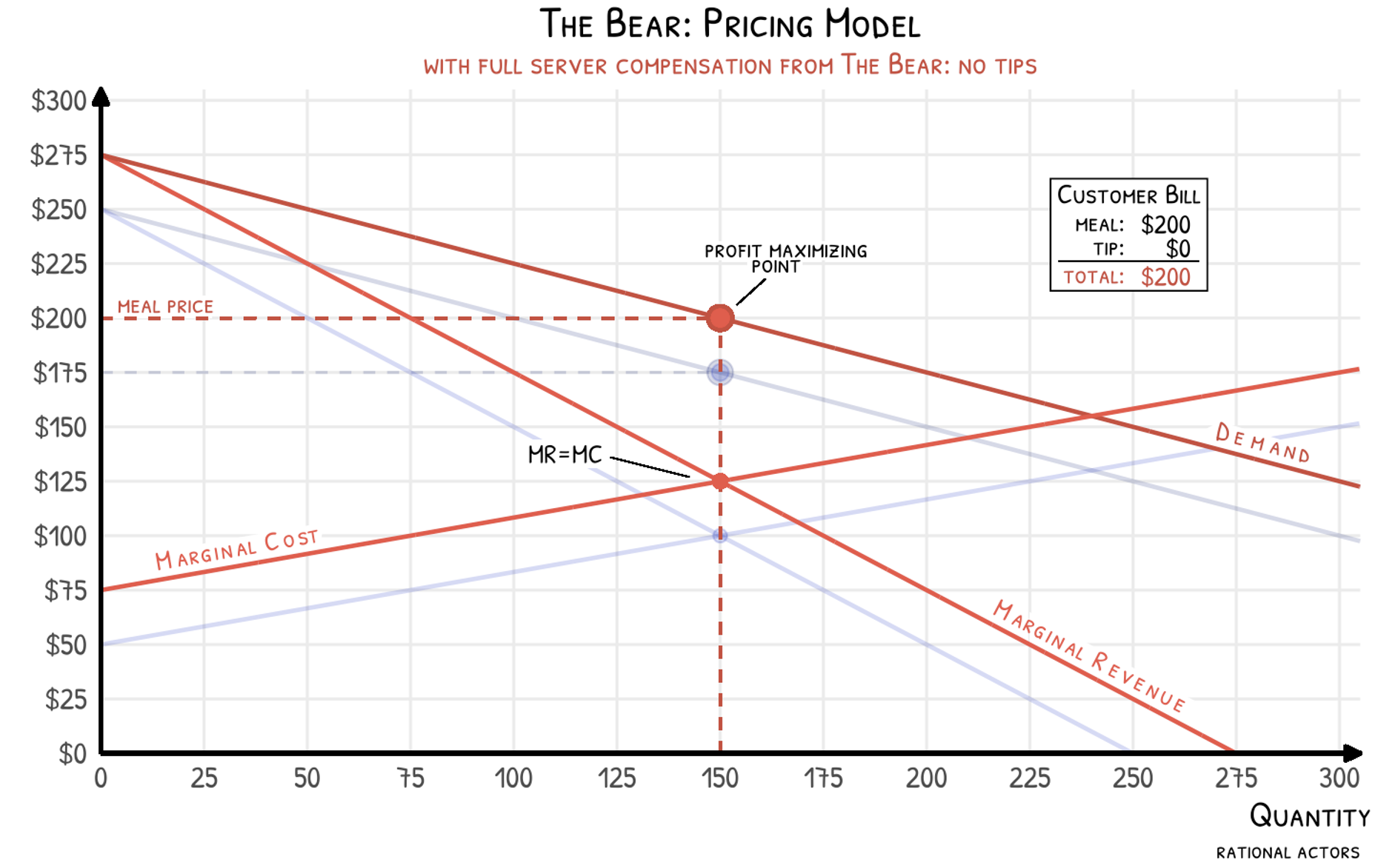
Here, The Bear maximizes profits by charging $200 for the nine-course meal instead of $175. And because of not having to tip, its customers are served for exactly $200. That’s the same total on the bottom of the bill as it was in the tipped setup! It’s the same picture, but each curve is shifted up by $25.
It’s tempting to conclude: “Employers in this situation are cleverly forcing customers to pay the servers either way.” Except the opposite story seems equally true. Suppose the restaurant started by fully compensating its servers with no tips, the same way a grocery store pays its cashiers. Few claim that grocery stores force compensation of cashiers onto customers. If the restaurant then switched to a tipped setup, the lowered demand for a meal would lead it to cut prices. And in the end, the customer would not be paying extra despite the introduction of tips. So, framed this way, the restaurant fails in its attempt to shift its costs onto customers.
Ultimately, either setup leads to the same volume of customers and same overall consumer expenditure. The price of the meal adjusts for the changes in demand and changes in costs inherent to either compensation scheme.4
Still, Richie is not happy about the idea of relying on customer tips.
“My additional thoughts about tipping is that in general it’s a pretty f*cked up practice.” – Richie
“Why’s it f*cked up?” – Tina
“You judge a professional based on their performance and then determine how much money they’re gonna make? That’s f*cking stupid. I go see a play, the actors are bullsh*t, I don’t pay them?” – Richie
Indeed, The Bear’s tipping decision may involve additional considerations not captured by this model. A few to ponder:
For tipping:
- Servers have a stronger incentive to provide a quality experience.
- Lower menu prices may attract more customers for whom the tip is not a salient consideration.
- Tips enable the restaurant to retain excellent servers, who otherwise may be tempted to leave for a job at a restaurant with tips.
Against tipping:
- Diners may discriminate in tip generosity, varying tip amounts based on race, gender, or attractiveness rather than on performance.
- Servers may experience unpredictable income from night-to-night.
- Tips create inequality in pay among servers and between waitstaff and back-of-house workers, creating the potential for workplace tensions.
Given his choice to have customers provide tips, creating strong incentives for the finest service must be one of Carmen’s nonnegotiables.
“Do you go to a lot of theater, Richard?”
1 Servers will also be paid by the restaurant. Illinois’ 2025 minimum wage is $15/hour, but employers may pay tipped employees as little as $9/hour if their full compensation still reaches $15/hour. If not, employers must make up the difference.
2 This is the most restrictive assumption and is made for ease of interpretation. To enrich the analysis, one could instead assume that each customer tips a fixed percent of the meal price, so the tip varies as The Bear varies its prices.
3 Here, we are assuming that the restaurant pays its servers in a way that fully replaces missed tips. In other words, server total compensation is the same in either system. While this is a restrictive assumption, it serves the purpose of comparing the effects of the two separate compensation schemes.
4 Suppose we go back and relax the assumption that each customer tips $25. Instead, assume each customer tips 20% of the meal price. Use an inverse demand curve for the full experience (in red in the provided graphs): P = 275 – 0.5Q. And use the marginal cost function with tips: MC = 50 + (1/3)Q. By defining a new, tipped demand curve and a new, untipped marginal cost curve, one can show that if no tips are requested The Bear will charge $203.35 and get 143.3 customers each night. With 20% tips, they would charge $165.18 and get 153.48 customers. And with the 20% tip, each customer would spend a total of $198.22 on their meal. Now the total customer expenditure differs based on payment setup. But the difference is small and in the opposite direction of naïve expectation. Customers pay less in a world of requested tips.

More from The Bear:




1 Servers will also be paid by the restaurant. Illinois’ 2025 minimum wage is $15/hour, but employers may pay tipped employees as little as $9/hour if their full compensation still reaches $15/hour. If not, employers must make up the difference.
2 This is the most restrictive assumption and is made for ease of interpretation. To enrich the analysis, one could instead assume that each customer tips a fixed percent of the meal price, so the tip varies as The Bear varies its prices.
3 Here, we are assuming that the restaurant pays its servers in a way that fully replaces missed tips. In other words, server total compensation is the same in either system. While this is a restrictive assumption, it serves the purpose of comparing the effects of the two separate compensation schemes.
4 Suppose we go back and relax the assumption that each customer tips $25. Instead, assume each customer tips 20% of the meal price. Use an inverse demand curve for the full experience (in red in the provided graphs): P = 275 – 0.5Q. And use the marginal cost function with tips: MC = 50 + (1/3)Q. By defining a new, tipped demand curve and a new, untipped marginal cost curve, one can show that if no tips are requested The Bear will charge $203.35 and get 143.3 customers each night. With 20% tips, they would charge $165.18 and get 153.48 customers. And with the 20% tip, each customer would spend a total of $198.22 on their meal. Now the total customer expenditure differs based on payment setup. But the difference is small and in the opposite direction of naïve expectation. Customers pay less in a world of requested tips.