It’s Fine, We’re Overbooked
The Bear: S4, E1 “Groundhogs”
Production and Costs: Marginal Analysis
The investors in The Bear are looking for every opportunity to make the restaurant profitable. They want no stone left unturned. One problem the restaurant currently has is that customers keep cancelling their reservations at the last minute. And their capacity is tiny.
“What happens if a four-top cancels day-of like happened just f*cking now?”
Fortunately, Richie has brought in some of the staff from Ever, the restaurant where he trained polishing forks. And they have the solution.
Jessica: “It’s fine, we’re overbooked.”
Richie: “We don’t overbook.”
Jessica: “I know. I do.”
To see how this works, and why Jessica’s strategy might help save The Bear, picture the following:
- The Bear takes reservations in 1.5 hour blocks. During each block, it has eight four-top tables. Each four-top gets four customers.11 The Bear has tables of other sizes too, and this model can be similarly repeated for other table and group sizes.
- The Bear can serve more than eight groups in a block, but any group after the eighth will have an extended wait even though they made a reservation.
- For groups served on time, the following apply:
- The restaurant collects $700 in revenue from the group.
- The group costs $480 to serve.
- For delayed groups, even though they had a reservation, the following apply:
- The Bear offers $25 off each meal, such that it now collects only $600 in revenue from the group.
- In addition to the $480 cost to serve, The Bear also offers free drinks to delayed customers, adding $40 in costs. The Bear also suffers reputational loss worth $120 per group.22 Why doesn’t The Bear simply not offer free drinks or the discounts? Because then the reputational loss would be even bigger. For simplicity, assume their apology package here is optimal. As a result, a delayed group costs $640 to serve.
- Each group has a 95% chance of showing up. Or equivalently, each group has a 5% chance of cancelling their reservation late.
The key question: how many reservations to accept in each block? This decision is perfect for marginal analysis, where the restaurant compares the additional revenue of taking one more reservation to the additional cost to find the optimal quantity. It’s incremental decision-making. So, only costs that change with the number of reservations matter.
The primary complication is that probabilities are involved. One must quantify expected marginal cost and expected marginal revenue, where expected means the probability-weighted average of all possible outcomes. Day-to-day results will vary due to randomness in cancellations, but the average captures the effectiveness of a strategy repeated indefinitely.
To start, suppose the restaurant takes eight reservations for each block. The table below shows the possible outcomes along with the revenues and costs that would follow. The probability of each outcome comes from a binomial distribution, given the 95% chance that each group shows.33 For simplicity, we are assuming that cancellations occur independently. So, it’s an appropriate model for day-to-day operations but less so during extreme events, like snowstorms, that may cause large numbers of simultaneous cancellations.
With Eight Reservations:
|
Groups
|
Probability
|
Revenue
|
Exp. Revenue
|
Cost
|
Exp. Cost
|
|---|---|---|---|---|---|
|
1
|
0.0%
|
$700
|
$0
|
$480
|
$0
|
|
2
|
0.0%
|
$1,400
|
$0
|
$960
|
$0
|
|
3
|
0.0%
|
$2,100
|
$0
|
$1,440
|
$0
|
|
4
|
0.0%
|
$2,800
|
$0
|
$1,920
|
$0
|
|
5
|
0.5%
|
$3,500
|
$19
|
$2,400
|
$13
|
|
6
|
5.1%
|
$4,200
|
$216
|
$2,880
|
$148
|
|
7
|
27.9%
|
$4,900
|
$1,369
|
$3,360
|
$939
|
|
8
|
66.3%
|
$5,600
|
$3,715
|
$3,840
|
$2,548
|
- Expected Revenue = $3,715 + $1,369 + … = $5,320
- Expected Cost = $2,548 + $939 + … = $3,648
If The Bear books eight groups night after night, it will average $5,320 in revenue from four-tops per block with $3,648 in costs.44 Why is the marginal revenue less than $600 if that’s the revenue collected from an additional delayed group? Getting exactly eight groups to show up is the optimal outcome. By adding a tenth reservation, the probability of that outcome decreases from 30% to 7.5%.
A clear problem is visible here. With eight reservations, all the four-tops are full only about 66% of the time. What if they overbooked by one, accepting nine reservations? The following outcomes would occur with corresponding probabilities.
With Nine Reservations:
|
Groups
|
Probability
|
Revenue
|
Exp. Revenue
|
Cost
|
Exp. Cost
|
|---|---|---|---|---|---|
|
1
|
0.0%
|
$700
|
$0
|
$480
|
$0
|
|
2
|
0.0%
|
$1,400
|
$0
|
$960
|
$0
|
|
3
|
0.0%
|
$2,100
|
$0
|
$1,440
|
$0
|
|
4
|
0.0%
|
$2,800
|
$0
|
$1,920
|
$0
|
|
5
|
0.1%
|
$3,500
|
$2
|
$2,400
|
$1
|
|
6
|
0.8%
|
$4,200
|
$32
|
$2,880
|
$22
|
|
7
|
6.3%
|
$4,900
|
$308
|
$3,360
|
$211
|
|
8
|
29.9%
|
$5,600
|
$1,672
|
$3,840
|
$1,146
|
|
9
|
63.0%
|
$6,200
|
$3,908
|
$4,480
|
$2,824
|
- Expected Revenue = $3,908 + $1,672 + … = $5,921.98 (+$601.98)
- Expected Cost = $2,548 + $939 + … = $4,204.84 (+$556.84)
Here, a different problem arises. With nine reservations, there’s a 63% chance all groups show, and The Bear is a table short. So, which problem is better? It depends on marginal cost and marginal revenue. The restaurant must choose between the risk of empty tables and the risk of disgruntled customers.
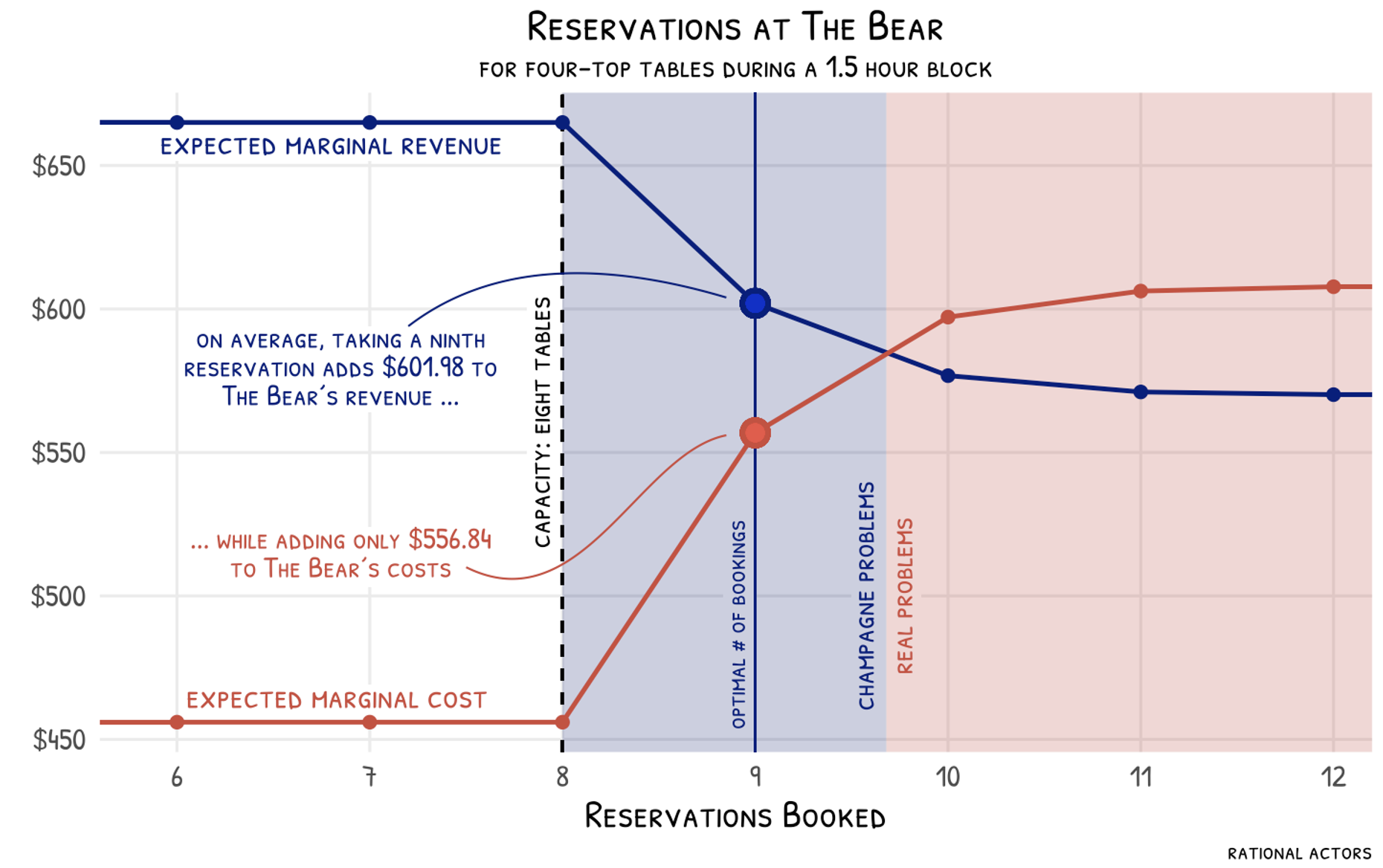
With nine reservations, a typical block yields $5,921.98 in revenue. That’s a $601.98 improvement over taking eight reservations. It also leads to $4,204.84 in costs on average. That’s $556.84 more than with eight reservations. In this case, the marginal revenue of the additional booking ($601.98) exceeds the marginal cost ($556.84). That’s a step in the right direction toward profitability.
Richie: “What do you do if everyone shows?”
Jessica: “They call that a champagne problem.”
With nine reservations, the added costs from appeasing disgruntled guests on the nights everyone shows are more than offset by the added revenues of making sure that all eight tables are (almost) always occupied. If The Bear is open five nights a week with two blocks each night, the move to nine reservations will increase its annual profit by more than $23,000.
If nine reservations is a good idea, how about ten? Similar calculations would show that adding a tenth reservation boosts revenue by $5774 and increase costs by $597. It’s one step too far. To maximize profit, The Bear’s strategy is to increase the number of bookings one-by-one while marginal revenue is greater than marginal cost. If marginal cost exceeds marginal revenue, the restaurant has gone too far.
What could change that would make it optimal to bump the number of bookings up to 10 and overbook by two? Each of the following:
- The probability of each group showing up drops to 92% or lower.
- The marginal cost of serving a delayed group falls from $640 to $616 or lower.
- The price per customer increases such that The Bear collects an additional $24 from each group.
Isn’t overbooking unfair to the customers? After all, they made a reservation, and now there’s no table. But the reason The Bear overbooks is that customers are not put off too much by it. Suppose instead that delayed customers really were outraged. Suppose the reputational hit per delayed group was not $120 but instead $192 or higher. In this case, it would then be optimal for The Bear to stop at eight reservations. Going to nine is only optimal given muted customer response.
Other industries also commonly overbook because their guests may not actually show up: rental car companies, airlines, hotels, and dentist offices. If the guests are very unreliable, they overbook by more. And that means sometimes, everyone will show up, and the sellers will take on high costs due to disgruntled customers. But the sellers know it’s worth it, because they are balancing revenues and costs by thinking on the margin. And trusting their data people.
Computer: “Did you read my charts?”
Carmen: “Absolutely not.”
1 The Bear has tables of other sizes too, and this model can be similarly repeated for other table and group sizes.
2 Why doesn’t The Bear simply not offer free drinks or the discounts? Because then the reputational loss would be even bigger. For simplicity, assume their apology package here is optimal.
3 For simplicity, we are assuming that cancellations occur independently. So, it’s an appropriate model for day-to-day operations but less so during extreme events, like snowstorms, that may cause large numbers of simultaneous cancellations.
4 Why is the marginal revenue less than $600 if that’s the revenue collected from an additional delayed group? Getting exactly eight groups to show up is the optimal outcome. By adding a tenth reservation, the probability of that outcome decreases from 30% to 7.5%.