Blips and Chitz
Rick and Morty: S2, E2 “Mortynight Run”
Pricing Strategies: Two-Part Tariff
Rick is making ethically questionable transactions for spending money. While Morty is mortified, Rick is focused on the possibilities with a big bag of foreign currency.
Rick: “These are flurbos. Do you understand what two humans can accomplish with 3,000 of these?”
Morty: “Uh, what?”
Rick: “An entire afternoon at Blips and Chitz!”
Blips and Chitz is an intergalactic arcade. It has beer, games, prizes, and (evidently) you can never tell what time it is. Its uniqueness gives Blips and Chitz significant market power in pricing its product. And that market power may make it possible for Blips and Chitz to extract more value than a typical seller with clever pricing strategies.
To see how, begin with the following assumptions about Blips and Chitz:
- Blips and Chitz sells access to video games, and it prices its customers per game played.
- Its games and environment are unique, so it has market power. That means a downward-sloping demand curve for its games. As the per-game price increases, players play fewer games.
- Its customers have identical preferences for games, so each individual customer’s demand curve is the same.11 This is an extreme assumption, but it’s only temporarily applied. We will relax it shortly.
- Blips and Chitz has constant marginal costs. With each additional game played, its total costs increase by 10 flurbos. That means a flat marginal cost curve.
First, imagine that Blips and Chitz sells access to their games like most other sellers: with a single price for each play. To maximize profit, Blips and Chitz sets its price so that marginal revenue equals marginal cost. The result is shown in the figure below for a single player’s demand curve.
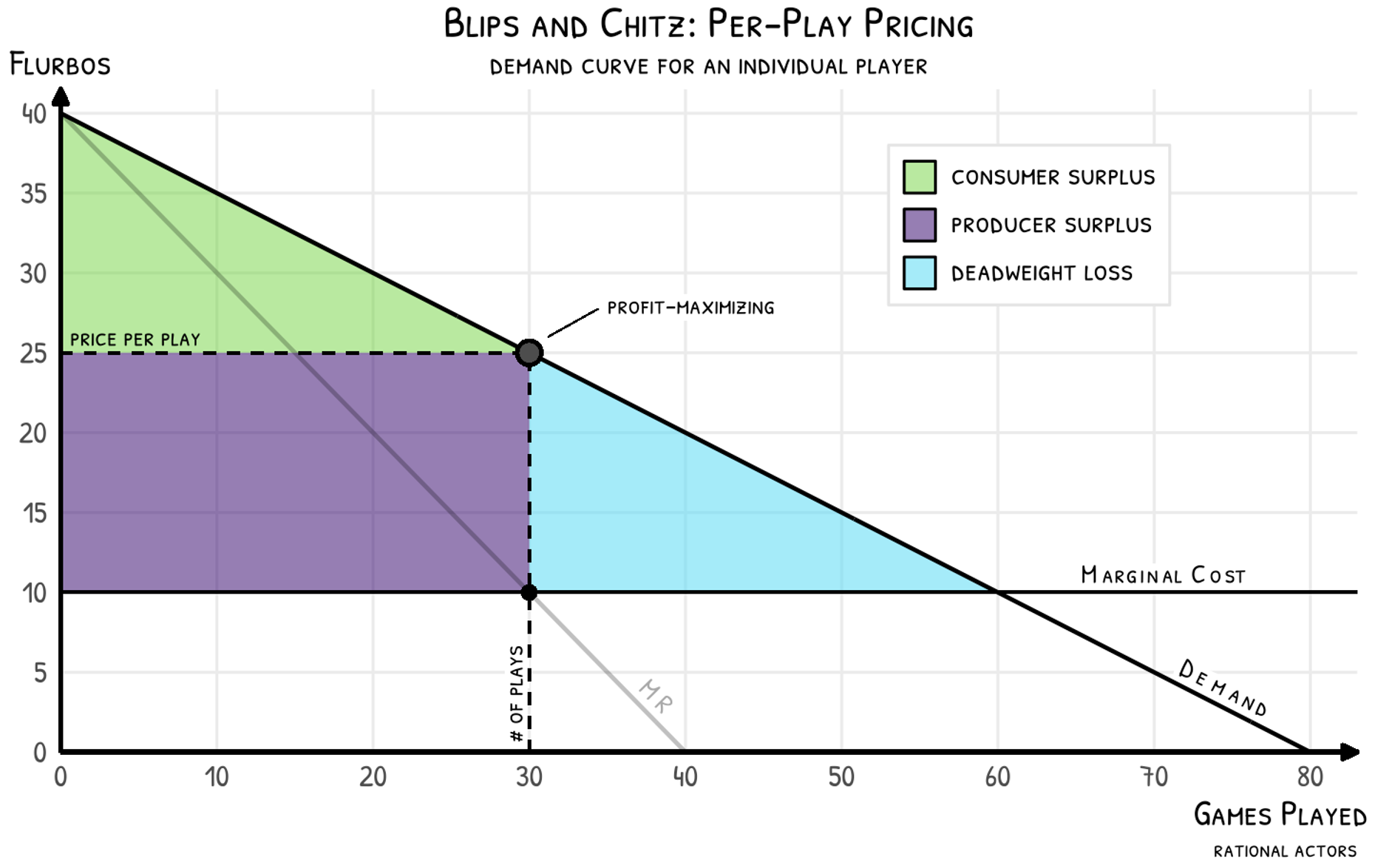
Blips and Chitz maximizes its profit from one player by charging 25 flurbos per game. The individual player is willing to play 30 games at that price. If this price maximizes profit for one player, it maximizes profit overall.
Sellers with market power may be able to increase their producer surplus (and thus, profits) with advanced pricing strategies. Producer surplus is total revenue minus variable costs.22 Maximizing profit is equivalent to maximizing producer surplus. Profit is producer surplus minus fixed costs. But over the space of different prices Blips and Chitz can choose, fixed costs do not vary.
This possibility exists because in the per-play pricing model, there is consumer surplus (in green above) and deadweight loss (in blue).33 The deadweight loss occurs due to a market inefficiency brought about by monopolistic pricing, where the sum of consumer and producer surplus is not maximized. Consumer surplus exists because for those 30 games, the player would have paid even more than 25 flurbos. And deadweight loss exists because there are many more games that the player would be willing to pay more than 10 flurbos for but doesn’t play. None of this value is captured by the arcade in per-play pricing.
An arcade may be able to capture large swaths of both the consumer surplus and deadweight loss by using a two-part tariff. This means that the arcade’s pricing involves two components: (1) a price for each game played and (2) an upfront fee that lets the player into the arcade to begin with.44 On our planet and dimension, some examples: Costco, country clubs, gym memberships.
What prices does Blips and Chitz set for each of these two components? First, it addresses the missing value that stems from the player only playing 30 games even though they would be willing to cover their marginal cost per game for 60 games. In other words, the arcade needs a strategy that induces more play.
Part 1: charge marginal cost per game played.55 This resembles the outcome in highly competitive markets, where firms charge marginal cost for their products. The big difference will be in the ability for the monopolistic firm to capture the consumer surplus this generates.
Blips and Chitz charges 10 flurbos per play instead of 25. The player will happily pay that 60 times. But if the arcade stops here, it’s a drag on its profit. It collects no producer surplus at all. The picture turns to one massive green triangle of consumer surplus. And the player is thrilled to have stumbled upon the universe’s most affordable arcade. That’s where the second component kicks in.
Part 2: charge an upfront entry fee equal to the consumer surplus the player would collect with the per-game price equal to marginal cost.66 A seller must be able to sufficiently deter arbitrage to increase producer surplus (and profit) using this strategy. But this requires no effort for Blips and Chitz. Players have no feasible way to resell the discounted experience of playing “Roy: A Life Well Lived” to anyone who hasn’t paid the entry fee. Whereas if Costco sells $5 ketchup and other grocery stores sell $7 ketchup, Costco may be concerned that its members may buy up large quantities of discount ketchup and resell it for $6. Sure, they benefit from selling so much ketchup, but likely have fewer members now that one saves $1 on ketchup by shopping at Costco instead of $2.
To pair with its cheap per-game pricing, Blips and Chitz charges 900 flurbos just to get in the door. This is all captured as producer surplus, since letting a player walk in the door adds nothing to the arcade’s costs.
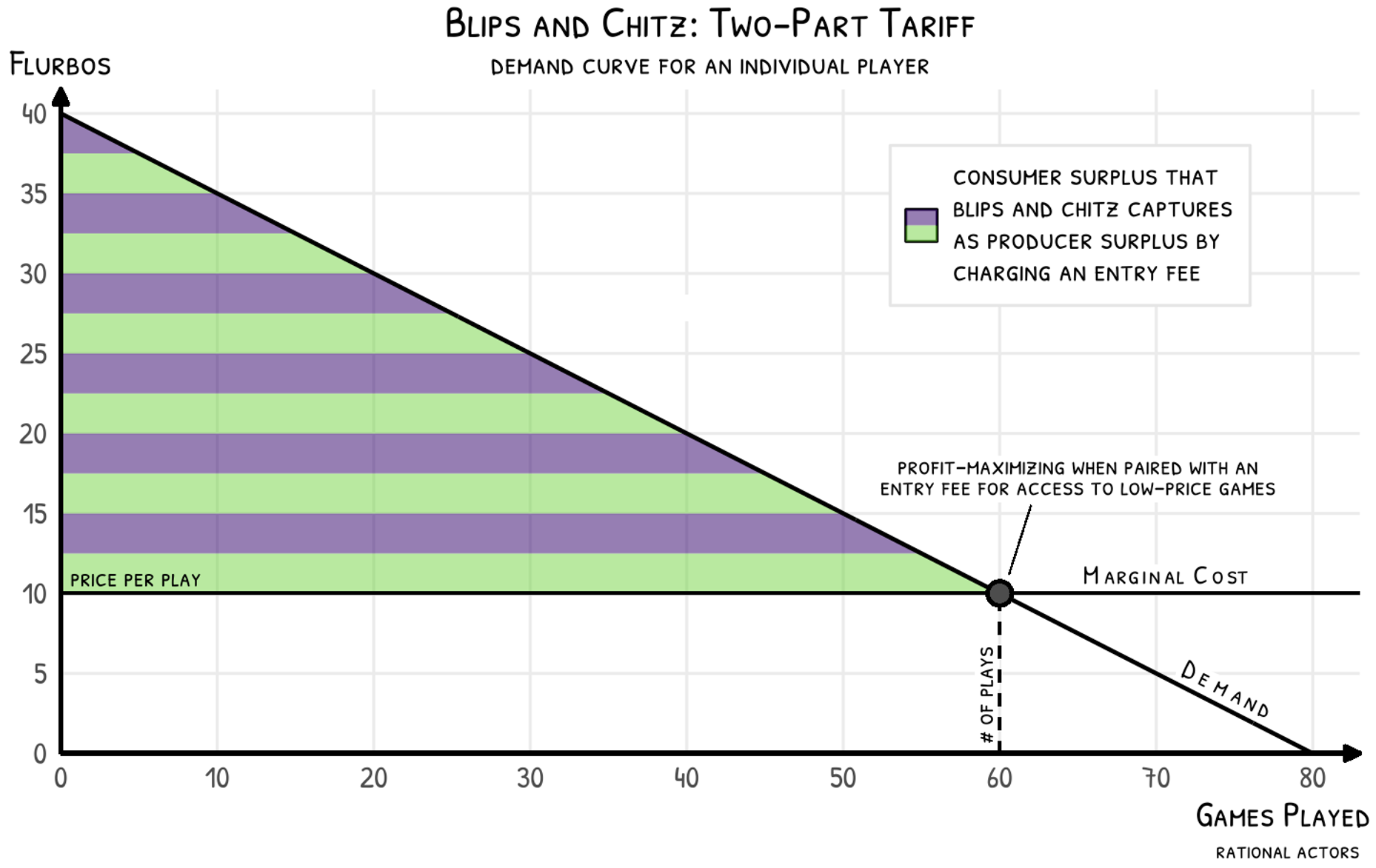
With standard monopolistic pricing, Blips and Chitz collects 450 flurbos in producer surplus from each customer. Now, with a two-part tariff, it doubles that to 900 flurbos. In fact, the arcade has squeezed out every possible flurbo that it could realistically capture given existing demand.
But what if the arcade’s customers have different preferences?77 Also assume that, in this scenario, Blips and Chitz cannot identify the preferences of individual customers and, therefore, cannot perfectly price discriminate. This is the more realistic case. Rick is determined to play every game in the arcade. He wants to take Roy off the grid in “Roy: A Life Well Lived.” But Morty is not so keen on it.
To see how this might alter the arcade’s strategy, imagine it has two potential customers: Rick and Morty. And at any hypothetical per-game price, Rick would want to play twice as many games as Morty.88 In functional form, Rick’s demand for games is QD = 100 – 2.5P and Morty’s demand for games is QD = 50 – 1.25P.
Blips and Chitz could continue to charge 10 flurbos per play. The resulting consumer surplus enjoyed by the different customers is shown below.
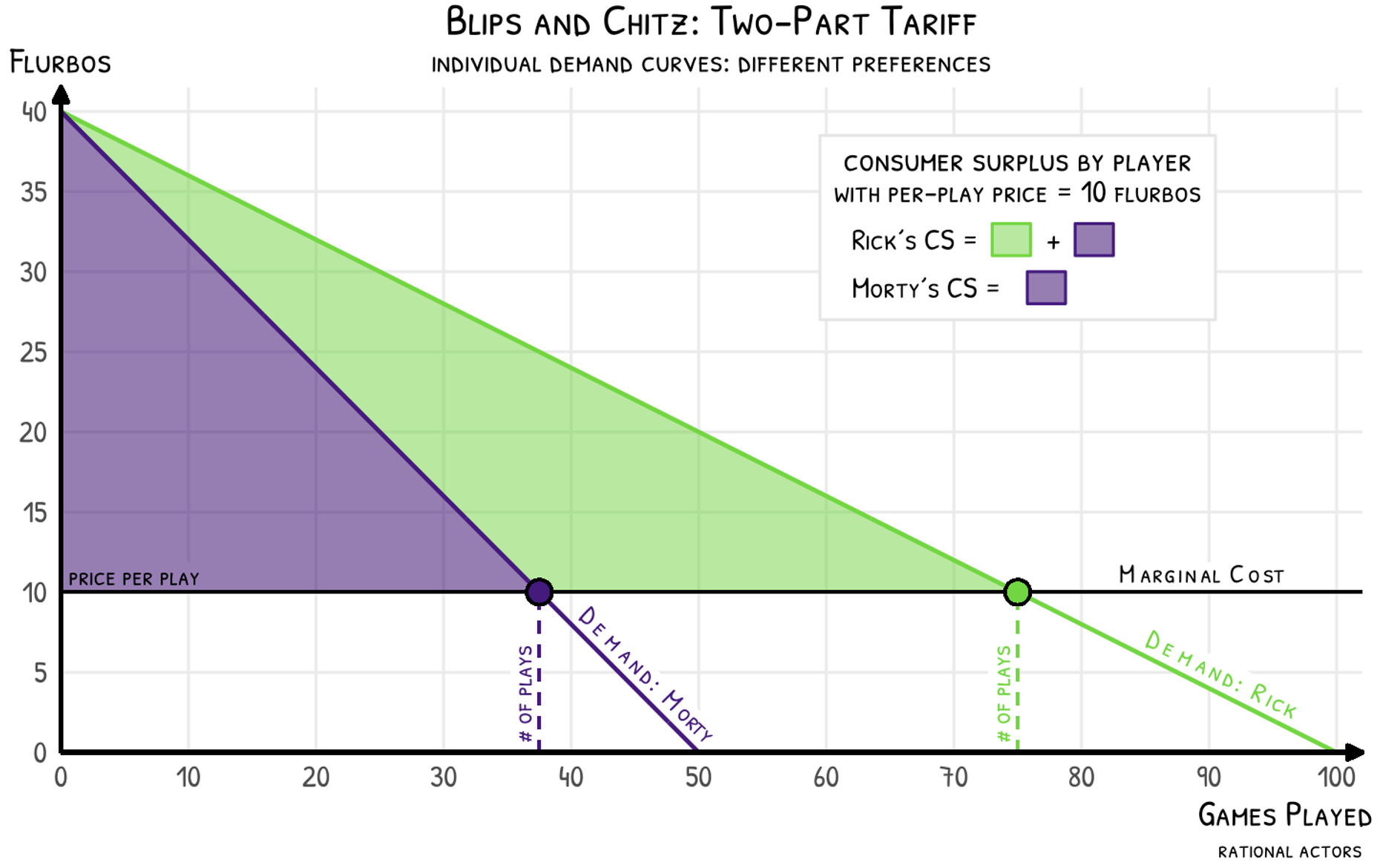
Rick would play twice as many games as Morty and get twice as much consumer surplus. But that consumer surplus is what Blips and Chitz tries to capture with the entry fee. This leaves them two sensible options:
- Charge a 562.5 flurbo entry fee (equal to Morty’s consumer surplus). Both Rick and Morty pay to enter, so total producer equals 1,125 flurbos. The arcade captures all Morty’s consumer surplus but only half of Rick’s.
- Charge a 1,125 flurbo entry fee (equal to Rick’s consumer surplus). Only Rick enters. Morty doesn’t enjoy Blips and Chitz enough to pay that much. Total producer surplus equals 1,125. The arcade captures all Rick’s consumer surplus but loses Morty as a customer.
This leaves Blips and Chitz in the same position either way. If they continue charging 10 flurbos for games, that is. But when its customers have varying preferences, sellers using a two-part tariff can often do better by increasing the per-unit fee (price per play) above marginal cost and lowering the lump sum fee (entry fee).
The math to find the optimal pairing of price per play and entry fee is more complicated. Instead, let’s test out a variety of combinations and compute the resulting producer surplus for the arcade. Now, if per-play price exceeds marginal cost, Blips and Chitz collects producer surplus from games played as well as the entry fees. Total Producer Surplus = (Per-Play Price – Marginal Cost)×(Number of Games Played) + Entry Fees.
The producer surplus Blips and Chitz collects from combinations of the two parts of its pricing scheme are provided below.

By charging 10 flurbos per play, the best Blips and Chitz can do is 1,125 flurbos (or 1,100 flurbos when considering round number entry fees). But among the combinations shown, Blips and Chitz does best by charging 18 flurbos per game and 300 flurbos to get in, collecting a producer surplus of 1,260 flurbos.99 It collects 600 flurbos in entry fees. And by collecting 8 flurbos in producer surplus for every game played, the arcade collects 660 flurbos in producer surplus on its games. Upping its per-play price and lowering its entry fee boosts producer surplus by almost 15%.
Then, as you start to bring more potential customers into the picture, the arcade’s pricing puzzle starts to resemble the same puzzle faced in the one-price world. Do we charge a high fee and cater to our most loyal players only? Do we charge a low fee and attract a crowd of players? But the arcade must remember that the efficiency of the fees depends on the price per play as well.
Either way, given its market power, Blips and Chitz can be more profitable with a clever pricing scheme like a two-part tariff. And if an absurd arcade can squeeze its customers for (almost) every drop of surplus, your local gym, amusement park, or golf club can do so too with a similar strategy. The next step for Blips and Chitz? Developing better ads.
“Are you tired of the same daily droll? Well, get on over to Blips and Chitz. We got, uh, one game. We got a whole bunch of games here. We got chabos and flobos. And you can shoot things! Get over here! Play the games. Use your flurbos to get tickets. ‘Roy 2’ just got here. Get over here at Jitz and Chitz.”
1 This is an extreme assumption, but it’s only temporarily applied. We will relax it shortly.
2 Maximizing profit is equivalent to maximizing producer surplus. Profit is producer surplus minus fixed costs. But over the space of different prices Blips and Chitz can choose, fixed costs do not vary.
3 The deadweight loss occurs due to a market inefficiency brought about by monopolistic pricing, where the sum of consumer and producer surplus is not maximized.
4 On our planet and dimension, some examples: Costco, country clubs, gym memberships.
5 This resembles the outcome in highly competitive markets, where firms charge marginal cost for their products. The big difference will be in the ability for the monopolistic firm to capture the consumer surplus this generates.
6 A seller must be able to sufficiently deter arbitrage to increase producer surplus (and profit) using this strategy. But this requires no effort for Blips and Chitz. Players have no feasible way to resell the discounted experience of playing “Roy: A Life Well Lived” to anyone who hasn’t paid the entry fee. Whereas if Costco sells $5 ketchup and other grocery stores sell $7 ketchup, Costco may be concerned that its members may buy up large quantities of discount ketchup and resell it for $6. Sure, they benefit from selling so much ketchup, but likely have fewer members now that one saves $1 on ketchup by shopping at Costco instead of $2.
7 Also assume that, in this scenario, Blips and Chitz cannot identify the preferences of individual customers and, therefore, cannot perfectly price discriminate.
8 In functional form, Rick’s demand for games is QD = 100 – 2.5P and Morty’s demand for games is QD = 50 – 1.25P.
9 It collects 600 flurbos in entry fees. And by collecting 8 flurbos in producer surplus for every game played, the arcade collects 660 flurbos in producer surplus on its games.