The Marginal Meeseeks
Rick and Morty: S1, E5 “Meeseeks and Destroy”
Production & Costs: Production Functions
(Based on an original idea by Talen Greeson, a student at the University of St. Thomas)
Rick and Morty want to get back to their adventures, but they’re bogged down by their family’s requests for help. Luckily, Rick has a solution.
Rick: “This is a Meeseeks box. Let me show you how it works. You press this:”
Mr. Meeseeks: “I’m Mr. Meeseeks. Look at me!”
Rick: “You make a request. Mr. Meeseeks, open Jerry’s stupid mayonnaise jar.”
Mr. Meeseeks: “Yes, siree!”
Rick: “The Meeseeks fulfills the request …”
Mr. Meeseeks: “All done.”
Rick: “… and then it stops existing.”
With a poof, Mr. Meeseeks is gone and the jar is open. Jerry, Beth, and Summer all come up with requests for Mr. Meeseeks, but Jerry’s request creates the most trouble.
Mr. Meeseeks: “Hey there, I’m Mr. Meeseeks.”
Jerry: “Mr. Meeseeks, I would like to take two strokes off my golf game.”
Our goal is to build a model of Jerry’s golf game, fine-tuned with observations from the episode, to reveal insights about improvements and coaching that may not be immediately evident. So, what features must the model have to be consistent with the observed interactions between Jerry and Mr. Meeseeks?
Observation 1: Mr. Meeseeks gives useful golf advice that should help, at least initially. We can see this in the Meeseeks’ initial attempts to help Jerry.
“Remember to square your shoulders, Jerry.”
Observation 2: Each Meeseeks added to the same task are less helpful than the one added before. When the first Meeseeks hits a wall, he presses the button to summon another. But there’s a lot of overlap in their ideas. The assistance given by an additional Meeseeks is called marginal product, and it decreases as Meeseeks are added.
1st Meeseeks: “Can you help me get two strokes off Jerry’s golf game?”
2nd Meeseeks: “Can do! I’m Mr. Meeseeks! Is he keeping his shoulders squared?”
1st Meeseeks: “Oooh, he’s trying!”
Observation 3: The marginal product of a Meeseeks, if there are enough of them, can be zero or even negative. It can actually be harmful to Jerry’s golf game if another Meeseeks is summoned.
It’s possible for marginal product to be zero because Jerry can be overwhelmed by the Meeseeks’ advice. And advice is primarily what additional Meeseeks have to offer.
Mr. Meeseeks: “Try again and keep your head down.”
Jerry: “Okay, well, which is it? Square my shoulders or keep my head down?”
Mr. Meeseeks: “Well, it’s both. But most importantly, you got to relax.”
How could marginal product be negative? With too many Meeseeks, coordination breaks down. Comically, at some point there are so many Meeseeks that they turn on Jerry. They hunt him down!
Mr. Meeseeks: “Come on out, Jerry.”
Jerry: “Guys, I’ll choke up. I’ll do whatever you tell me to do, okay?”
Mr. Meeseeks: “Oh, we’re well past that, Jerry.”
Observation 4: Given Jerry’s current ability to follow the Meeseeks’ coaching, a two-stroke reduction is not possible. This limit exists because the Meeseeks run out of ideas and marginal product turns negative before Jerry reaches his goal.
20th Meeseeks: “The job can't be done! We'll never get two strokes off his game!”
Observation 5: The Meeseeks are successful in other tasks. The mayonnaise jar is no problem. The Meeseeks even successfully make Summer popular at school and help Beth be a more complete woman, hardly simple tasks. Therefore, the requestor’s coachability plays a critical role in the Meeseeks’ productivity.
Observation 6: The Meeseeks don’t disappear if Jerry does. They only disappear once the task is complete. When Jerry gives up and goes to dinner, the negative side of the Meeseeks comes out. If the requestor provides no assistance at all, the situation devolves quickly.
We can capture these features in a production function. First, the variables:
- Q: the quantity of strokes removed from Jerry’s golf game. His request is to reach Q = 2.
- C: the golfer’s coachability, which ranges from 0 to 1 continuously, or from 0% to 100%.
- M: the number of Meeseeks coaching the golfer, which can be 0 or any positive integer.
The following production function and its marginal product of a Meeseeks (MPM) use these variables to capture observations 1-6 listed above:1
Q = 4CM – 0.04M2
The marginal product of a Meeseeks comes from taking the first derivative of Q with respect to M:2
MPM = 4C – 0.08M
Assume that Jerry’s coachability at the beginning of the episode is 0.1 (10%).
1. If C=0.1, then MPM = 0.4 – 0.08M. As long as M is less than 5, an added Meeseeks is helpful in removing (fractions of) strokes.
2. Because of the negative multiplier on M in MPM, marginal product falls as Meeseeks are added.
3. Marginal product is zero if M=5 and is negative if there are more than five Meeseeks.
4. Since Meeseeks are helpful all the way up to M=5, the maximum number of strokes taken off Jerry’s game occurs at M=5. Plug M=5 and C=0.1 into the production function to find that Q=1. In the best-case scenario, Jerry would be able to take off just a single stroke, not two.3
5. If Jerry were more coachable and C=0.2, then MPM = 0.8 – 0.08M and each Meeseeks added is more helpful than in the scenario where C=0.1. This makes coachability and Meeseeks complements in the production of golf improvements and other requests.4
6. When Jerry gives up and C falls to zero, that leaves Q = -0.04M2, so problems emerge if Meeseeks exist, and those problems increase rapidly as M increases.
The graph below visualizes how the number of Meeseeks affects Jerry’s golf game, depending on Jerry’s coachability level.

But the crucial decision was never Jerry wondering what the optimal number of Meeseeks was. He didn’t decide to summon twenty Meeseeks from the very beginning. Instead, each Meeseeks had to decide if calling upon another Meeseeks would be helpful. That’s marginal thinking!5 Analyzing this problem on the margin rather than over the whole spectrum of possible numbers of Meeseeks reveals insights about what went wrong.
So, instead of graphing total production at each number of Meeseeks, we can graph the marginal product of each Meeseeks. How helpful is one more? Because that’s the question each Meeseeks should have asked himself before pressing the button again. And these lines are closely related. The marginal product is the slope of the production function.
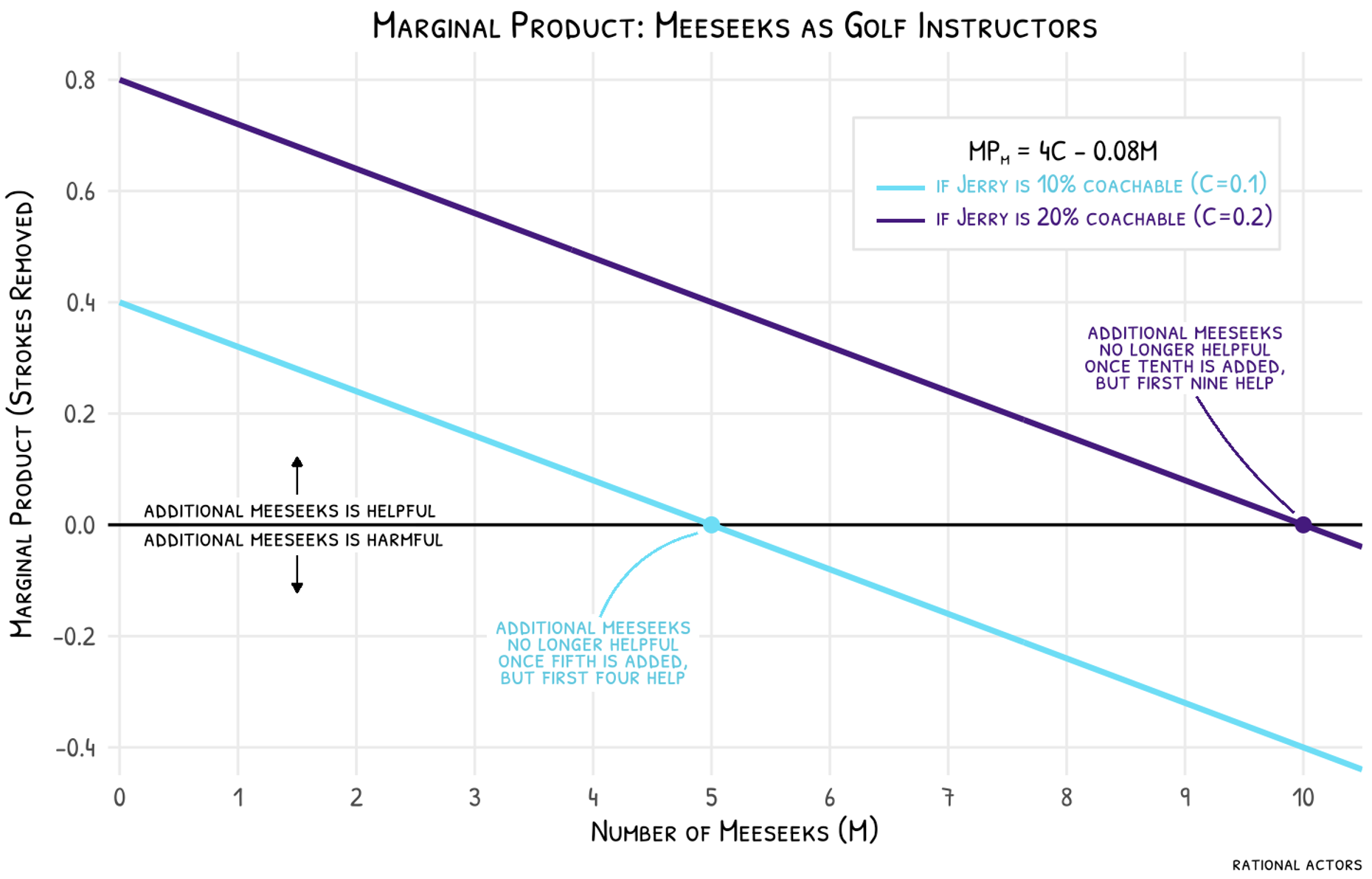
Analysis on the margin helps create an effective stopping rule for how many times to press the button. Since a button press appears costless, Jerry’s golf game is most helped when the marginal product of a Meeseeks is zero.6
This model reveals important insights about this process:
- A more coachable golfer, say with 20% coachability, can absorb a bigger team of coaches. For them, productivity is maximized with ten Meeseeks instead of five.
- Because the inputs are complements, it’s easy to attribute failure to the wrong input. Was the failure to reach two strokes the fault of the Meeseeks or was the fault Jerry’s? It was both, even though the Meeseeks appear ineffective or even harmful at times.
- With his limited coachability, Jerry was doomed from the start. No amount of Meeseeks could get him to a two-stroke reduction. But a small improvement in coachability would have fixed it! A coachability factor of about 14% would have been sufficient.7
If Jerry had been more self-aware from the beginning, he might have been able to follow Rick’s word of warning about the Meeseeks box.
Rick: “Knock yourselves out. Just keep your requests simple. They’re not gods.”
1 There may be other functional forms that do this as well, but simplicity is valuable, and this is likely the simplest. The commonly used Cobb-Douglas production function Q = ACaMb cannot produce negative marginal products.
2 Meeseeks are discrete, so Q is properly defined only at integer values of M. But treating M as continuous is convenient computationally and leads to no differences in our conclusions.
3 Since the production function is differentiable with respect to M and has a global maximum given its form, one can find the maximum by setting the first derivative equal to zero and solving for M.
4 Inputs are complements when the cross-partial, ∂MPM/∂C, is positive. And for MPM = 4C – 0.08M, ∂MPM/∂C = 4.
5 And actually, if Jerry had known from the beginning that he would accumulate a team of Meeseeks, marginal thinking would still have helped lead him to a more efficient answer.
6 This may seem obvious, given that we already found that Jerry’s golf game is most aided by five Meeseeks. But what if Rick charged Jerry each time the button was pressed? Then, marginal thinking is crucial, and he would stop where the dollar value of the marginal product equals the per-press charge, even if his golf game isn’t maximally aided yet. He would also need to take charge of the button-pressing, since the Meeseeks may have different incentives to summon additional Meeseeks than Jerry has.
7 Maximum output occurs at M* = 50C, which yields Q* = 100C². Plug in Q* = 2 and solve for C. Also notice that maximized output is convex in coachability. Each additional coachability point is more helpful than the last.

More from Rick and Morty:


1 There may be other functional forms that do this as well, but simplicity is valuable, and this is likely the simplest. The commonly used Cobb-Douglas production function Q = ACaMb cannot produce negative marginal products.
2 Meeseeks are discrete, so Q is properly defined only at integer values of M. But treating M as continuous is convenient computationally and leads to no differences in our conclusions.
3 Since the production function is differentiable with respect to M and has a global maximum given its form, one can find the maximum by setting the first derivative equal to zero and solving for M.
4 Inputs are complements when the cross-partial, ∂MPM / ∂C, is positive. And for MPM = 4C – 0.08M, ∂MPM / ∂C = 4.
5 And actually, if Jerry had known from the beginning that he would accumulate a team of Meeseeks, marginal thinking would still have helped lead him to a more efficient answer.
6 This may seem obvious, given that we already found that Jerry’s golf game is most aided by five Meeseeks. But what if Rick charged Jerry each time the button was pressed? Then, marginal thinking is crucial, and he would stop where the dollar value of the marginal product equals the per-press charge, even if his golf game isn’t maximally aided yet. He would also need to take charge of the button-pressing, since the Meeseeks may have different incentives to summon additional Meeseeks than Jerry has.
7 Maximum output occurs at M* = 50C, which yields Q* = 100C². Plug in Q* = 2 and solve for C. Also notice that maximized output is convex in coachability. Each additional coachability point is more helpful than the last.