Jerry Smith, Economist From Earth
Rick and Morty: S1, E9 “Something Ricked This Way Comes”
Externalities: External Costs
King Flippy Nips, the ruler of Pluto, abducts Morty and Jerry, after Jerry proudly defies NASA and claims that Pluto is actually a planet. The King lays out the red carpet for Jerry and uses him as a propaganda tool for the Plutonians who want reassurance that Pluto is indeed a planet.
But Scroopy Noopers, a Plutonian scientist, explains to Morty the reason why Pluto lost its planet status in the eyes of the real scientists.
“The center of Pluto, Mr. Smith, is made of a substance called plutonium. Mines like these suck plutonium out to the cities where corporations use it to power everything. Diamond cars. Golden showers. And the more we remove, the more Pluto shrinks.”
This situation is a case of negative externalities: actions that create problems for people not directly involved. The extraction of plutonium by the mines causes Pluto’s 4 billion residents to live on a smaller, more compressed planet with more frequent plutoquakes and sinkholes.
We can make sense of this situation by modeling the market for plutonium with supply and demand. Assume there are many different plutonium mines: the sellers of plutonium. And assume there are many corporations that purchase the plutonium.
In a competitive market, as the market for plutonium appears to be, the amount extracted is determined by the equilibrium price for a barrel of plutonium. Below, I model the market for plutonium each day on Pluto.
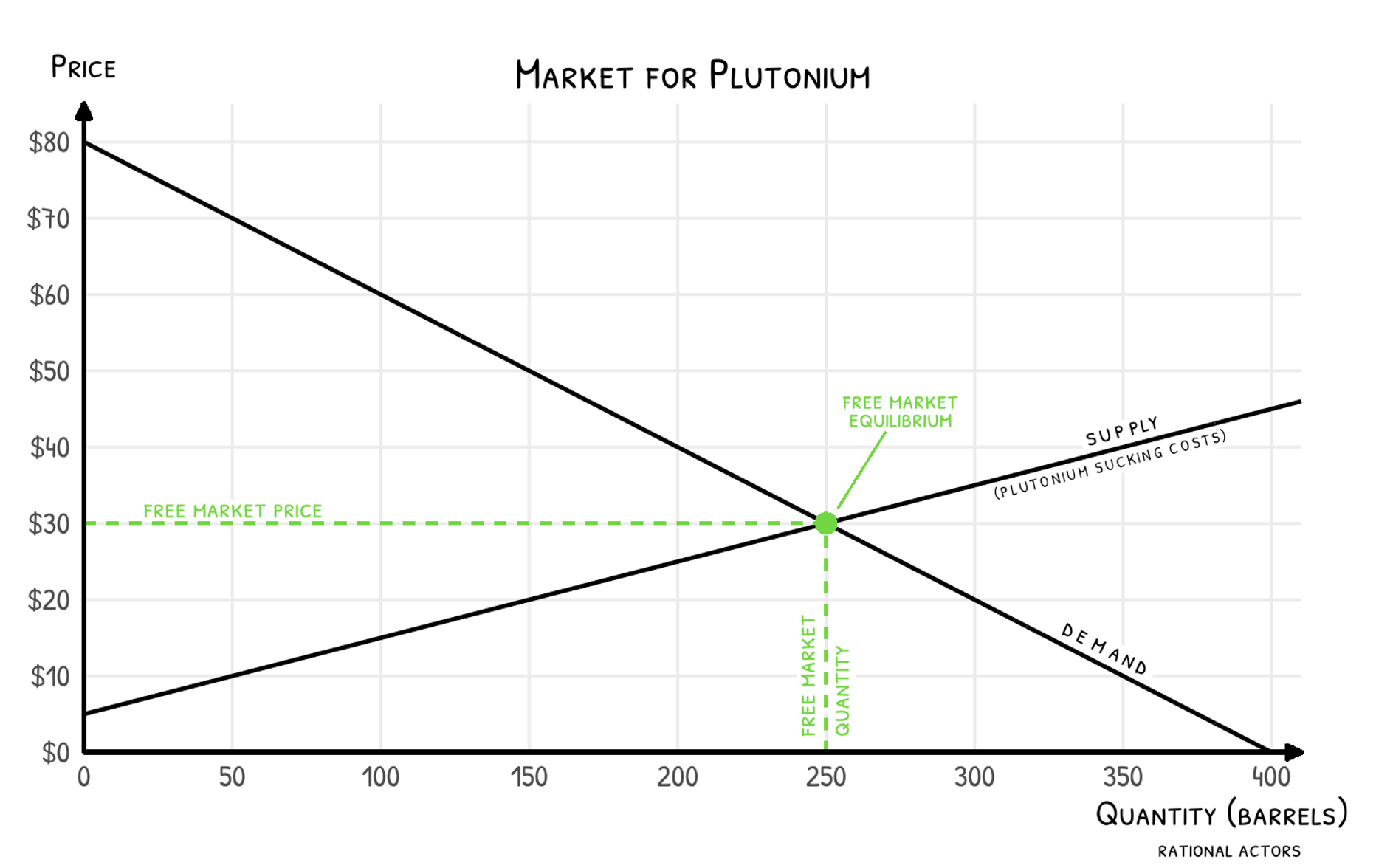
The going rate for a barrel of plutonium is $30. As a result, the mines extract (and then sell) a combined 250 barrels each day. Why not more than 250 barrels? Since the mines are out to make a profit, it must be that the most accessible plutonium that they don’t touch costs more than $30 per barrel to extract. Perhaps they are deeper in the center of Pluto. Similarly, each of the 250 barrels they choose to extract costs less than $30 to extract. Some of those barrels may cost almost $30 and are therefore barely worthwhile to the mine to suck out and sell. The height of the supply curve represents these extraction costs.
Similarly, all the barrels end up purchased by corporations for uses whose value is higher than $30, which is why they purchase the plutonium. But some of the plutonium powers things that are barely worth the $30 paid for it. The height of the demand curve represents these use values.
So, what’s wrong with this picture? The mines make their extraction decisions (and the corporations make their purchasing decisions) by considering their individual costs and benefits without considering the problems caused for other Plutonians.
Suppose each barrel of plutonium extracted from Pluto leads to $30 in costs imposed on other Plutonians. This is called an external cost.¹ If we add this external cost to the sucking costs for the mines, we can then visualize the costs of plutonium production for all of Pluto (which includes both the mines and general Plutonian population). Call their sum social costs: the costs for the producer of the product plus the external costs. This is what Pluto as a whole pays for each barrel.
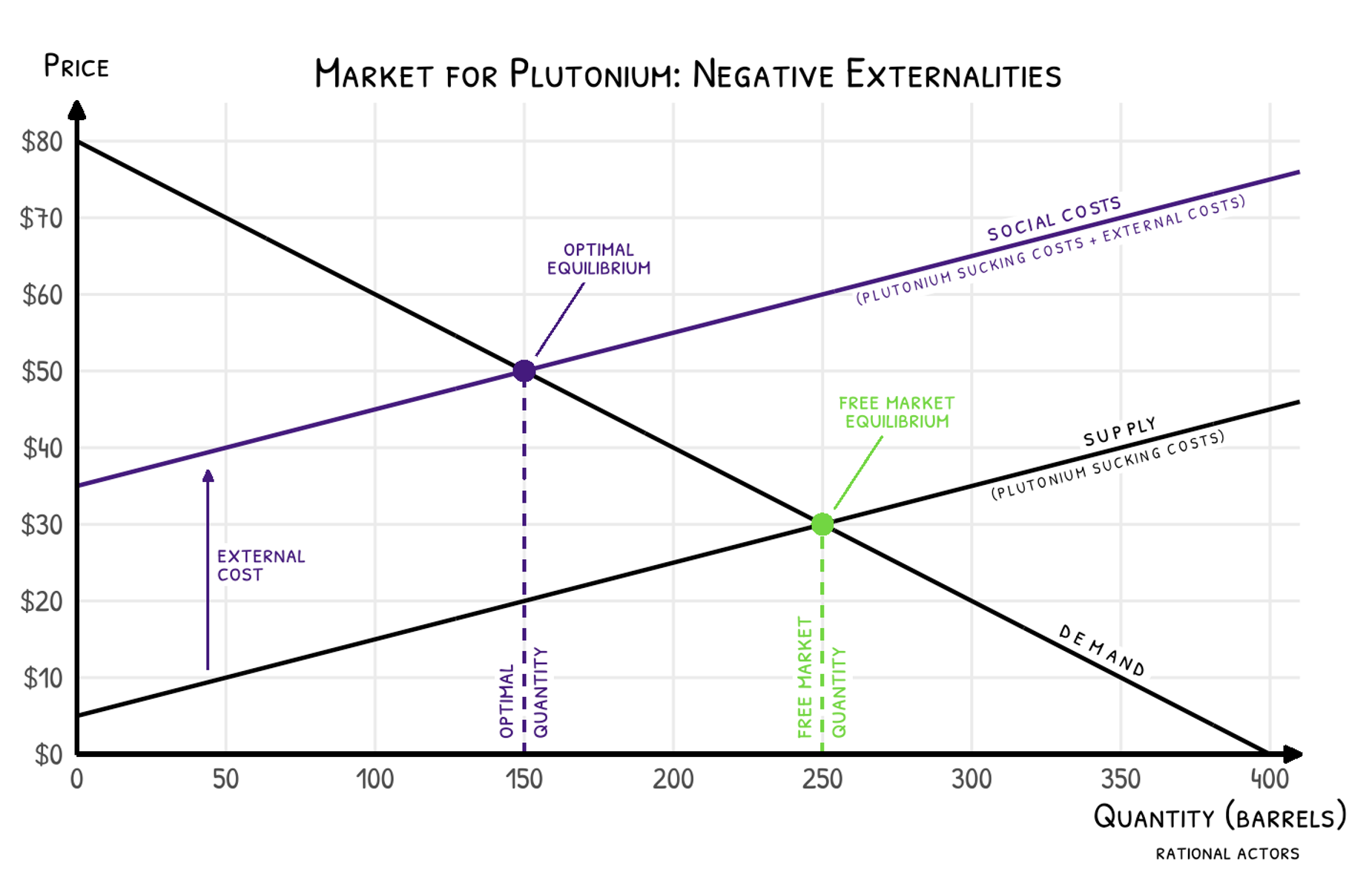
The optimal number of barrels occurs where the social costs curve crosses the demand curve. Given the $30 external cost, this occurs at 150 barrels. Plutonium mines extract 100 barrels more than the optimal amount every single day. Why would Pluto be better off if these 100 barrels were not sucked out? Consider the use value (from the demand curve) and the overall cost (from the social costs curve).
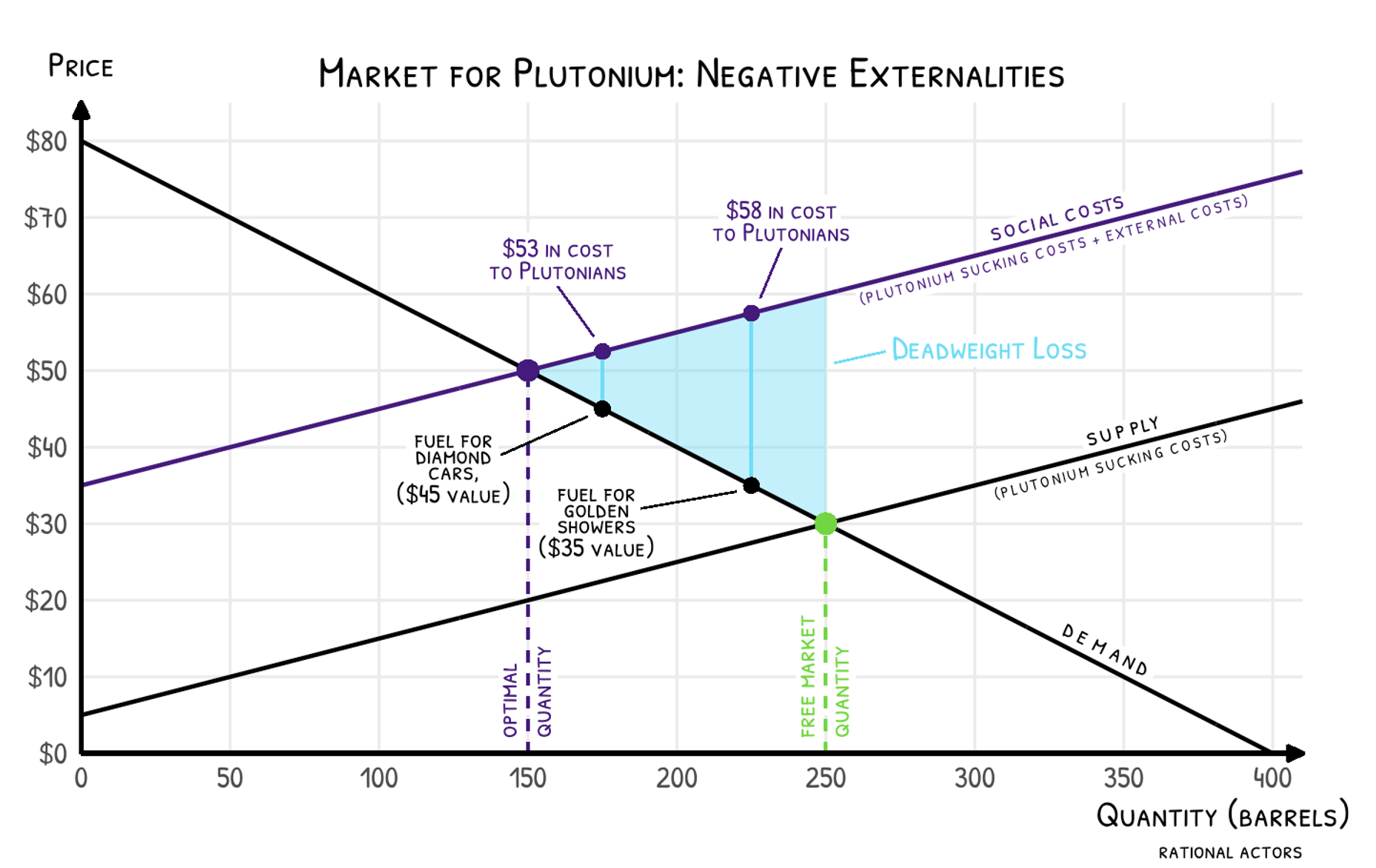
For each of these 100 barrels, the cost to all of Pluto exceeds the frivolous, low-value uses of the plutonium. The $30 external cost exceeds the combined benefits that the mines (the sellers) and the corporations (the buyers) get from the plutonium. These 100 barrels do more harm than good. This results in a deadweight loss: a loss in economic value due to a market distortion.
But the market continues to extract 250 barrels every day regardless. The $30 external cost does not affect the mines directly. They only incur the sucking costs. So, they are prone to overextract as a result.²
Scroopy Noopers is trying to address the deadweight loss through an information campaign but admits that his efforts are failing.
“The rich Plutonians won’t wake up, and they love your Dad telling everyone Pluto’s a planet, because that means they can keep mining until Pluto goes from planet to asteroid to meteor and finally … poof.”
Is there a more effective solution than impassioned speeches and public protests? Perhaps a solution that more effectively addresses the problem with these 100 barrels would be appropriate.
A fitting solution is one that discourages corporations from buying and using plutonium for things that have values between $30 and $50 and discourages mines from sucking out any plutonium for which their own costs exceed $20. The price that buyers pay for plutonium needs to increase and the price that sellers receive for plutonium needs to decrease. How can that be done? With a tax applied to each barrel of plutonium.³
Taxes like this can be used to address carbon emissions, secondhand cigarette smoke, traffic congestion on busy freeways, and all sorts of situations where an excess of economic activity leaves the population worse off as a result. And this includes the tragic shrinking of Pluto.
“Pluto is a cold, cold celestial dwarf.”
¹ It’s purely coincidental that the external cost is equal to the equilibrium price in this example.
² The overextraction that occurs here is a direct result of a competitive market with many sellers. If there was a single extracting firm on Pluto, a monopolist, it would likely restrict supply by extracting less. It would do this to keep the price high. And depending on just much plutonium the monopolist holds back, it might lead to an outcome closer to optimal than the competitive market.
³ Taxes applied to the production (or consumption) of a good or service to correct negative externality problems are called Pigouvian taxes.

More from Rick and Morty:


¹ It’s purely coincidental that the external cost is equal to the equilibrium price in this example.
² The overextraction that occurs here is a direct result of a competitive market with many sellers. If there was a single extracting firm on Pluto, a monopolist, it would likely restrict supply by extracting less. It would do this to keep the price high. And depending on just much plutonium the monopolist holds back, it might lead to an outcome closer to optimal than the competitive market.
³ Taxes applied to the production (or consumption) of a good or service to correct negative externality problems are called Pigouvian taxes.