Decoys All the Way Down
Rick and Morty: S5, E2 “Mortyplicity”
Game Theory: Prisoner’s Dilemma
Squid aliens are after Rick and his family. As a precaution, Rick creates a decoy Smith family and receives alerts should harm befall the decoys. Real trouble begins when the decoys begin creating decoys. Every decoy Rick believes himself to be the real Rick and has created decoy families to protect himself. It’s decoys all the way down, or as Rick calls it, an “Asimov Cascade.”
As each decoy family encounters other decoy families and faces questions about their authenticity, deadly escalation ensues between the decoy Ricks.
Beth: “Stop shooting, dad! They're us, we don't have to fight them!”
Rick: “Classic prisoner's dilemma, Beth. I'm a cool guy, you know, I can talk it out. But that *sshole …”
Other Rick: “Me? You decoy piece of sh*t. You're the one that shot first!”
Other Beth: “We can work this out, just stop trying to kill each other!”
Rick is correct. This is exactly like the canonical game theory model: the prisoner’s dilemma.11 The original prisoner’s dilemma: Two accomplices are interrogated separately. Each can either stay silent or betray the other. If both stay silent, each gets 1 year in prison. If both betray, each gets 3 years. If one betrays while the other stays silent, the betrayer goes free while the silent one gets 5 years. Each prisoner prefers a lesser sentence for themselves. This model will help us understand the behavior of the decoys when they meet. Their encounters, each of which we will call a game, occur as follows:
- The game has two players: Rick and Other Rick.
- Each Rick has two possible actions: fight or work it out.
- Each Rick values two things: (1) being the real Rick and not a decoy and (2) surviving the encounter with the other Rick.22 One could assign utility functions to facilitate comparisons of potential outcomes that combines the player’s preferences for both survival and authenticity.
- Each of the four possible outcomes, as created by combinations of their actions, has distinct payoffs for each Rick.
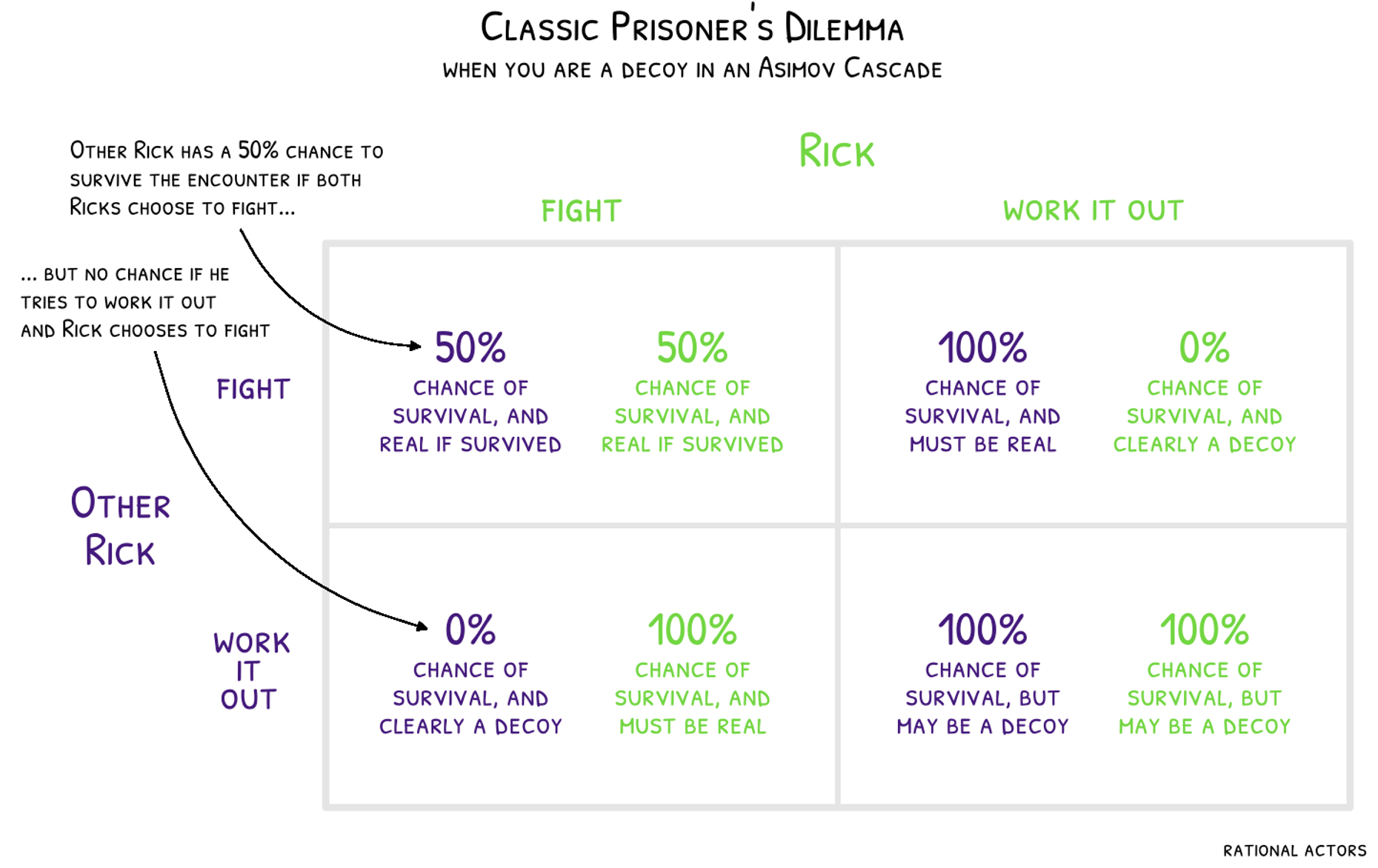
- If both Ricks choose to fight, each has a 50% chance of survival. The survivor will be, at least in their mind for the time being, the real Rick.
- If both Ricks choose to work it out, each survives but is left wondering if they are a decoy. Still, this is the best outcome when considering their combined payoffs.
- If one Rick chooses to fight while the other chooses to work it out, the escalating Rick kills the peaceful Rick. The escalating Rick will be, at least in their mind for the time being, the real Rick.
The game can be visualized in matrix form as shown below. Rick is the column player, whose actions and resulting payoffs are in green. Other Rick is the row player, whose actions and resulting payoffs are in purple.
In game theory, predictions of individual behavior are made by identifying best responses. If the other player does x, what should I do? And what if they do y?
Other Rick:
- If Rick fights, best response: fight (to have a 50% chance of survival)
- If Rick works it out, best response: fight (same survival rate and an authenticity boost)
Rick:
- If Other Rick fights, best response: fight (to have a 50% chance of survival)
- If Other Rick works it out, best response: fight (same survival rate and an authenticity boost)33 Because this is a symmetric game, Rick’s best responses are the same as Other Rick’s best responses. Also note that in this game and in all similar prisoner’s dilemmas, each player has a dominant strategy: the same best response for all possible actions of the other player.
Given rational, self-interested players in the game, their behavior will converge on the Nash equilibrium: the set of actions such that each player’s action is a best response to the other player’s action.44 I say the Nash equilibrium, because there is only one such equilibrium in this game. But in general, games can have more than one Nash equilibrium. Perhaps even infinitely many. Or less formally, each player is making the optimal move given the move made by the other player.55 One can test whether a set of actions is a Nash equilibrium by asking “Can either player increase their payoff by unilaterally switching their action to something else?” If switching is optimal, holding fixed the action of the other player, the tested set of actions is not a Nash equilibrium.
In an encounter between decoy Ricks, as each player pursues their own self-interest, the pattern of payoffs leads to mutual escalation. Both choose to fight. That’s the Nash equilibrium of the game.
Rick: “Sorry, decoy Beth, but this only ends one way, with one of us accepting we're a decoy.”
Other Rick: “And once he knows he's a decoy, he knows he won't be safe until he's killed the real Rick, along with anyone who think he's him.”
Best responses and the resulting Nash equilibrium are highlighted below.

In a prisoner’s dilemma like this, each player’s pursuit of their own self-interest leads to a group outcome that is worse than another imaginable outcome. Each Rick may wits for a ceasefire, but acting alone, he can only change his own behavior. As a result, the decoys in an Asimov Cascade escalate to mutually assured destruction. The horrifying outcome does not necessarily arrive due to malicious intent or irrationality. It’s merely a product of individual incentives.
Dilemmas of this sort are common. Two countries spend trillions in national defense, leaving them no safer relative to each other despite spending lots of valuable resources in the name of safety. Athletes use performance-enhancing drugs to get an edge, but so do their opponents, so both sacrifice their health and get no actual advantage. A prisoner and his accomplice both confess to their crimes to get a lesser sentence when they could go free if both stayed quiet.
In each of these examples, the players in the game could get a better group outcome if they could coordinate their actions. The decoys both work it out. Countries sign a peace treaty and lower their weapons. Athletes coordinate prohibitions against doping. Prisoners plead the fifth.
But each of these coordinated outcomes is often tenuous. Individual incentives for self-interested parties are too strong. In a world where every decoy waived a white flag in their encounters, a single decoy could deviate and eliminate all other decoys. That’s tempting, especially when one is programmed to be an effective clone of Rick Sanchez’s manipulative, narcissistic, and cynical personality. A decoy safe haven may not be sustainable. Eventually, all the decoys deviate and destruction ensues.66 Players in prisoner’s dilemmas may be able to work out sustainable coordination when the game is played repeatedly, which creates the possibility for punishment mechanisms for deviating players. Punishment works by making it in the other player’s best interest to coordinate rather than deviate. But in one-shot games where the players encounter each other once and never again, which is likely true for the Rick decoys, there exists no future interactions where punishments can be carried out for past malfeasance.
Even the decoy Summers, less prone to selfish desires than the Rick decoys, escalate to deadly violence in their encounters with each other. Self-interest rules the day. For the decoys, the only safe strategy may be to avoid playing the game at all.
Morty: “Where are we going?”
Rick: “Off grid, Morty. We're gonna live in the woods, like libertarians. We'll hunt rabbits and trade with, like, little pieces of gold bar that we cut off with a knife.”
1 The original prisoner’s dilemma: Two accomplices are interrogated separately. Each can either stay silent or betray the other. If both stay silent, each gets 1 year in prison. If both betray, each gets 3 years. If one betrays while the other stays silent, the betrayer goes free while the silent one gets 5 years. Each prisoner prefers a lesser sentence for themselves.
2 One could assign utility functions to facilitate comparisons of potential outcomes that combines the player’s preferences for both survival and authenticity.
3 Because this is a symmetric game, Rick’s best responses are the same as Other Rick’s best responses. Also note that in this game and in all similar prisoner’s dilemmas, each player has a dominant strategy: the same best response for all possible actions of the other player.
4 I say the Nash equilibrium, because there is only one such equilibrium in this game. But in general, games can have more than one Nash equilibrium. Perhaps even infinitely many.
5 One can test whether a set of actions is a Nash equilibrium by asking “Can either player increase their payoff by unilaterally switching their action to something else?” If switching is optimal, holding fixed the action of the other player, the tested set of actions is not a Nash equilibrium.
6 Players in prisoner’s dilemmas may be able to work out sustainable coordination when the game is played repeatedly, which creates the possibility for punishment mechanisms for deviating players. Punishment works by making it in the other player’s best interest to coordinate rather than deviate. But in one-shot games where the players encounter each other once and never again, which is likely true for the Rick decoys, there exists no future interactions where punishments can be carried out for past malfeasance.