Costly Signals and Alien Parasites
Rick and Morty: S2, E4 "Total Rickall"
Asymmetric Information: Signaling
The Smith household is full of zany characters: Photography raptor, Sleepy Gary, Pencilvester, Amish cyborg, Hamurai, Reverse giraffe, Ghost in a jar, Tinkles. The Smith family has pleasant memories with all of them.
But most are alien parasites. They embed pleasant memories in their hosts, creating new parasites along the way. This spells trouble for both the Smith family and the world at large. Rick puts the household on lockdown. He has figured out what’s happening.
“All right, everybody listen to me. I don’t know if any of you guys are real, but this house has been infested with fake loved ones that spread through fake memories and our planet will be destroyed if they get out.”
Each character knows whether it is real or a parasite. But Rick cannot tell. This situation is an example of asymmetric information: some participants in the situation know more than others. And for Rick, knowing which characters are real is planet-saving information.
If only he could just ask each character if they are real and get honest responses. But the parasites want to pass themselves off as real to spread and escape the Smith household. As the members of the Smith family interact with the zany characters, Morty picks up on an important differentiating feature.
“I figured it out Rick. The parasites can only create pleasant memories. I know you’re real because I have a ton of bad memories with you.”
This difference between the two types of characters creates an opening for the real people to differentiate themselves. They do this through signaling: the participant who knows more provides information to the other participant to differentiate themselves. But the signal that the real people send must be something that the alien parasites cannot replicate. Since the parasites can conjure pleasant memories just as real people can, the only way for real people to prove their authenticity is to recall unpleasant memories.
Rick creates a perfect solution. He engages individual characters and gives them the chance to conjure a memory before deciding to welcome them as a member of the family or shoot them. But he only welcomes them if the memory they conjure is sufficiently unpleasant. This scenario can be modeled as follows:
- Think of each character as trying to solidify their status in the family. And status depends on two things:
- How pleasant the memories are between that character and the rest of the family. The more pleasant the memories, the higher their status. In other words, unpleasant memories are costly.
- Whether the character is alive. A dead character gets no benefit from being a member of the family.
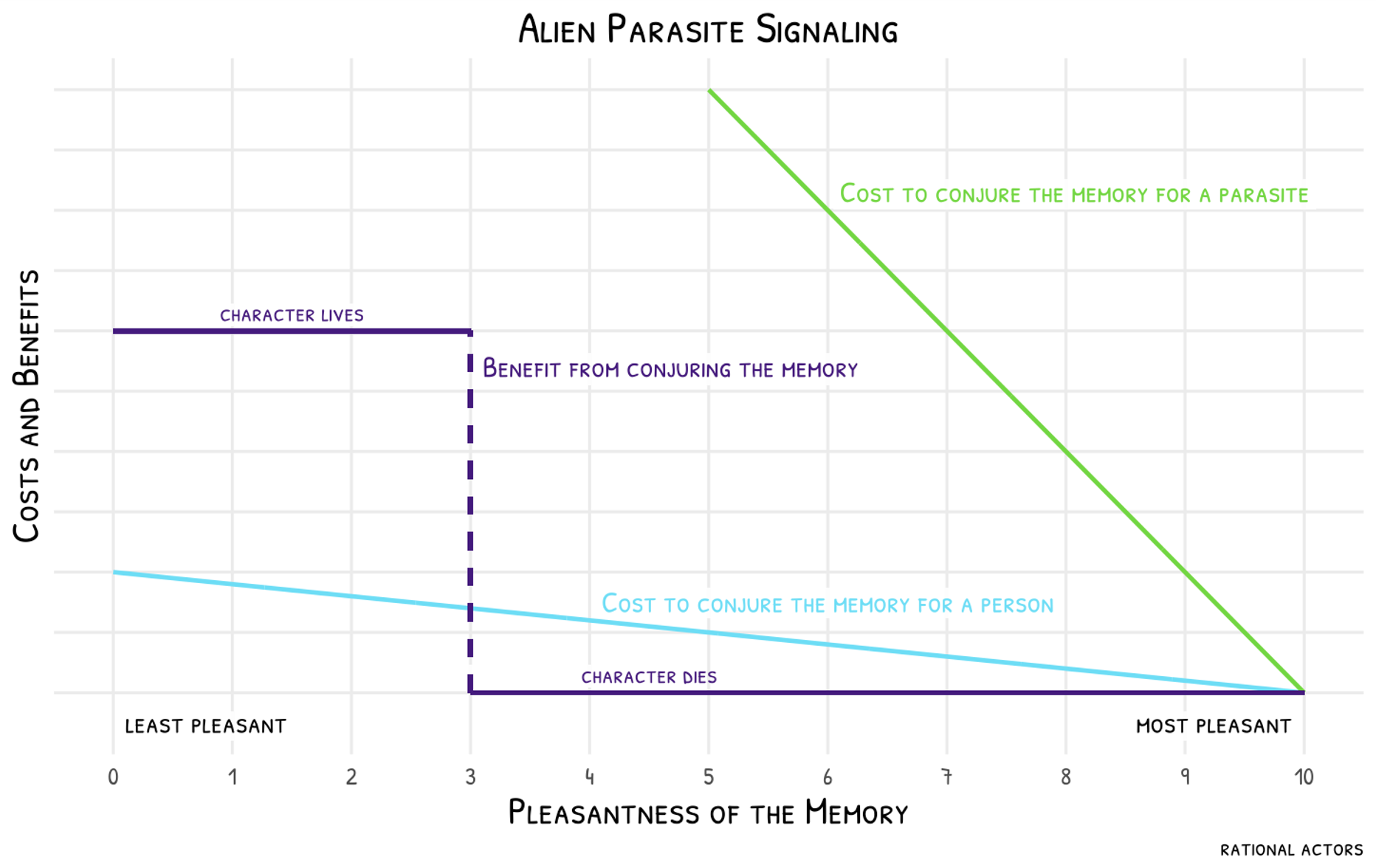
- Assume that memories can be characterized by their pleasantness on a scale of 0 to 10 where 0 is the least pleasant. Characters differ in how costly it is for them to conjure unpleasant memories. For parasites, conjuring a memory that is one point less pleasant is 10 times more costly than it is for real people.11 Perhaps it’s physically impossible for the alien parasites to conjure unpleasant memories. This would be equivalent to infinite costs and would yield the same conclusions as the simplified model.
- Each character interacts with Rick (or someone already deemed real) and chooses what kind of memory to conjure on the 0 to 10 scale.
- Rick’s policy for each interaction is as follows:
- If the conjured memory is unpleasant (between a 0 and a 3), the character lives and receives significant benefits as a family member.
- If the conjured memory is too pleasant (between a 3 and a 10), the character dies and receives no benefits.
- Status in the family, which each character wants to maximize, is defined by benefits minus costs.
The costs and benefits of each character’s choice can be visualized in the following graph:
Each character gets their chance to conjure a memory. Morty conjures a memory of being kicked and threatened by Summer, which clears her. Rick has so many fond memories with Pencilvester, that he gives the character a chance to clear himself.
“Come on, man. Haven’t we ever had an uncomfortable silence or an awkward fart on a road trip?”
But it’s optimal for the parasites, like Pencilvester and Mrs. Refrigerator, to provide pleasant memories and accept their fate. To conjure an unpleasant memory is much too costly. And it’s optimal for the real people to accept the cost of an unpleasant memory to differentiate themselves from the parasites.
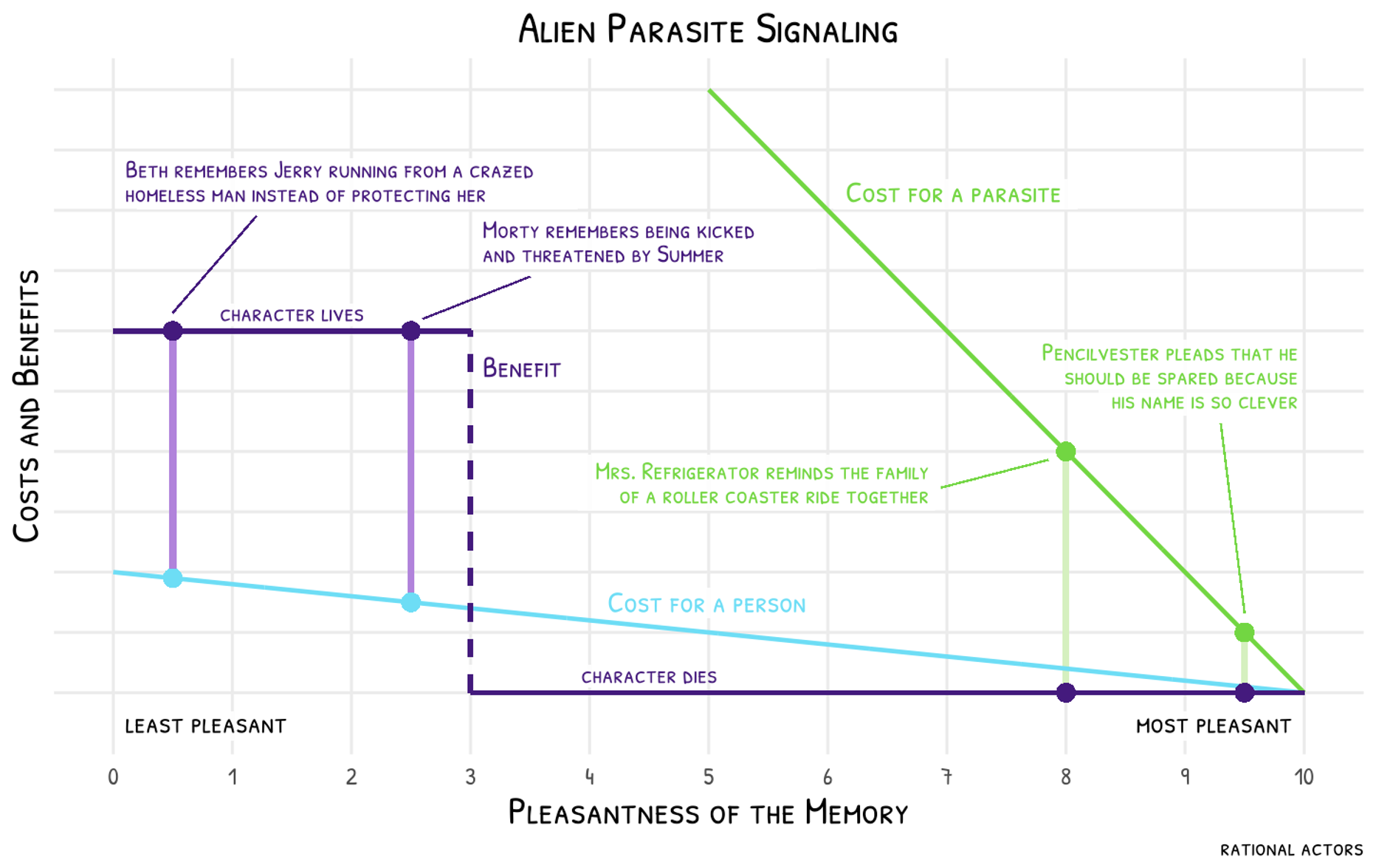
The result is that the real people conjure painful memories and live, while the parasites are unwilling to do so and are killed. But do the real people need to endure such unpleasant memories? Does Beth really need to be reminded of the time that her husband, Jerry, left her to fend for herself while under the attack of a crazed homeless man? These memories are costly. But that’s necessary when sending signals. The easy, pleasant signals are the ones easily replicated by the parasites. The high cost is a feature, not a bug.
These costly signals show up in a variety of settings. Students pay big sums of money for a college degree that separates them from others without highly sought-after skills.22 An active debate exists as to whether education mainly builds skills (the “human capital” view) or mostly serves as a costly way to signal ability (the “signaling” view). Both theories can explain why degrees are valuable, though they imply different effects of expanding access to education or providing government subsidies to education. Companies with high-quality products offer long warranties to signal to customers that their products will last. Companies selling junk would quickly go bankrupt by offering such warranties. Peacocks grow extravagant, mobility-limiting tails to attract mates. Weaker males couldn’t survive with such a burden. In each of these cases, the high cost of the signal ensures its truth.
Costly signals are everywhere. And in the Smith household, they’re the only thing keeping alien parasites at bay.
“And that’s the wa-a-a-ay the news goes”
¹ Perhaps it’s physically impossible for the alien parasites to conjure unpleasant memories. This would be equivalent to infinite costs and would yield the same conclusions as the simplified model.
² An active debate exists as to whether education mainly builds skills (the “human capital” view) or mostly serves as a costly way to signal ability (the “signaling” view). Both theories can explain why degrees are valuable, though they imply different effects of expanding access to education or providing government subsidies to education.