Unethical Consumption
The Office: S4, E1 “Fun Run”
Supply and Demand: Maximum Willingness to Pay
Meredith is in the hospital after Michael ran her over in the parking lot. Dwight goes to visit her, and he has concerns unrelated to Meredith’s wellbeing.
Dwight: “As a farmer, I know that when an animal is sick, sometimes the right thing to do is to put it out of its misery. With the electricity we're using to keep Meredith alive we could power a small fan for two days. You tell me what's unethical.”
Dwight seems to have a priority ranking system for all possible uses of electricity. In a world where electricity has no price, someone like Dwight would need that that to decide who gets how much. But how could they have enough information to do this job well? Prices and markets offer a way out of this difficulty. They offer a different ranking system that nobody needs to build by hand: demand.
Each electricity user (and each use) must have some maximum willingness to pay for a kilowatt hour of electricity. If electricity is priced higher than that, they won’t use it. At high electricity prices, a homeowner may cut back on air conditioning use. But they would likely leave their refrigerator plugged in, because that use is more valuable.
Demand maps out all the possible uses for electricity, ranked by willingness to pay. Then, when an actual price for electricity is known, the high-ranked uses reveal themselves because those consumers will go ahead and use electricity while those with frivolous purposes and low willingness to pay will hold back.
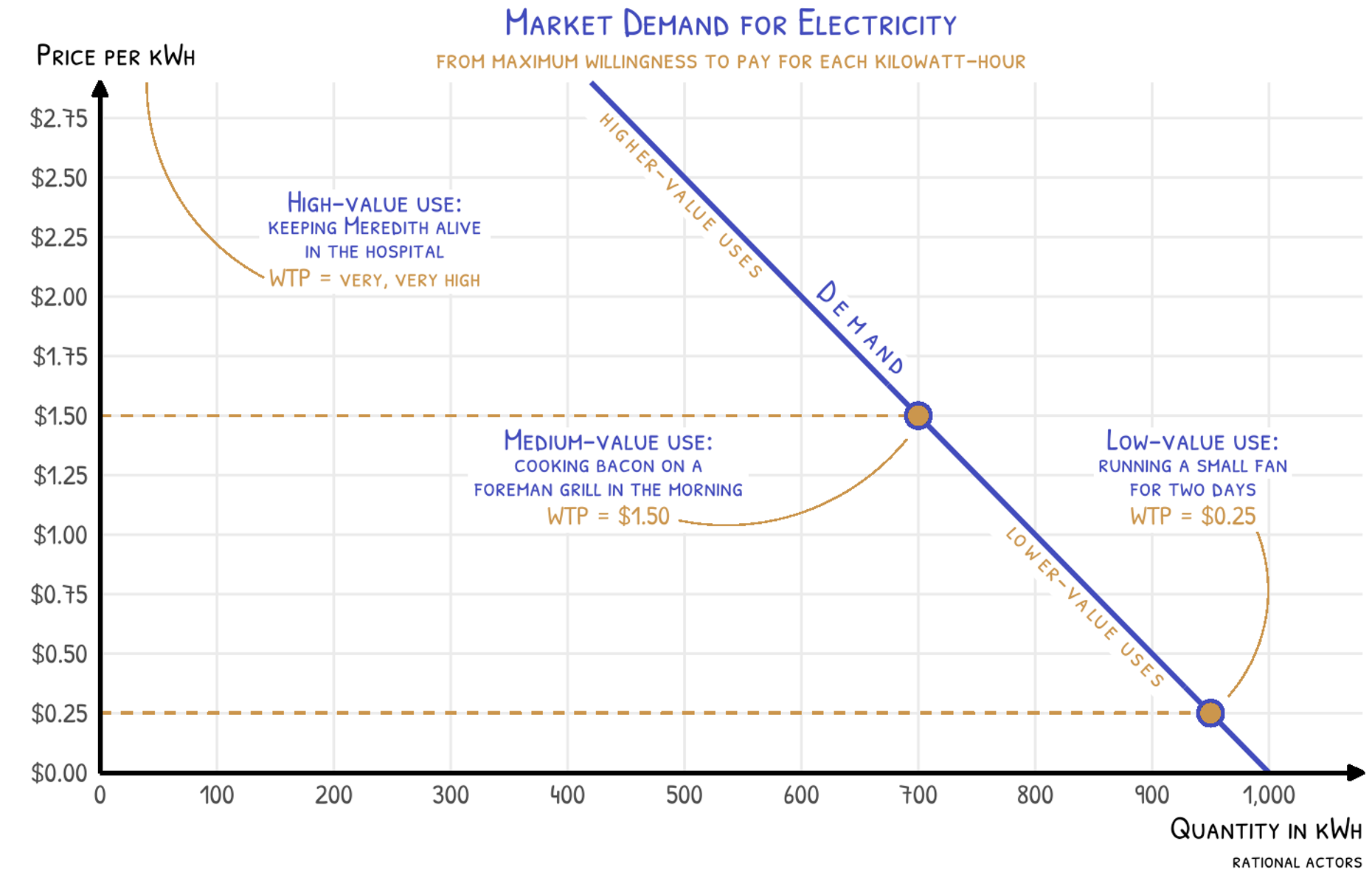
On the actual demand curve, the higher-value uses appear on the top left and the lower-value uses on the bottom right.1 If a kilowatt hour is priced at $1.50, people would demand 700 kilowatt hours for uses they deem important enough.2 The height of the demand curve at any given quantity tracks the willingness to pay of the marginal use.
How does this ranking system compare to Dwight’s? The hospital keeping Meredith alive would be willing to pay a lot more for this electricity than someone running a small fan for two days. So, a market-based system for electricity is more likely to deliver electricity in adequate quantities to the hospital than a system where Dwight is the electricity czar. That seems like a good thing.3
The information that forms this demand-based ranking is aggregated without anyone collecting it. That’s a feature of this mechanism. Imagine a government surveyor from the department of electricity going door to door to ask people about how much they enjoy their various uses for electricity to properly allocate kilowatt hours across the economy. It’s a fool’s errand.4
The demand curve can’t tell Dwight which allocation of electricity is most ethical. But it does reveal that Dwight’s comparison between the two uses is misguided. Life-saving machines provide much more value than small fans as measured by willingness to pay. Each use of electricity has its spot on the demand curve, and the price sorts out actual use. Dwight’s ranking system is not needed, and no amount of surveying would make it work.
Dwight: “Blink once if you want me to pull the plug.”
Meredith: “Don’t pull any plugs.”
1 This ordering is why the demand curve slopes downward, consistent with the law of demand: as the price increases (or decreases), quantity demanded decreases (or increases). It’s commonly assumed for ease of computation that demand is a straight line.
2 Embedded in maximum willingness to pay is an implicit ability to pay as well, which depends on available financial resources. A rich family may have a higher willingness to pay to power a Roomba than a poor family does to power its refrigerator. If the real-world price of electricity is high enough that lower-income families can’t afford it for vital uses, the case for financial redistribution strengthens. Redistribution, rather than price controls, preserves the feature that the good or service is allocated to those who value it the most.
3 Given the current income distribution, allocating electricity to the highest willingness to pay maximizes the total value consumers get from it.
4 Survey responses are cheap talk. Anyone can claim to have a very high value for electricity. Willingness to pay is more credible, because paying is costly. This is how markets reveal trustworthy information about how consumers value goods and services. F.A. Hayek’s key insight in “The Use of Knowledge in Society” also applies here, that this information is local and highly dispersed. Markets and prices aggregate this information in a unique way.

More from The Office:




1 This ordering is why the demand curve slopes downward, consistent with the law of demand: as the price increases (or decreases), quantity demanded decreases (or increases). It’s commonly assumed for ease of computation that demand is a straight line.
2 Embedded in maximum willingness to pay is an implicit ability to pay as well, which depends on available financial resources. A rich family may have a higher willingness to pay to power a Roomba than a poor family does to power its refrigerator. If the real-world price of electricity is high enough that lower-income families can’t afford it for vital uses, the case for financial redistribution strengthens. Redistribution, rather than price controls, preserves the feature that the good or service is allocated to those who value it the most.
3 Given the current income distribution, allocating electricity to the highest willingness to pay maximizes the total value consumers get from it.
4 Survey responses are cheap talk. Anyone can claim to have a very high value for electricity. Willingness to pay is more credible, because paying is costly. This is how markets reveal trustworthy information about how consumers value goods and services. F.A. Hayek’s key insight in “The Use of Knowledge in Society” also applies here, that this information is local and highly dispersed. Markets and prices aggregate this information in a unique way.