Cheaper in January
The Office: S2, E11 “Booze Cruise”
Pricing Strategies: Intertemporal Price Discrimination
Michael’s memo to the office about an upcoming leadership retreat has many scratching their heads.
“It’s time for our first quarter camaraderie event, so pack a swimsuit, a toothbrush, rubber-soled shoes, and a ski mask.”
When their destination is finally revealed, it’s not the most exciting place the staff can imagine going. At least not in the winter.
Michael: “We are going on a booze cruise on Lake Wallenpaupack.”
Stanley: “In January?”
Michael: “It’s cheaper.”
Maybe a swimsuit won’t be necessary. Michael’s appeal to the lower prices leads to deeper questions. Why are these harbor cruises priced so much lower in January than in July? And why don’t all sellers vary their prices over the calendar year or perhaps even hour-to-hour?
To see why, suppose that the ship, the Lake Wallenpaupack Princess, has market power in the sale of harbor cruises on the lake. Maybe the cruise experience offered is difficult to replicate or there is limited docking space for other potential cruise ships. This makes it possible for the company to use intertemporal price discrimination: charging different prices at different times (of the year, week, day, etc.).
The price differences over time depend entirely on demand. When are people most excited and willing to pay high prices for a trip around a lake in Pennsylvania?
For simplicity, imagine the ship takes harbor cruises in July and January and add these features to the model:
- Demand is greater in July. The weather is warmer. People can swim and tan. Being outside is more pleasant.
- Marginal costs, the added costs to the cruise company when more passengers board, are the same in each month. For further simplicity, assume that marginal costs are also constant. Each additional passenger added costs the company an additional $10.11 The more realistic alternative is that marginal costs increase as passengers increase. With increasing marginal costs, January and July prices diverge even further. We may also need to assume that Lake Wallenpaupack doesn’t freeze over in the winter, making January cruises impossibly costly.
The Princess can take advantage of these demand differences by charging different prices in different months as if it’s a different company and/or product in each month. Different companies sell different products at different prices all the time!
Its profit-maximizing prices occur at the point on each demand curve where marginal revenue equals marginal cost. The results of this process are shown below.

Many companies sell their products at the same price year-round. What if the Princess did that? Maybe, for example, they charge $20 every month. At the price, nobody would want to board in January. The Princess is left selling July cruises at less than profit-maximizing prices. That makes little financial sense. And lowering prices even further so that some January cruises can set sail only makes the profitability of July cruises even worse.
Instead, it maximizes annual profits to charge different prices in different months when demand differs so greatly between them. And the month with greater demand gets higher prices.
Why don’t all sellers charge different prices at different times? Surely the demands for many products fluctuate by the month or day or even by the hour, even if they always sell the exact same product. The following features may explain why other sellers may refrain from intertemporal price discrimination:
- Customers begin to anticipate price changes and respond accordingly. A sandwich shop with lower prices at 11 a.m. and higher prices at noon leads diners to move up their lunch schedule for the cheaper sandwich. Because the Princess sells a different (and to most people, worse) product in January, high-demand customers will refrain from buying January cruises. Only the stingy, low-demand customers (like Michael) will snap up seats in the cold months.
- Their product can be resold. A video game company raises its prices from $60 to $80 during the Christmas season to take advantage of the high seasonal demand. But clever gamers (or even non-gamers) buy up large quantities of the discs or access codes in August, wait for the game’s prices to increase in November, then resell the previously purchased games at $75. The gaming company then gets very few high-demand customers. Reselling a seat on a cruise is just not possible, unless the Princess sold access through fully transferable tickets, which seems unlikely and easily fixable.
- Customers view price differences as unfair, lowering brand reputation and harming customer goodwill. A concert venue charges $500 the first day that tickets are on sale to take advantage of the high demand of superfans, then lowers the price to $100 the next day. The superfans feel taken advantage of and view it as unfair to pay more than the concertgoers who will sit right next to them at the show. Their demand for future concerts decreases drastically. The Princess can likely avoid this. Everyone (except Michael?) can see that a January cruise is a worse product. And customers generally expect lower prices for lower-quality goods and services. Resentment avoided.
A January harbor cruise gets around these hurdles because its product is different (and worse). But many bars pull this off with the exact same product, charging low prices at 4 pm and high prices just two hours later. Resale is nearly impossible. Patrons can’t easily get off work early for the discount drinks. And the marketing trick of framing the low price as “happy hour” seems to quell customer backlash.
So, the Lake Wallenpaupack Princess raises its annual profit with different prices by the month and avoids the snags that prevent many other companies from following its example. But aren’t they losing money on January cruises if customers are only pitching in $15 each?
Profit in each month can be measured by Profit = (P – ATC)*Q where Q is the number of passengers, P is the price charged to each passenger, and ATC is the average total cost at Q.22 This formula comes from Profit = Total Revenue – Total Cost where Total Revenue = P*Q and Total Cost = ATC*Q. The Princess will have positive profits for the month if P > ATC and losses if the opposite is true.
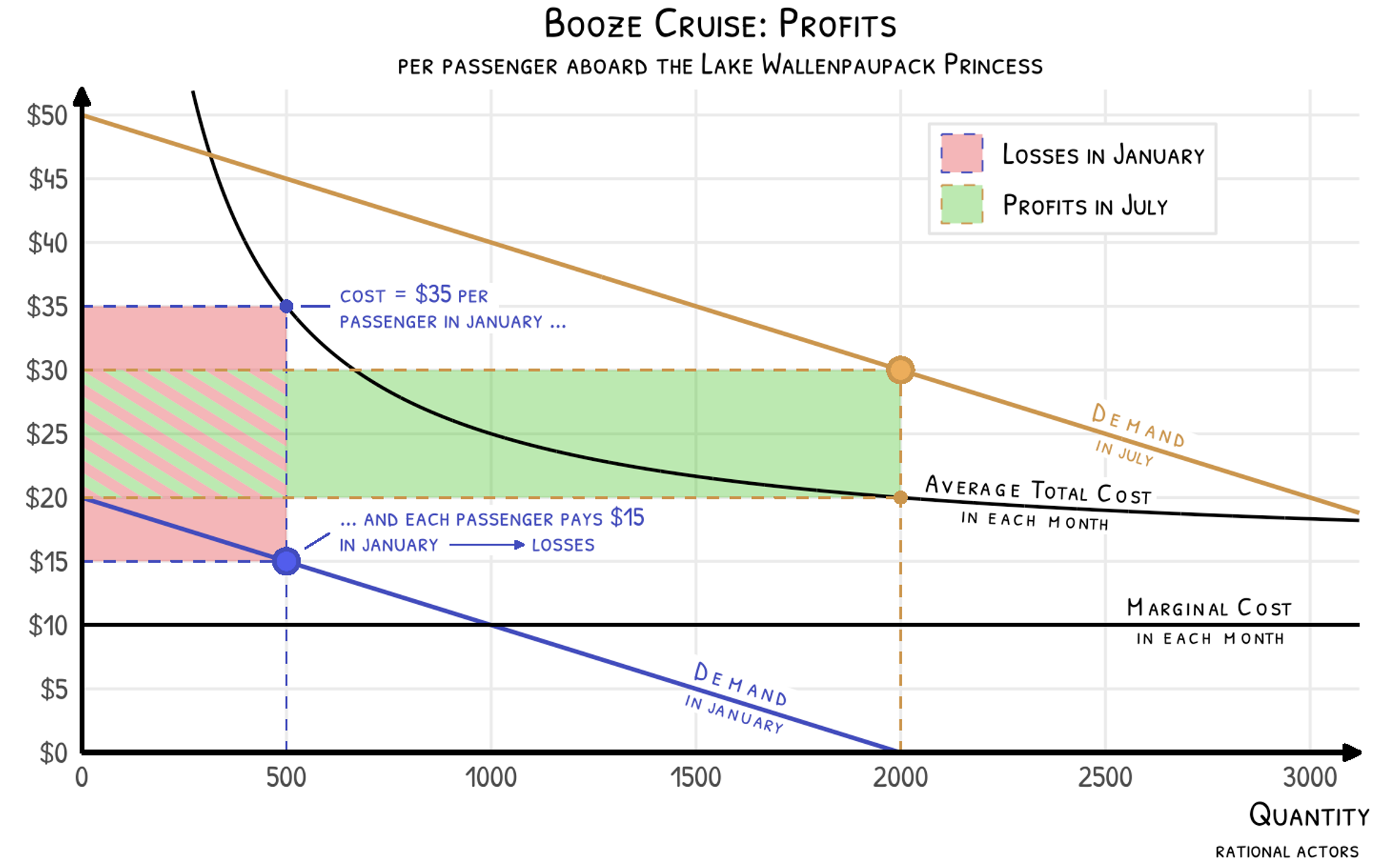
In this case, the Princess makes a $20,000 profit in July but suffers a $10,000 loss in January. In the winter month, its $7,500 in revenue is overwhelmed by:
- $5,000 in variable costs that accrue from letting 500 customers on board
- $12,500 in fixed costs that get paid regardless of the number of customers, things like capital payments on the ship, mooring fees, ship maintenance, and insurance premiums
Given the losses, wouldn’t the Princess be more profitable overall by shutting down in January and only selling summer cruises? In this case, the answer is a resounding “No!” Shutting down saves $5,000 in costs but forfeits $7,500 in revenue. It saves so little in the cost category because the $12,500 in fixed costs show up in the books whether they operate or not. If the Princess shuts down, its January profit would be a $12,500 loss. That’s even worse.33 Some costs labeled as “fixed” may be more accurately described as “quasi-fixed” costs: costs that don’t vary with the quantity produced but can be avoided if production ceases entirely. For example, the company may be able to avoid paying mooring fees by taking the ship out of the lake in January. These quasi-fixed costs would then factor into decisions to operate or shut down. While truly fixed costs are sunk (in the sense that they will be paid either way), quasi-fixed costs are not yet sunk.
It’s only in the ship’s best interest to shut down if the total revenue from operating (at the month’s profit-maximizing price) is less than the month’s variable costs.44 In the case of constant marginal costs, as we have assumed here, this means the ship would shut down if its profit-maximizing price is less than $10. Its losses would become bigger each time an additional customer boards. The Lake Wallenpaupack Princess is out on the lake year-round because it maximizes annual profit by doing so. Especially because it can charge different prices by the season.
I hope you learned as much about economics from this episode as you did about effective management.
“Leader...ship. The word ‘ship’ is hidden inside the word ‘leadership,’ as its derivation. So, if this office is, in fact, a ship, as its leader, I am the captain. But we're all in the same boat. Teamwork!”
1 The more realistic alternative is that marginal costs increase as passengers increase. With increasing marginal costs, January and July prices diverge even further. We may also need to assume that Lake Wallenpaupack doesn’t freeze over in the winter, making January cruises impossibly costly.
2 This formula comes from Profit = Total Revenue – Total Cost where Total Revenue = P*Q and Total Cost = ATC*Q.
3 Some costs labeled as “fixed” may be more accurately described as “quasi-fixed” costs: costs that don’t vary with the quantity produced but can be avoided if production ceases entirely. For example, the company may be able to avoid paying mooring fees by taking the ship out of the lake in January. These quasi-fixed costs would then factor into decisions to operate or shut down. While truly fixed costs are sunk (in the sense that they will be paid either way), quasi-fixed costs are not yet sunk.
4 In the case of constant marginal costs, as we have assumed here, this means the ship would shut down if its profit-maximizing price is less than $10. Its losses would become bigger each time an additional customer boards.