Customer Service, This is Kevin
The Office: S3, E21 “Product Recall”
Comparative Advantage and Trade: Increasing Opportunity Costs
Dunder Mifflin is in crisis. Five hundred boxes of paper with an obscene watermark have been shipped out to loyal customers. As a result, their phones are ringing off the hook. The office is not prepared for this. Kelly is their only customer service representative on a day-to-day basis. So, Michael calls others into action.
“We have a lot of angry customers out there. This puts us at threat level midnight. Accounting, you are on customer service duty today.” - Michael
“That’s really not our job.” - Oscar
“Midnight, Oscar!” - Michael
Kelly provides brief training to the accountants: Kevin, Oscar, and Angela. Kelly points out that the three accountants may not be particularly suited to a customer-facing job.
“Look, I know the reason that you guys became accountants is because you're not good at interacting with people. But guess what? From now on, you guys are no longer losers!” - Kelly
“I wonder how many phone calls you’re missing while you’re teaching us to answer calls.” - Oscar
Oscar is already thinking about opportunity costs. He’s onto something.
But the most crucial part of this exchange is the acknowledgement of different skills among the Dunder Mifflin staff. On a day like this, it may suit the company to have four workers just like Kelly on the staff. But on a day-to-day basis, the different skills across all workers allow Dunder Mifflin to accomplish so much more.
To model this, suppose that Dunder Mifflin has two primary outputs: customers saved (typically done by customer service reps) and accounts reconciled (typically done by accountants).11 This is a simplifying assumption to allow us to compare the production of the four workers mentioned so far: Kelly, Kevin, Oscar, and Angela. The same conclusions reached here apply to the broader list of outputs which includes the sale of paper and delivery of it as well as the larger set of workers at their disposal. Each worker is on the clock for 8 hours each day. And their productivity towards saving disgruntled customers or reconciling accounts can be described by the time it takes them to accomplish one of those things.
Kelly
Kelly is the most talkative person in the office. She was made for answering phones and helping customers. It takes Kelly only 15 minutes to save one customer. But because she has no accounting training, it would take her four hours to reconcile a single account.
- 1 customer saved costs 15 minutes and 15 minutes could be used to reconcile 1/16th of an account
Kevin
Kevin is an actual accountant, but hardly their best. It takes 2 hours for Kevin to reconcile an account. But his calm demeanor lends itself to customer service. He could save a customer in an hour.
- 1 customer saved costs 1 hour and 1 hour could be used to reconcile 1/2 of an account
Oscar
Oscar is a fantastic accountant. He can reconcile an account in 30 minutes. And he has a similar aptitude for customer service as Kevin, saving one customer for every hour worked there.
- 1 customer saved costs 1 hour and 1 hour could be used to reconcile 2 accounts
Angela
Angela is just as quick with accounts as Oscar. She can reconcile an account in 30 minutes. But she lacks for people skills and is not at all suited for customer service. She can only save one customer for every four hours of work on the phones.
- 1 customer saved costs 4 hours and 4 hours could be used to reconcile 8 accounts
As Michael assigns each worker to combinations of the two tasks, their daily outputs can be visualized with a production possibilities frontier (PPF). The slope of each PPF is equal to the opportunity cost of saving one more customer in terms of accounts reconciled.22 The slope is negative, because producing more of one output requires less of the other.

Kelly has the lowest opportunity cost of saving customers. As she is asked to do more customer service, the office misses out on very few reconciled accounts. Angela is the opposite. Because of her lack of people skills (and aptitude for accounting), each additional customer saved takes a lot of her valuable time. Time that could have been used to reconcile many accounts.
If Michael assigns them all to the accounting department, they could reconcile a total of 38 accounts in a day.33 That’s 2 from Kelly, 4 from Kevin, 16 from Oscar, and 16 from Angela. And in a customer service emergency, they could save a combined 50 customers. But most days do not call for production at these extremes.
To map out the combined Dunder Mifflin PPF as a combination of all the individual production possibilities, consider who Michael will call upon as the office needs to start saving customers. If Dunder Mifflin wishes to produce as much as possible, it should be Kelly who springs into action first. Her opportunity cost for saving customers is the lowest of the four. To call upon any of the other three would mean accepting the loss of a greater number of accounts reconciled.
As the office handles more calls from customers, they are all assigned to Kelly. Therefore, in the combined PPF, the initial slope is the same as in Kelly’s individual PPF. But there’s a limit to what Kelly can do in a day: saving 32 customers. Once the call volumes exceed that number, Kevin must be next. That’s because Kevin has the next lowest opportunity cost. Kevin can save 8 customers in a full day’s work. Once the total exceeds 40, it’s time to shift Oscar to customer service. And by the same logic, once the total exceeds 48, Angela must be called into action.
This process leads to a bowed out PPF as visualized below.
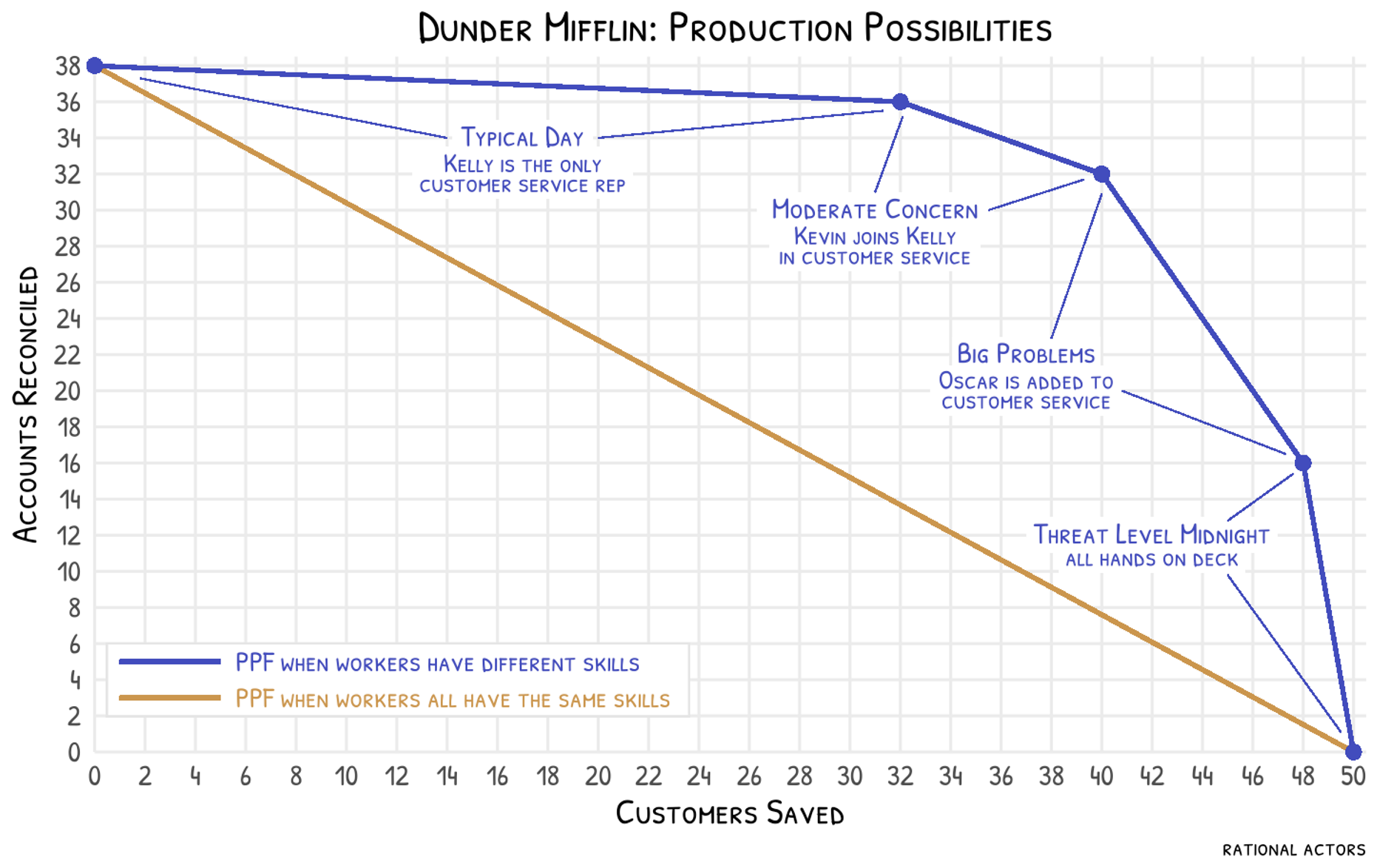
Notice how the slope of the Dunder Mifflin PPF becomes steeper as the office needs to save more and more customers. This is an example of increasing opportunity costs. As the staff scrambles to save a greater number of customers, it sacrifices a greater number of accounts reconciled. Because even Angela must be shifted to customer service, the costs of this watermark incident go well beyond the loss in future sales.
And yet the diversity of skills in the office is more of a feature than a bug. If these four workers were each identical (and thus perfectly substitutable between tasks), the PPF would be a straight line, and the possible production levels of Dunder Mifflin would be far more limited. The diversity of their skills is a massive strength for the office!
But this overall productivity boost requires specialization. In a typical day, Kelly is only handling the customer service line. And if the threat level doesn’t reach midnight, all of Angela’s time is dedicated to accounting. Workers specialize and rarely cross over into different areas. This leads to a division of tasks based on where opportunity costs are the lowest and maximizes the paper company’s outputs.44 The same story occurs beyond a single workplace. People are sorted into the kinds of jobs that they are comparatively better at and specialize in that job. This leads to an economy with greater production of goods and services. But in this case they are not sorted into roles by a branch manager of a regional paper supply company, but by the price (wage) mechanism in labor markets.
Opportunity costs are the differentiating factor. It’s not about “can they do this task?” it’s about “how much is given up if they do this task instead of another?”. So, even if the task at hand is relatively simple, not just anyone should be doing it.
“All you need to know how to do is pick up the phone and say, ‘Customer Service, this is Kelly!’ Except don't say ‘Kelly,’ say your own name.”
1 This is a simplifying assumption to allow us to compare the production of the four workers mentioned so far: Kelly, Kevin, Oscar, and Angela. The same conclusions reached here apply to the broader list of outputs which includes the sale of paper and delivery of it as well as the larger set of workers at their disposal.
2 The slope is negative, because producing more of one output requires less of the other.
3 That’s 2 from Kelly, 4 from Kevin, 16 from Oscar, and 16 from Angela.
4 The same story occurs beyond a single workplace. People are sorted into the kinds of jobs that they are comparatively better at and specialize in that job. This leads to an economy with greater production of goods and services. But in this case they are not sorted into roles by a branch manager of a regional paper supply company, but by the price (wage) mechanism in labor markets.