How Many Managers?
The Office: S6, E16 “The Manager and the Salesman”
Production and Costs: Cost Minimization
Dunder Mifflin is now part of Sabre. The company’s CEO, Jo Bennett, is having a look around the office to take stock of who does what.
Jo: “Who is this tall drink of sun tea?”
Gabe: “That is Jim Halpert, co-regional manager of this office.”
Jo: [pointing to Michael] “I thought this guy was the manager.”
Gabe: “Oh, he is. He’s the co-manager and that’s the other co-manager.”
Jo: “Two guys doing one job? We gotta do something about that.”
Two managers? She can hardly believe her ears. Jim and Michael do their best to convince Jo that this setup is for the best, but she is not having it.
Jo: “I think one of you should return to sales, and the other one be manager.”
But is it so obvious that the office should have one fewer manager and one more salesperson? Why not go the other way and promote Dwight to be a third manager? How does a CEO make this decision?
We can model this situation as a cost minimization problem given that the office has a certain number of clients to serve. Assume that the production process involves two variable inputs: the number of managers (M) and the number of salespeople (S). And assume that the office can choose fractional amounts of both, perhaps by adjusting work hours or partially reassigning duties, so that M and S are continuous variables.
The first step is to model the production process. Define the output (Q) as the number of clients the office serves. How do combinations of managers and salespeople affect output? Assume the following production function:
$$Q = 90\frac{M}{1+M}S^{0.75}$$
where the functional form is chosen for the following characteristics:
- The multiplier, 90, helps scale the output to realistic levels for the office.
- The office must have both types of workers to serve any clients. If M = 0, then Q = 0, even if there are a million salespeople. And if S = 0, no amount of managers will help either.
- Both inputs are subject to diminishing marginal returns. Adding more of one input (holding the other input fixed) is decreasingly helpful.
For any number of clients the office may need to serve, there exist countless possible combinations of managers and salespeople that would allow for that. The figure below visualizes this with isoquants: curves connecting possible combinations of the two inputs that lead to the same output.1
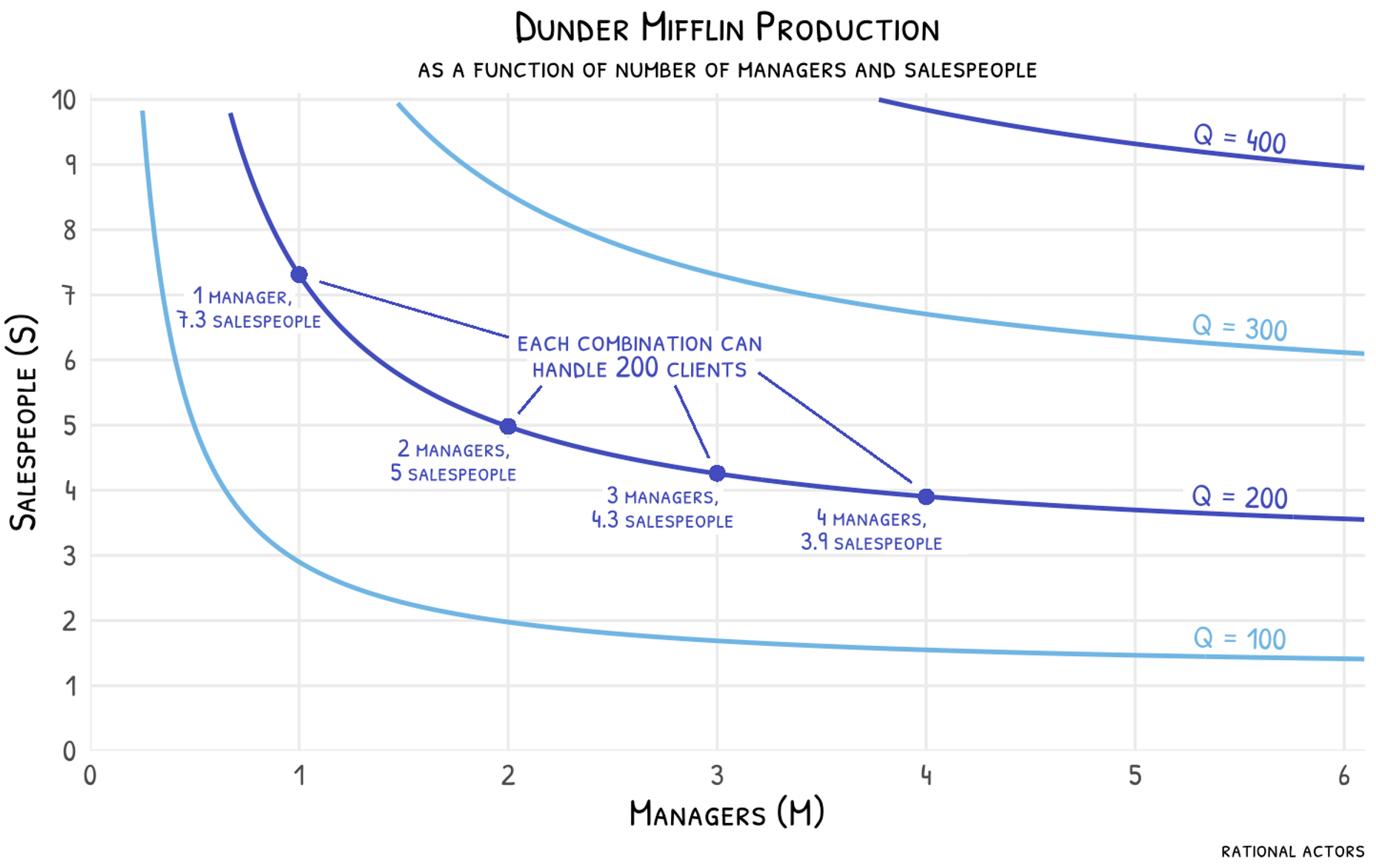
Suppose the office’s main constraint in choosing combinations of managers and salespeople is that it must be able to serve 200 clients.
Jo’s decision about how best to do that depends on each input’s marginal product: the additional output generated by using one additional unit of an input. These can be found by taking the partial derivative of the production function with respect to the input of interest.
$$MP_{M} = \frac{90S^{0.75}}{(1+M)^{2}} \;\;\;\;\;\; MP_{S} = \frac{67.5M}{(1+M)S^{0.25}}$$
The slope of an isoquant at any single point is the marginal rate of technical substitution: the number of salespeople that can be reduced when adding an additional manager without changing the level of output.2 The marginal rate of technical substitution (MRTS) is equal to the ratio of marginal products.3
$$MRTS_{MS} = \frac{MP_{M}}{MP_{S}} = \frac{4S}{3M(1+M)}$$
If the office must continue serving its 200 clients, its task simplifies to choosing the least costly combination of managers and salespeople that still allows for that. Assume the following:
- Sabre competes for salespeople and managers in a competitive labor market and pays market rate salaries for its managers and salespeople.
- The pay for a manager is $92,000.
- The pay for a salesperson is $40,000.4
Cost minimization means searching along the isoquant at the output of interest, Q = 200, for the mix of inputs with the lowest costs. This process is visualized below, keeping the isoquant for Q = 200 and adding isocost lines which show all combinations of managers and salespeople with the same costs.

When Sabre acquires Dunder Mifflin, the branch’s mix of managers and salespeople is at point A: 2 managers and 5 salespeople.5 And the following are true at point A:
- PayM / PayS = 2.3 … managers cost 2.3 times more than salespeople, which would be fine if the marginal managers were 2.3 times as productive as the marginal salesperson. The slope of each isocost line is -2.3, the ratio of manager pay to salesperson pay.
- MPM = 33.44 and MPS = 30.09 … so the marginal manager is only 1.1 times as productive as the marginal salesperson. The slope of the isoquant at point A is -1.1, the marginal rate of technical substitution.
These numbers imply that Dunder Mifflin could reduce the number of managers (which increases MPM due to decreasing marginal product) and increase the number of salespeople (which decreases MPS due to decreasing marginal product) to maintain its output at a lower cost. At the cost-minimizing mix of managers and salespeople, the slope of the isocost line must equal the slope of the isoquant. Therefore, the following must be true:
$$\frac{\color{#3f4cc4}{MP_{M}}}{\color{#3f4cc4}{MP_{S}}} = \frac{\color{#d5933c}{Pay_{M}}}{\color{#d5933c}{Pay_{S}}}$$
or by rearranging,
$$\frac{\color{#3f4cc4}{MP_{M}}}{\color{#d5933c}{Pay_{M}}} = \frac{\color{#3f4cc4}{MP_{S}}}{\color{#d5933c}{Pay_{S}}}$$
This condition says that to be minimizing costs, the office’s marginal return on investment (how much output the office gets from the last unit of input divided by how much it costs to get that) should be equal across worker types. In addition to sales and management, Sabre has an accounting department, quality assurance, customer service, and human resources in the office. To minimize costs, those department sizes would be determined by a similar rule.
$$\frac{\color{#3f4cc4}{MP_{Management}}}{\color{#d5933c}{Pay_{Management}}} = \frac{\color{#3f4cc4}{MP_{Sales}}}{\color{#d5933c}{Pay_{Sales}}} = \frac{\color{#3f4cc4}{MP_{Accounting}}}{\color{#d5933c}{Pay_{Accounting}}} = … $$
Does Jo Bennett really have a mathematical production function that she’s taking partial derivatives from to reach her conclusions? Of course not. The real insight of the model is that cost minimizing decisions happen on the margin. What effect would moving one of your managers to sales have on productivity? And what effect does it have on costs? The answers to both questions must be considered together.
In this situation, the second manager is not productive enough on the margin to justify the higher pay. Sabre can do better by reducing the management staff and adding to sales. And if the optimal mix calls for 1.42 managers? Not a problem. The office just needs an assistant (to the) regional manager.
Now the only thing left to do is decide who goes to sales and who stays in management.
Michael: “I have been saying the word ‘manager’ a lot, so whenever Jo thinks ‘manager’ she thinks of me.”
1 The diminishing marginal products of each input generates convex isoquants and guarantees an interior cost-minimizing solution.
2 Or, going in the other direction, the number of additional salespeople needed to maintain the same output if reducing the number of managers by one.
3 This can be found by totally differentiating the production function at a fixed quantity.
4 The pay difference reflects the exclusion of commissions for salespeople, which increase with new client acquisition rather than client retention. Since the office’s task here is to serve its existing 200 clients at minimum cost, only base salaries and the commissions for this relatively small number of clients are considered.
5 Technically, with this production function, 2 managers and 5 salespeople serves 200.6 clients, not 200. Close enough!

More from The Office:



1 The diminishing marginal products of each input generates convex isoquants and guarantees an interior cost-minimizing solution.
2 Or, going in the other direction, the number of additional salespeople needed to maintain the same output if reducing the number of managers by one.
3 This can be found by totally differentiating the production function at a fixed quantity.
4 The pay difference reflects the exclusion of commissions for salespeople, which increase with new client acquisition rather than client retention. Since the office’s task here is to serve its existing 200 clients at minimum cost, only base salaries and the commissions for this relatively small number of clients are considered.
5 Technically, with this production function, 2 managers and 5 salespeople serves 200.6 clients, not 200. Close enough!