Salaries of the Severed
Severance: S1, E1 “Good News About Hell”
Labor Markets: Compensating Differentials
At Lumon Industries, there are jobs that are apparently sensitive enough to require workers to undergo a special procedure. Helly R is one such worker, and while on the job (as an innie), she learns about this from her outer self (her outie) in a video.
“I have, of my own free accord, elected to undergo the procedure colloquially known as severance. I give consent for my perceptual chronologies to be surgically split, separating my memories between my work life and my personal life. I acknowledge that henceforth, my access to my memories will be spatially dictated. I will be unable to access outside recollections whilst on Lumon’s severed basement floor, nor retain work memories upon my ascent. I am aware that this alteration is comprehensive and irreversible.”
There are at least four workers on the severed floor, including Mark S. While Mark’s outer self is at a dinner party, other guests allude to ethical concerns about his choice to undergo the severance procedure to take the job.
“The point is that Mark made a decision. And that decision was controversial, ethically and socially. Morally. Scientifically.”
It’s clear that Lumon also has regular office workers: no moral quandaries there. So, why did Mark take this position? Why does anyone, given the downsides? Their outies will gain no friends through work. They will have eight-hour gaps in their lives every workday. The procedure may have risks. Even if they can’t remember what happens at work, what if they get injured there? Those injuries would stay with them when they leave.
We may find some clues by analyzing these office jobs, some severed and some not, through supply and demand in a labor market. The supply side is made up of people considering whether to take a job and offer (sell) their time, energy, and skills. And they compete with other potential workers to get these jobs.
Suppose Lumon offers a salary of $60,000 (and perhaps other benefits as well) to all its office workers, both severed and otherwise. Given the way that the dinner guests talk about severance, it seems likely a lot fewer people would want to take a job on the severed floor than take a normal job upstairs. And the same would be true at salaries other than $60,000 as well. Because workers are the sellers in a labor market, this idea translates as a greater supply of regular workers than of severed workers.
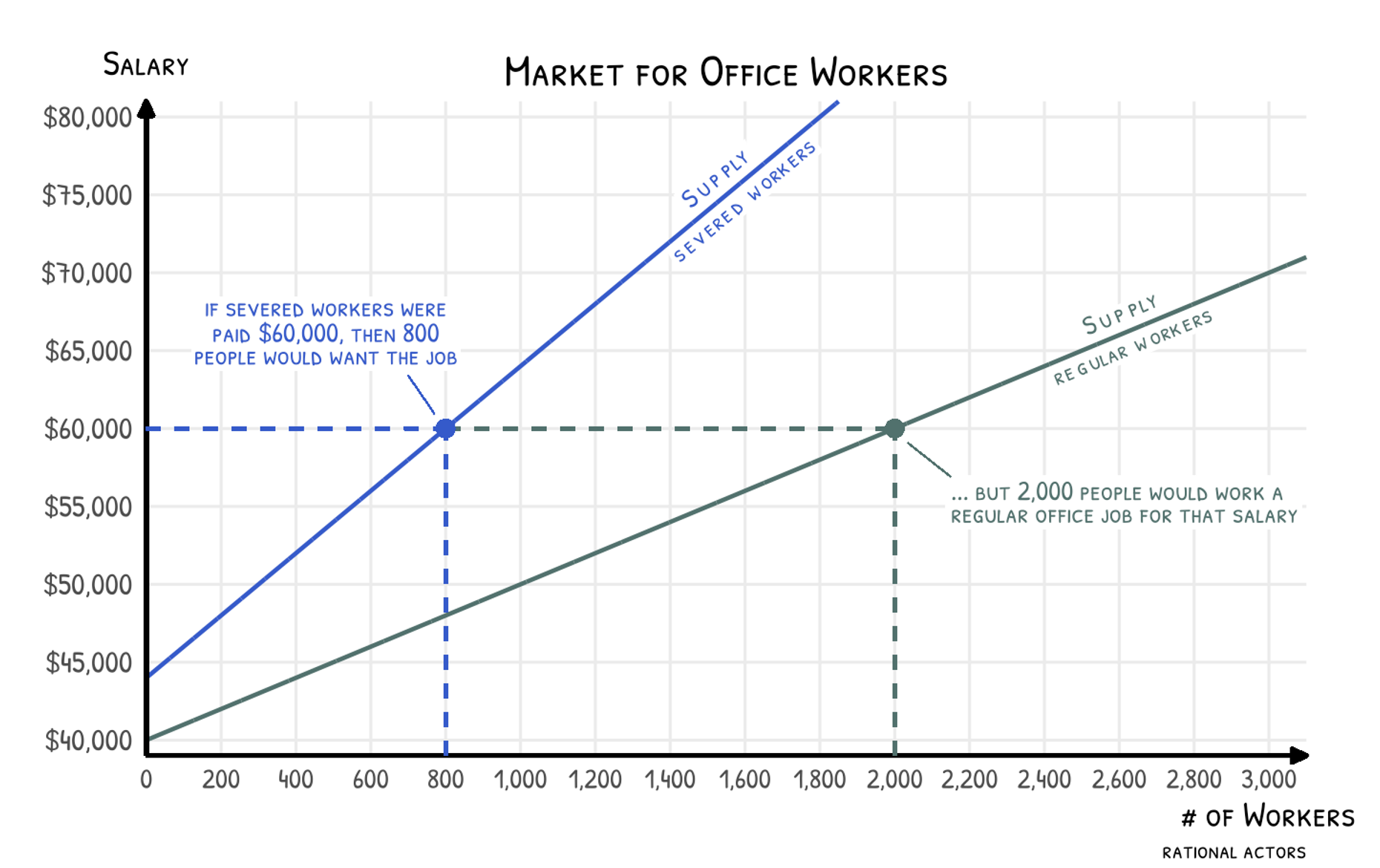
For example, perhaps 800 workers would be willing to take a severed job at a salary of $60,000. But 2,000 would take a regular office job at that salary. At higher salaries, there are more people willing to take both types of jobs, but there are always fewer applicants for severed positions at any given salary.
On the demand side are businesses, like Lumon, that hire office workers. At relatively low salaries, the businesses would want to hire lots of workers. But competition between each other often leads them to offer higher salaries than they otherwise would.
Suppose the demand for severed workers is the same as the demand for regular office workers.1 This assumption will allow us to highlight the effect of the severance procedure on the market for office workers while holding all else equal.
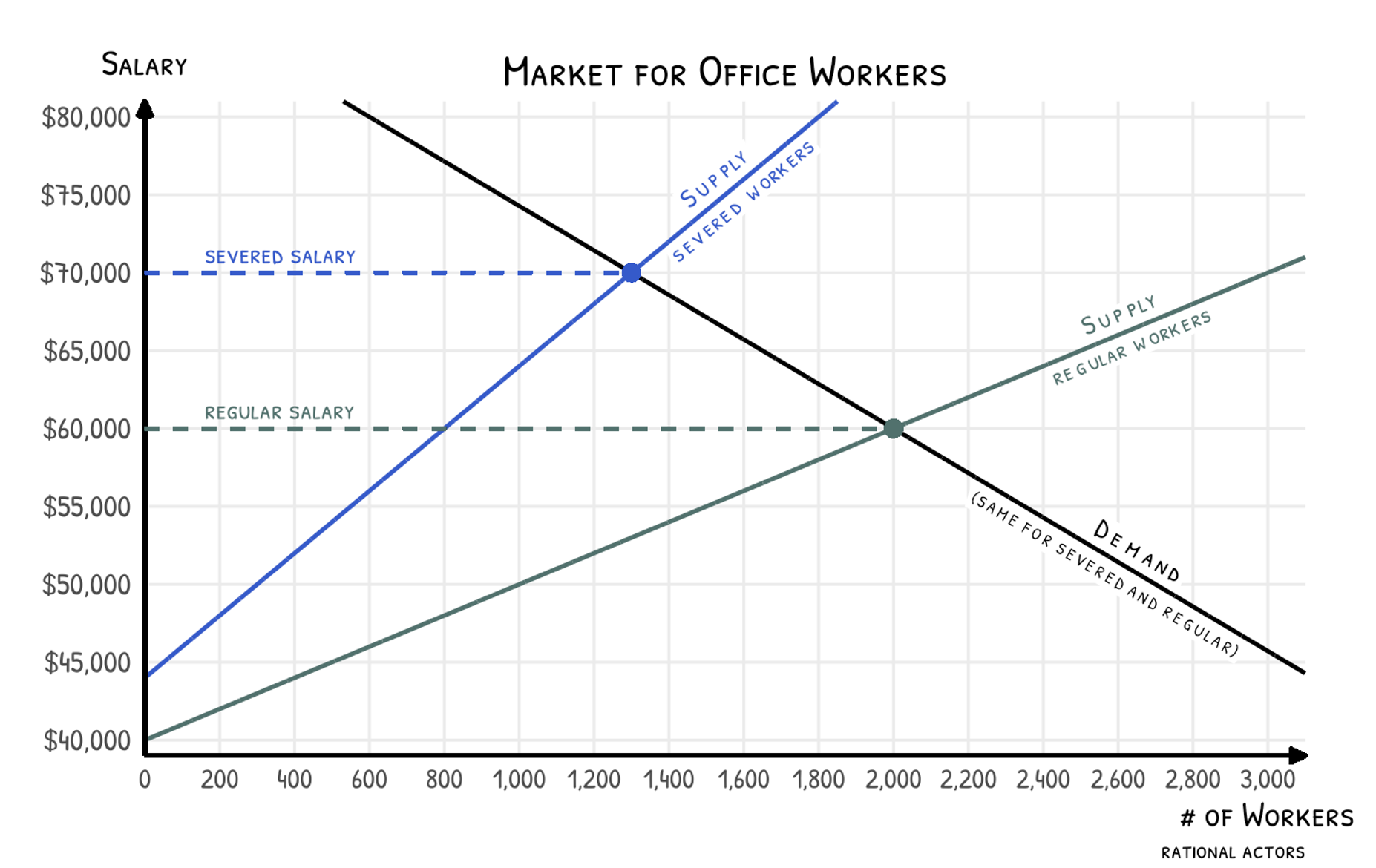
In this market, regular office workers earn a $60,000 salary. And perhaps Lumon would prefer to pay severed workers the same salary. After all, they are not a charity. But at that salary, only 800 people want a severed job even though employers would like to hire 2,000 severed workers. As a result, employers compete to lure hard-to-find workers by increasing salaries. And existing employees would easily be able to negotiate raises knowing they are among a minority of people willing to take such a position.2
This process pushes the salaries of the severed all the way up to $70,000, a 17% pay bump compared to the office workers who remember what they did at work when they go home. The pay difference is called a compensating differential: an increase in pay to compensate for a job’s undesirable qualities. We even see this play out on a small scale in this very episode: Mr. Milchick gives Mark a gift card to Pip’s Bar & Grille to compensate for the wound on his head.
The same forces affect the salaries of real-world jobs too. These forces boost the pay of high-seas fishermen, loggers, oil rig workers, morticians, and other workers with jobs that have requirements or conditions that many people are not willing to accept. On the flip side, desirable job conditions of musicians, sportswriters, and video game testers compensate for the low salaries.
This feature of labor markets also provides clear advice for job seekers looking for an occupation they would enjoy that also pays well. The advice: find a job with characteristics that you can easily tolerate even though most others cannot. That’s why Mark is at Lumon. The severance procedure and 8-hour gaps in his day are features, not bugs. Yet he gets compensated as if they are bugs, because for most people they are.
Does the higher compensation let Lumon off the hook for such controversial working conditions? Perhaps not. Conditions in the basement severed floor may be much worse than anyone knows. If known, supply would further decrease and Lumon would be forced to compensate even more. But the severance feature prevents any potential mistreatment from becoming public knowledge. And they clearly have an incentive to keep it that way.
“You know my mother was an atheist. She used to say there was good news and bad news about hell. The good news is, hell is just the product of a morbid human imagination. The bad news is, whatever humans can imagine they can usually create.”
¹ It is possible that demand for severed workers is much higher than for regular workers. Maybe the work the innies do is extremely valuable to Lumon and other employers. It’s also possible that the demand is much lower, perhaps because the value of additional severed workers diminishes very quickly. Either way, there would be effects of these differences on prevailing salaries.
² What if Lumon is the only company that severs? In that case, they may have some monopsony power in the market for severed office workers. But that would not necessarily change this analysis entirely. In a pure monopsony, the monopsonist is truly the only potential employer for a group of workers, such as the only coal mine in a small town that hires coal miners. But Lumon still competes for workers with other businesses, given that jobs on the severed floor seem to involve no special requirements or skills. And within a monopsony model, the relationship between the repugnance of the job and the salaries offered to the workers would be similar. A monopsonist hiring workers to undesirable positions would still find it in their best interest to compensate with higher pay.

More from Severance:


¹ It is possible that demand for severed workers is much higher than for regular workers. Maybe the work the innies do is extremely valuable to Lumon and other employers. It’s also possible that the demand is much lower, perhaps because the value of additional severed workers diminishes very quickly. Either way, there would be effects of these differences on prevailing salaries.
² What if Lumon is the only company that severs? In that case, they may have some monopsony power in the market for severed office workers. But that would not necessarily change this analysis entirely. In a pure monopsony, the monopsonist is truly the only potential employer for a group of workers, such as the only coal mine in a small town that hires coal miners. But Lumon still competes for workers with other businesses, given that jobs on the severed floor seem to involve no special requirements or skills. And within a monopsony model, the relationship between the repugnance of the job and the salaries offered to the workers would be similar. A monopsonist hiring workers to undesirable positions would still find it in their best interest to compensate with higher pay.