Because I’m Severed?
Severance: S2, E2 “Goodbye, Mrs. Selvig”
Labor Markets: Discrimination
After being fired from Lumon, Dylan is interviewing with a door company, Great Doors, and everything is going very well. He even convinces the interviewer that he’s been interested in doors since the age of five. But all pleasantness disappears after Dylan clarifies that he previously worked on Lumon’s severed floor. The interviewer is no longer interested.
Interviewer: “Well, Mr. George, thanks for coming in.”
Dylan: “What?”
Interviewer: “We’ll consider your application thoroughly.”
Dylan: “That’s it? Just because I’m severed?”
Interviewer: “Like I said, we’ll consider your application thoroughly.”
Dylan: “Okay. You’re not considering me at all. That’s discrimination.”
Indeed, Dylan is being treated differently based on a personal characteristic. This is textbook labor-market discrimination.1 If this discrimination extends beyond this one door company, what happens to Dylan, Irving, and other severed job seekers?
To answer this question, we can model the market for clerical office work as follows:
- There are many different businesses seeking to hire office workers.2
- There are two types of workers: severed (like Dylan) and regular.
- The severance procedure has no effects on outies and their productivity in other jobs. Therefore, severed workers and regular workers are equally productive and are perfect substitutes for any hiring firm.3
- The price in this market is a salary.4
An equilibrium emerges where the number of office workers willing to work equals the number of workers employers want to hire. This happens at a unique salary level.
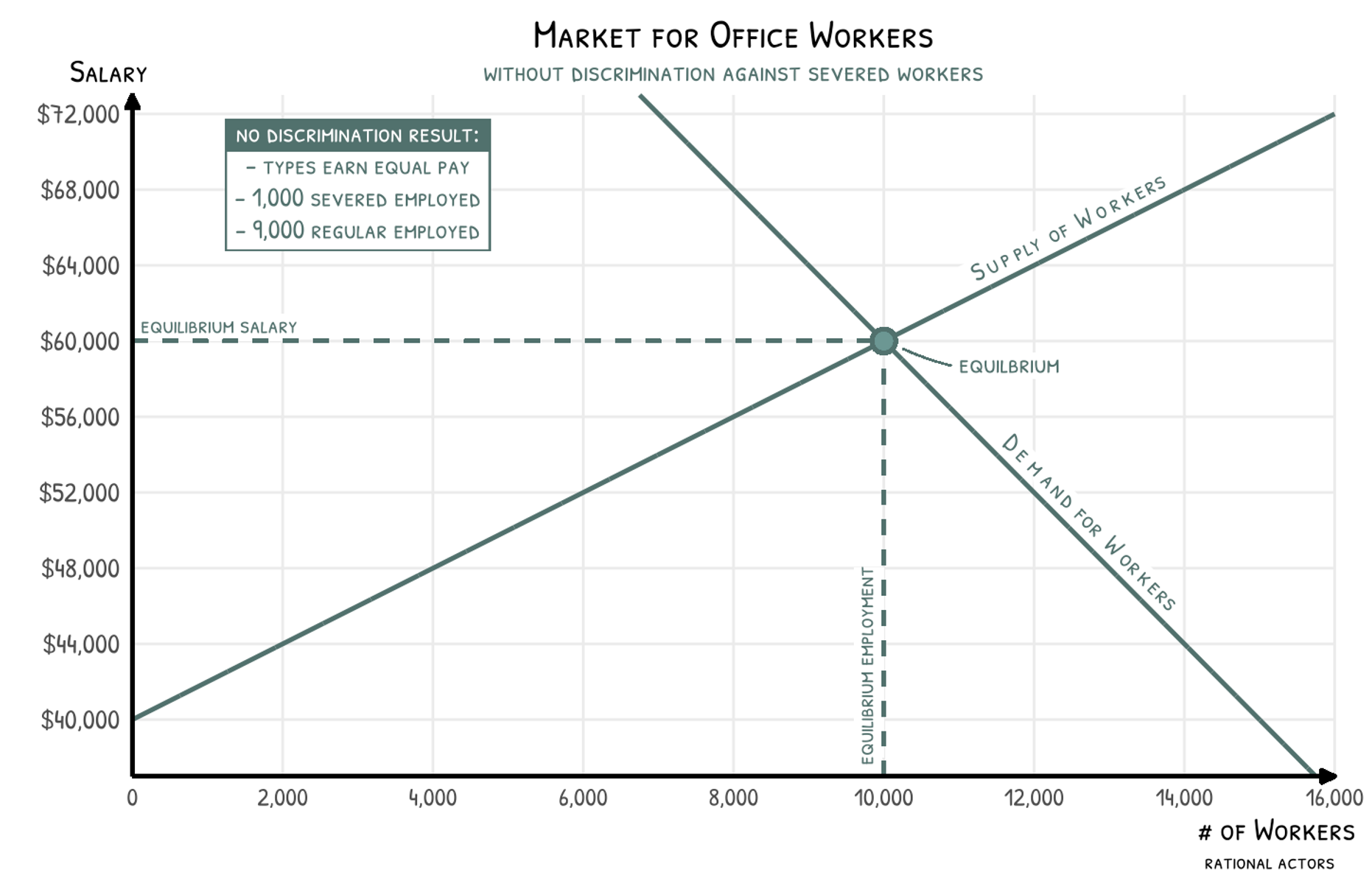
Office workers earn a $60,000 salary, and 10,000 are employed. Suppose severed workers are a smaller group: 1,000 of the employed are severed and 9,000 are regular workers.
An important detail is hidden in this model. As the demand curve shows, if employers had to pay $68,000, they would want to hire 8,000 workers. But at $60,000, they want to hire 10,000. Therefore, those 2,000 workers must be worth between $68,000 and $60,000 to the firms that would hire them.
For example, the 9,000th worker in this market might add $64,000 to a firm’s revenue. This figure is the worker’s marginal product. The salary must be $64,000 or lower for the firm to hire them. Employers hire if the market salary is less than the worker’s marginal product.
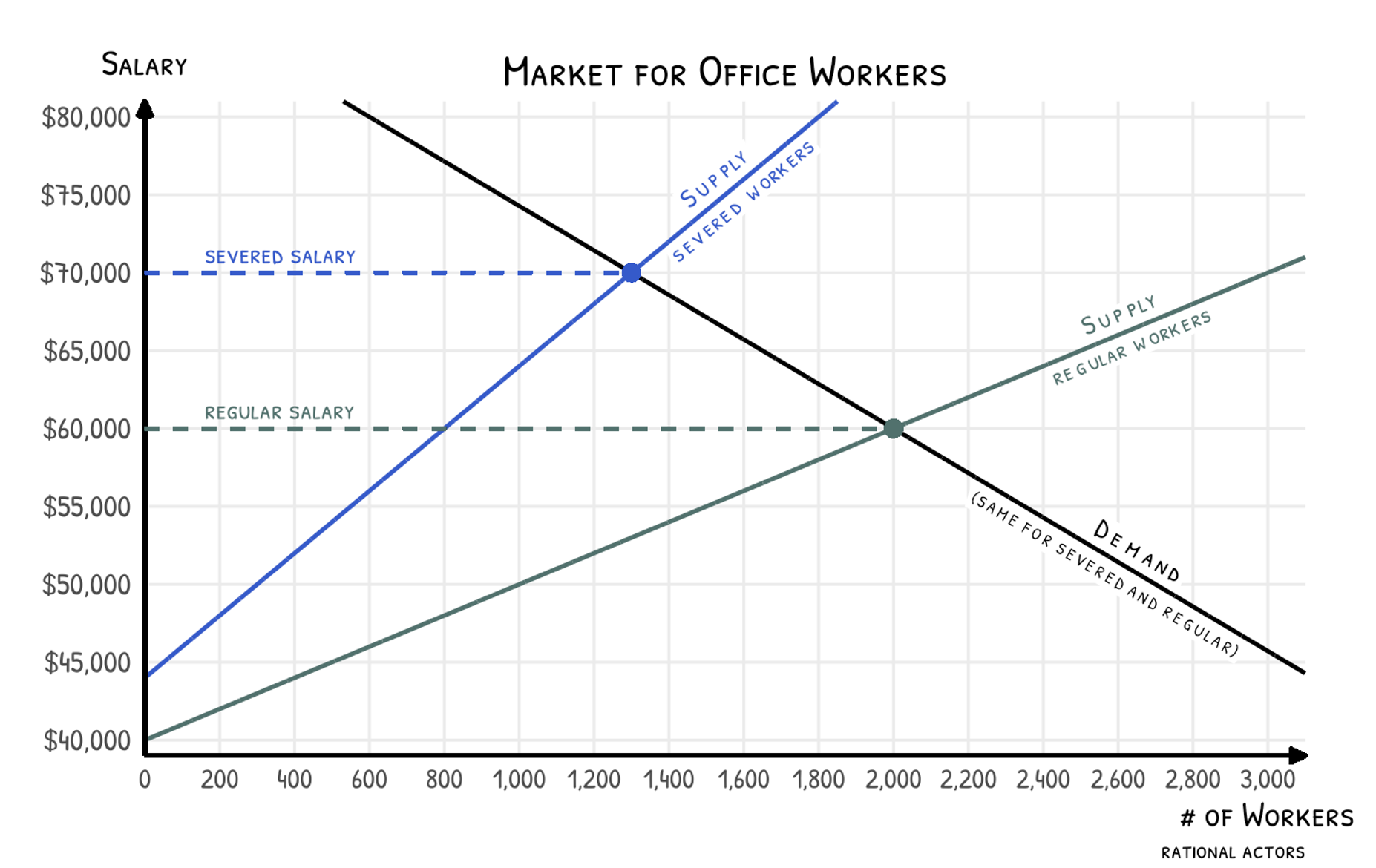
Now, consider the market for severed office workers specifically. Since severed and regular workers are substitutes, demand for severed workers is perfectly elastic at the market salary.5 If severed workers try to bargain for $60,001, the firm will hire a regular worker instead. And firms would hire a staff comprised entirely of severed workers if they could pay them $59,999.
If firms have a preference against hiring severed workers, they act as if these workers carry an extra cost to have on the staff. Instead of hiring if the salary is less than the marginal product, they hire if salary + discrimination cost is less than the marginal product, where the discrimination cost quantifies the distaste employers have for hiring severed workers.6
Now firms hire if salary + discrimination cost is less than the marginal product or alternatively if salary is less than the marginal product – discrimination cost. They treat discriminated workers as if they are less productive than they really are. To see the effect of this on severed workers, add in the following details:
- Every firm has a discrimination cost equal to $10,000.
- Since the height of the demand curve comes from the marginal product, the addition of discrimination to the model shifts demand down by $10,000.

The results will be felt by severed workers. Their pay falls by the discrimination cost: $10,000. If they bargain for $50,001, firms will hire regular workers instead. And because fewer severed workers are willing to accept these jobs at reduced salaries, employment of severed workers falls too.
The interviewer’s additional comments reveal something important about the nature of the discrimination against severed workers.
“We need a certain kind of person here, Mr. George, not a certain kind of two people. What do you think this is, a carpet factory? You want to circumcise your brain? That’s your business. But it doesn’t mean I have to hire you. And personally, I think it’s abhorrent.”
He doesn’t make the case that the door company’s customers will boycott their product because Dylan works there. How would they know anyway? He also doesn’t claim that Great Doors’ current employees would be dispirited by the hire.7 Instead, the distaste seems to be held by the employer itself. It may even be held by this particular interviewer (and the interviewers at the other offices that are hiring).
But profit motives work against this kind of discrimination. If it exists, there are strong incentives for profit that would eradicate it. An existing company could decide to ignore its distaste for severed workers or promote a non-discriminating hiring manager. They could then hire a team of severed workers who would each produce at least $60,000 of value and would only have to pay each $50,000 or slightly above. A new market entrant could take the same approach.
As a result, the existing, discriminating companies would be hiring mostly regular workers for $60,000 while their non-discriminating competitors would be hiring equally productive workers at discounted salaries. The non-discriminating firms could then outcompete the discriminators in the product market due to lower costs. Imagine a competing door company in Kier. Due to its lower-paid staff of severed workers, it could undercut Great Doors’ prices and make a lot more profit. In the extreme, Great Doors and other discriminators may go out of business.
The key dynamic occurs as customers demand more of the cheaper products produced by non-discriminating firms. To keep door production moving, non-discriminators must seek out even more severed workers to hire. This raises demand for severed workers and would eventually remove the wage gap between the two groups of workers. Are these firms concerned with the plight of the severed worker? Likely not. They are concerned for their own profits. And their profit pursuit reduces discrimination.8
As it turns out, discrimination is costly. Employers often benefit from treating their employees well and fairly.
Dylan: “May I ask about benefits?”
Hiring manager: “There’s a coffee maker.”
1 Not all forms of discrimination are illegal. In the United States, labor market discrimination is unlawful only when based on protected characteristics such as race, sex, religion, national origin, age, or disability. Being severed may not fall into any existing protected category, meaning Dylan’s treatment could be discriminatory without necessarily being illegal.
2 Therefore, one would not classify this market as a monopsony with just one employer.
3 This is a crucial assumption. If severed workers were less productive on average, wage differences could emerge that reflect these productivity differences rather than discrimination.
4 Or the price is the total value of the salary and benefits package. None of our conclusions depend on this distinction.
5 Similar logic applies in goods markets, where demand for a strict subset is more elastic than demand for the larger set. For example, the demand for Coca-Cola is more elastic than the demand for soda. The only difference between the soda market and the demand for these workers is that other sodas are not perfect substitutes for Coca-Cola.
6 This framework follows Gary Becker’s model of taste-based discrimination.
7 These two explanations would be discrimination by customers and discrimination by employees respectively.
8 This is the idea of the invisible hand! But note that is only true for discrimination by employers. If instead, the distaste for severed workers came from a firm’s customers or its current employees, then discriminating sustains its profits. The devil is truly in the details.

More from Severance:


1 Not all forms of discrimination are illegal. In the United States, labor market discrimination is unlawful only when based on protected characteristics such as race, sex, religion, national origin, age, or disability. Being severed may not fall into any existing protected category, meaning Dylan’s treatment could be discriminatory without necessarily being illegal.
2 Therefore, one would not classify this market as a monopsony with just one employer.
3 This is a crucial assumption. If severed workers were less productive on average, wage differences could emerge that reflect these productivity differences rather than discrimination.
4 Or the price is the total value of the salary and benefits package. None of our conclusions depend on this distinction.
5 Similar logic applies in goods markets, where demand for a strict subset is more elastic than demand for the larger set. For example, the demand for Coca-Cola is more elastic than the demand for soda. The only difference between the soda market and the demand for these workers is that other sodas are not perfect substitutes for Coca-Cola.
6 This framework follows Gary Becker’s model of taste-based discrimination.
7 These two explanations would be discrimination by customers and discrimination by employees respectively.
8 This is the idea of the invisible hand! But note that is only true for discrimination by employers. If instead, the distaste for severed workers came from a firm’s customers or its current employees, then discriminating sustains its profits. The devil is truly in the details.