Skip to content

Ring Tribute

The Lord of the Rings: The Rings of Power: S2, E5 “Halls of Stone”

Supply and Demand: Tax Incidence

Prince Durin and Disa are wandering through the markets of Khazad-dûm, when Disa spies an item to her liking.

Seller: “Two hundred for that one.”

Prince Durin: “Two hundred? For a bloody rock?”

Disa: “It’s a tuning crystal.”

Prince Durin: “I don’t care if it’s a cart and six horses. I won’t pay it.”

Seller: “Blame the king’s new law. For every coin spent, another goes to the crown. Ring tribute, he calls it.”

King Durin appears to be funding both his purchases from the elves and the dwarves’ doubled mining operations with taxes. Ring tribute is an ad valorem tax: the tax owed is a percent of the item’s price.11 Ad valorem means “according to value” such that the amount owed increases with the price. An alternative tax is per-unit, where a fixed tax amount is applied to each unit sold. Both types of taxes could be applied broadly to all transactions, like a sales tax or ring tribute, or applied to specific goods, like cigarette taxes or gas taxes. Who bears the brunt of this tax? One could imagine that tuning crystals would sell for 100 coins without the tax. Then, sellers double the price to 200 coins with the tax to come out even. But they would lose lots of customers, surely, by doubling the price. Maybe instead the price would have been close to 200 coins even without the tax, and sellers only bumped it up slightly. To arrive at a firm answer, we must model supply and demand in the market for tuning crystals. Let’s begin with what we know:
  • To acquire a tuning crystal, buyers must part with 200 coins. Call this the price buyers pay.
  • Due to ring tribute, the sellers only keep 100 coins as their reward for the sale, since half goes to the king. Call these 100 coins the price sellers receive.
  • With no tax, the price buyers pay and the price sellers receive are equal. But a tax drives a wedge between them. A 100% ad valorem tax means the price buyers pay must be double the price sellers receive.22 Who is responsible for paying the tax: buyers or sellers? If sellers are being taxed, the higher costs lead to higher prices, pushing some of the tax onto buyers. If buyers are being taxed, the depressed demand leads to lower prices, pushing some of the burden onto sellers. As a result, the effects of a tax levied on buyers and a tax levied on sellers are identical.
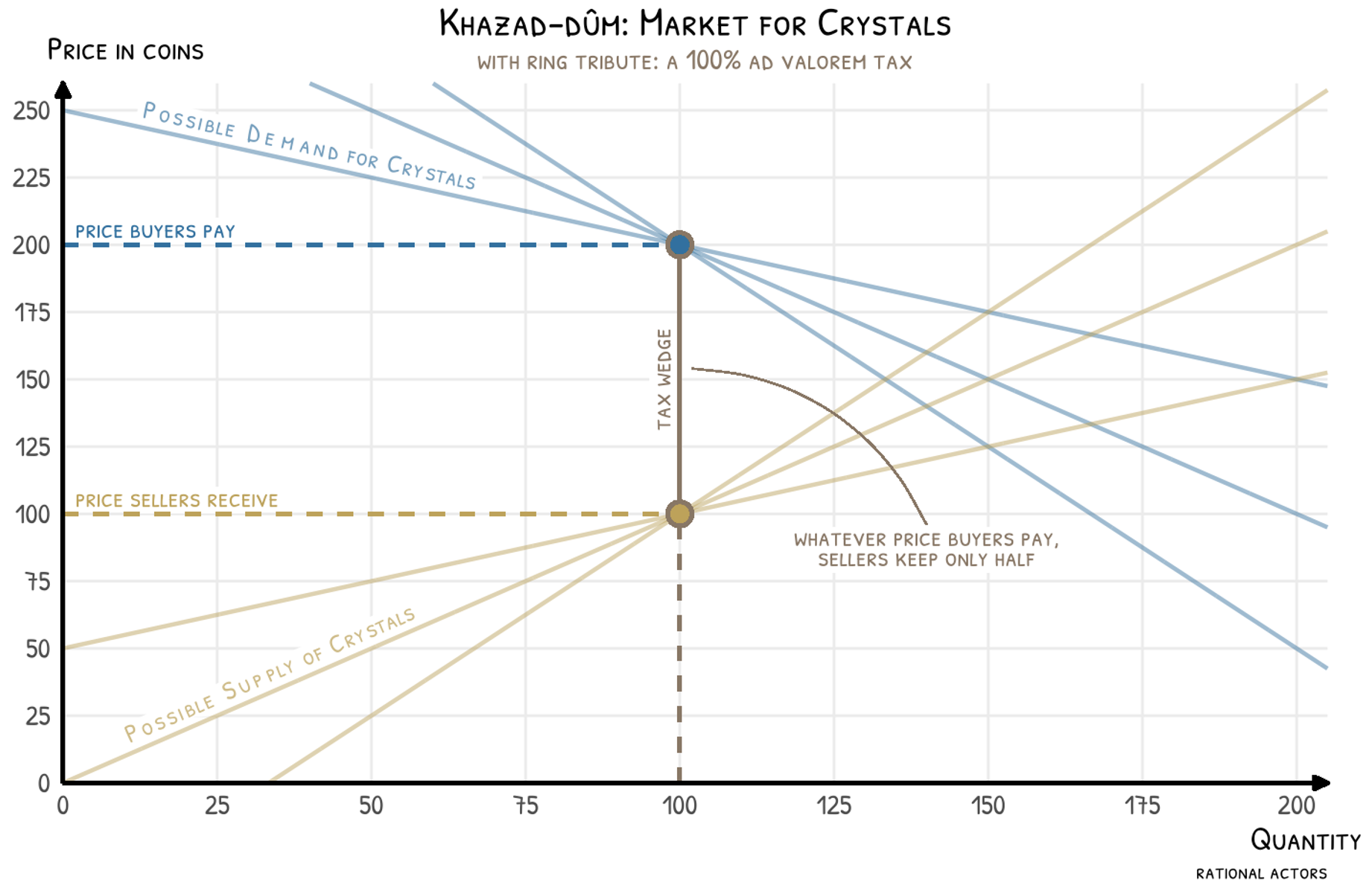
Suppose 100 tuning crystals are transacted in the market each day with the tax in place. We can then graph all the figures we have so far. The only certainties are that sellers have 100 crystals ready to go if they are rewarded with 100 coins for the sale, and buyers will want to purchase 100 crystals if they have to part with 200 coins to get one. The leap is to model the supply and demand curves that go through the points we have already established.
This leaves many possibilities for where the price would land if no tax had been levied on the crystals. The number of possible upward-sloping supply and downward-sloping demand curves is infinite. The way forward is to think carefully about elasticity: for given changes in the price of a crystal, how much do quantity supplied and quantity demanded move? Suppose first that supply is relatively elastic and demand is relatively inelastic. Perhaps the crystals are easy enough to mine that sellers are just waiting on a high enough price to justify quarrying much more of them. And perhaps on the demand side, these crystals are an absolute necessity for buyers. While they might grumble about higher prices, they would buy similar quantities anyway. If these elasticities were accurately described, corresponding supply and demand curves would paint a clear picture about who is really paying the tax.33 An elastic supply curve has a flatter slope such that small changes in the price generate large changes in quantity supplied. A relatively inelastic demand curve has a steeper slope. A linear demand curve has elastic segments at higher prices and inelastic segments at lower prices. But if you compare two demand curves at the same point, a steeper one would be less elastic (and would have a larger range of prices where it was inelastic).
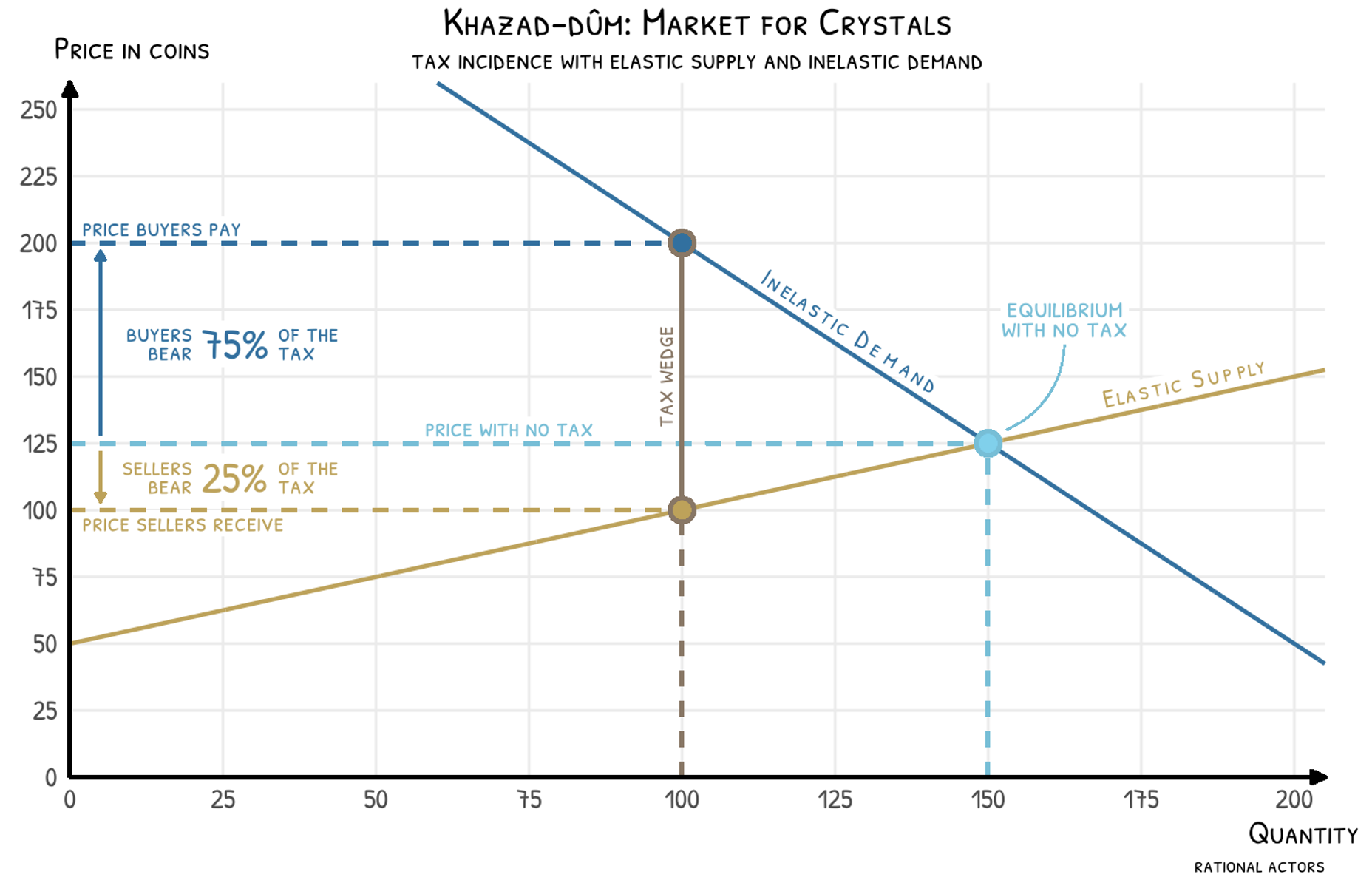
In this case, because higher prices don’t scare off buyers so fast, sellers can pass a lot of the tax onto consumers in the form of higher prices without losing too many customers. As a result, buyers bear much more of the tax than sellers do. Ring tribute drives up the price that buyers pay more than it depresses the price sellers receive.44 In this example, the elasticity of demand at the no-tax equilibrium is 0.56 (inelastic). The elasticity of supply is 1.67 (elastic). With elasticities as absolute values, the share of the tax borne by buyers is ES / (ES + ED) and the share borne by sellers is ED / (ES + ED). These formulas are exact for linear supply and demand curves and a close approximation for curved ones. But suppose elasticities went the other way. Mining more crystals is a real chore, so a higher price for sellers doesn’t lead to a significant boost in quantity supplied. And for buyers, the crystals are luxuries that they could easily forgo if faced with higher prices.
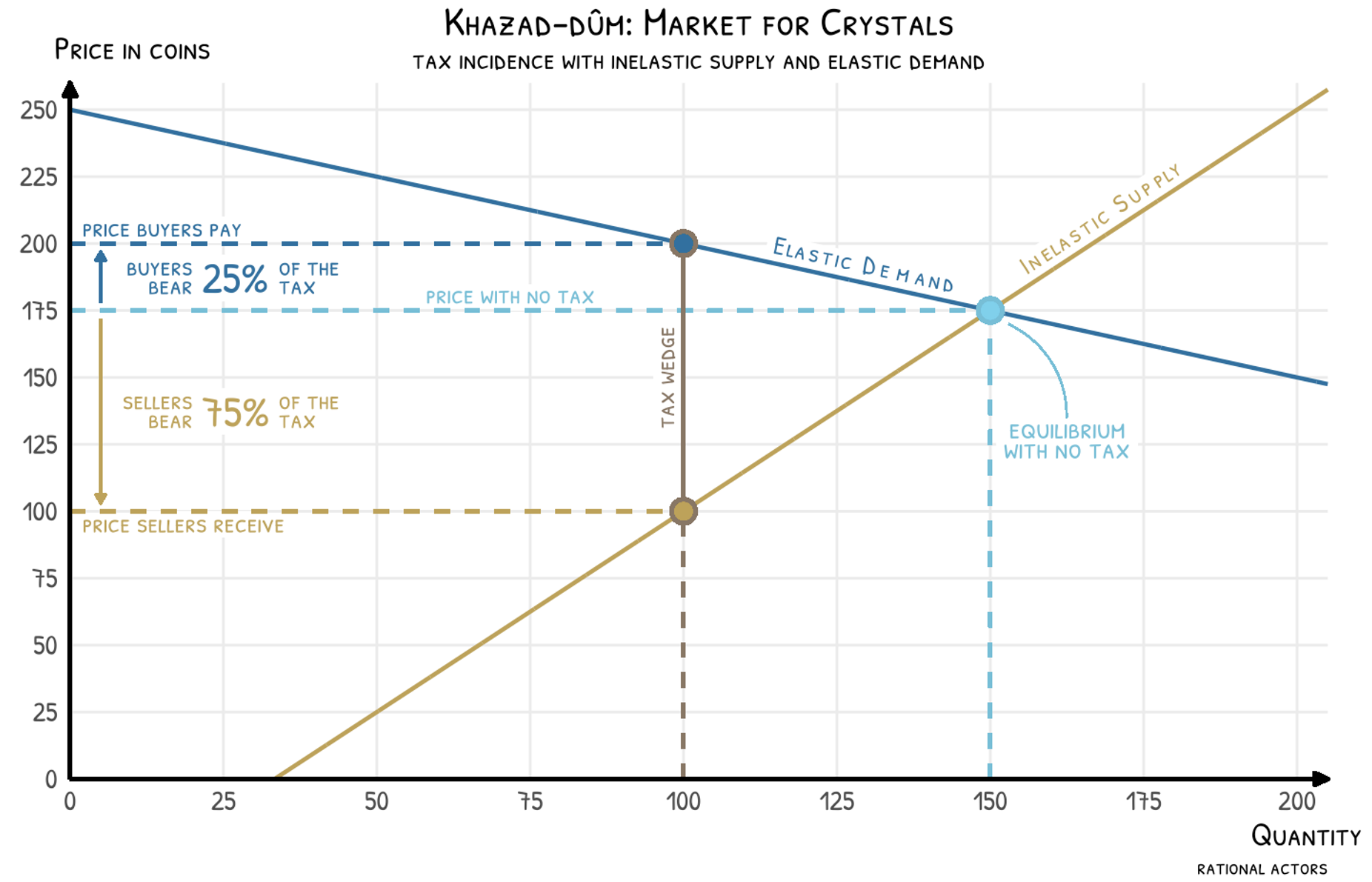
In this case, it’s the sellers who bear most of the tax.55 Here, the elasticity of demand at the no-tax equilibrium is 2.33 (elastic). The elasticity of supply is 0.78 (inelastic). Even though they owe the king a coin for each coin they collect, prices only increase by a modest amount. To push prices any higher would leave crystals unsold. Buyers are sensitive to price changes, after all. Which side of the market is ultimately making the bigger sacrifice to fund the king’s expenses? Whichever group, buyers or sellers, is less price sensitive. A stated price of 200 coins, 100 of which go to the king, doesn’t mean that buyers are paying the whole tax. With no tax in place, crystals would sell for somewhere between 100 and 200 coins. Both buyers and sellers take a hit. The king’s law decides who hands the coins to the crown, but elasticities decide who actually parts with the coins.66 Note that the king’s tax revenue comes with a real cost. In the market for crystals alone, 50 mutually beneficial transactions no longer occur, so 2,500 coins’ worth of total surplus is lost. Is more consumer surplus or producer surplus lost? It depends, of course, on elasticities!

Disa: “Sir, this is for our wee girl’s birthday next week. Spare a bit for her sake. We’ll give you one hundred.”

Prince Durin: “One hundred?”

Disa: “One hundred. How does that sound?”

Seller: “Like mine shaft robbery.”

1 Ad valorem means “according to value” such that the amount owed increases with the price. An alternative tax is per-unit, where a fixed tax amount is applied to each unit sold. Both types of taxes could be applied broadly to all transactions, like a sales tax or ring tribute, or applied to specific goods, like cigarette taxes or gas taxes.

2 Who is responsible for paying the tax: buyers or sellers? If sellers are being taxed, the higher costs lead to higher prices, pushing some of the tax onto buyers. If buyers are being taxed, the depressed demand leads to lower prices, pushing some of the burden onto sellers. As a result, the effects of a tax levied on buyers and a tax levied on sellers are identical.

3 An elastic supply curve has a flatter slope such that small changes in the price generate large changes in quantity supplied. A relatively inelastic demand curve has a steeper slope. A linear demand curve has elastic segments at higher prices and inelastic segments at lower prices. But if you compare two demand curves at the same point, a steeper one would be less elastic (and would have a larger range of prices where it was inelastic).

4 In this example, the elasticity of demand at the no-tax equilibrium is 0.56 (inelastic). The elasticity of supply is 1.67 (elastic). With elasticities as absolute values, the share of the tax borne by buyers is ES / (ES + ED) and the share borne by sellers is ED / (ES + ED). These formulas are exact for linear supply and demand curves and a close approximation for curved ones.

5 Here, the elasticity of demand at the no-tax equilibrium is 2.33 (elastic). The elasticity of supply is 0.78 (inelastic).

6 Note that the king’s tax revenue comes with a real cost. In the market for crystals alone, 50 mutually beneficial transactions no longer occur, so 2,500 coins’ worth of total surplus is lost. Is more consumer surplus or producer surplus lost? It depends, of course, on elasticities!

iconblack

More from The Lord of the Rings: The Rings of Power: