Númenórean Free Trade
The Lord of the Rings: The Rings of Power: S1, E3 “Adar”
Supply and Demand: International Trade
Galadriel and Halbrand, after being rescued at sea, are brought to the island kingdom of Númenor. There, the Elven Galadriel gives Halbrand a history lesson about Númenor and its people.
Galadriel: “In the Great War, your ancestors stood with Morgoth. These men stood with the Elves. As a reward, the Valar granted them this island, which has changed much since then.”
Halbrand: “Do I detect a note of envy?”
Galadriel: “Not envy. Sorrow. Once, Elves came and went freely from these shores. Our people were as kin. Sharing gifts, knowledge.”
Halbrand: “What happened?”
Galadriel: “Númenor began to turn away our ships. In time, they broke off all contact.”
Galadriel rues the loss of friendship between the Elves and Númenórean Men. But she also knows the island is thriving less than it could be due to a lack of sharing and trade. Númenor’s isolation is detrimental to its people.
To see why, consider the market for ship-grade lumber. Númenor has adopted an economic system of self-sufficiency with no international trade. Therefore, all its logs come from Númenórean forests, cut down by local guild members. Númenor lacks the vast forests found in Middle-earth. And while they have tall trees, they are fewer and more costly to bring down.
Interactions between buyers and sellers for logs in the isolated marketplace will yield a market price and a market quantity as visualized below, where demand consists only of Númenórean consumers and supply only of Númenórean producers.

The results in isolation:
- The price per log is 8 gold coins.
- The price is high enough to cover the production costs of cutting down 4,000 logs. The guild of lumberjacks benefits greatly, with 16,000 gold coins worth of producer surplus.
- Many consumers would pay even more than 8 coins. Their benefit is measured by a consumer surplus of 8,000 gold coins.
The woodland Elves of Middle-earth have access to an incredible supply of lumber and more advanced production technology. This means a tremendous supply of logs in Middle-earth that sell for only 4 gold coins.
If Númenor reopens its ports to trade with the Elves, buyers could purchase from either the Númenórean lumber producers or the Elves. The price difference would have extreme consequences. First, Númenórean producers would grudgingly lower their prices to 4 gold coins to compete with the Elven producers.1 The decreased price would be too low to justify the current volume of log production. Operations would shrink, and the guild of lumberjacks would experience job losses.
On the other hand, access to ship-grade logs at half the price would mean abundance for consumers and other Númenórean guilds that rely on lumber for their operations. Consumption of logs would increase drastically. That means more new homes and more new ships.
If Númenórean production shrinks but consumption grows, where do the logs come from? They arrive on Elven ships as imports. These results can be seen below.2

If the import of Elven lumber is harmful to local producers but helpful to local buyers, how is the King (or Queen Regent) of Númenor to craft trade policy? One needs to measure how much harm and how much benefit. Free trade with Middle-earth in the market for lumber brings the following:
- A loss in producer surplus worth 12,000 gold coins.
- A gain in consumer surplus worth 24,000 gold coins.
- A net gain in total surplus worth 12,000 gold coins. The gains to local consumers are far greater than the losses to local producers.3
As a result, free trade is massively beneficial to Númenóreans overall. The same is true in the markets for other goods as well, though the dynamics may differ. Consider the market for fish produced and sold by the barrel. Númenor’s easy access to the seas and the superiority of its ships make fish abundant and cheap. A barrel of fish carries a market value of only 2 gold coins in isolation.
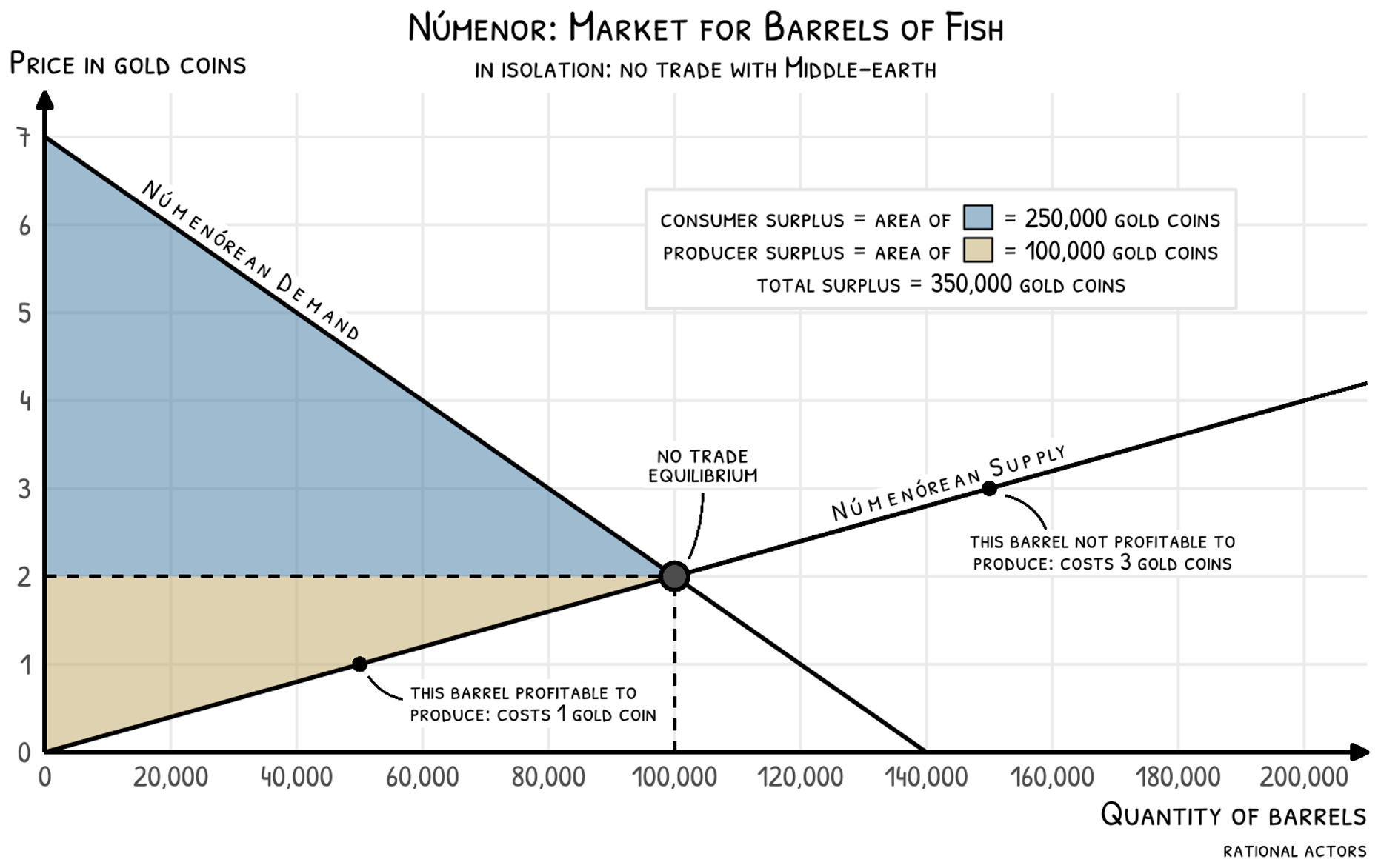
But the woodland Elves lack the same easy access to fish stocks. To produce fish in large quantities, the Elves face high costs. This leads to a high price per barrel in Middle-earth: 4 gold coins.
What if Númenor opened to free trade in this market? Númenórean fish producers would now have access to buyers willing to pay much higher prices. They can raise their prices all the way up to 4 gold coins. The higher price then justifies a massive expansion in fishing operations off the Númenórean shores. The guild of fisheries expands its employment greatly too.
But Númenórean buyers must now compete with Elves in the purchase of fish. Now that a barrel is priced at 4 gold coins, Númenóreans cut back on their fish consumption.
If Númenor’s fleets now bring in far more fish than before, but its people consume far less, what becomes of all the additional barrels of fish? They are exported to Middle-earth. These results can be seen in the figure below.

How to weigh the gain to producers and loss to consumers? By total surplus, of course. The following occur in this market:
- A gain in producer surplus worth 300,000 gold coins.
- A loss in consumer surplus worth 160,000 gold coins.
- A net gain in total surplus worth 140,000 gold coins. The gains to local producers are far greater than the losses to local consumers.
Overall, if Númenor were to reestablish relations with the Elves and engage again in free trade, it would become much wealthier. Its resources would be redirected towards the industries where it has efficient production, resulting in a much greater abundance of goods and services. Its total surplus across these two goods would increase by 40%.4
Are there downsides? For the current members of the guild of lumberjacks, yes. Some may lose their jobs. But many former lumberjacks will find employment elsewhere, including the new fishing boats. The prosperity of an entire kingdom is a more worthy cause than assurances to a single guild. In a perfect world, that prosperity would also lead to programs that retrain the unemployed and provide a safety net for unexpected shocks.
The overall lesson? Self-sufficiency is a fast track to poverty. Individual people gain greatly from trading with each other. Countries and large groups of people do too. Now the big step is for the local rulers to convince the populace of the riches brought about by free trade. Or maybe the other way around, depending on current political circumstances. Either way, a lesson in supply and demand would help.
Galadriel: “[the last king] was loyal to the Elves?”
Elendil: “Is loyal. We forced him from the throne for it.”
1 This makes an implicit assumption that Númenórean logs and logs from Middle-earth are of similar quality.
2 Here, the blue line is the Middle-earth supply of logs. It’s perfectly flat, which implicitly assumes that Númenor can buy as much lumber as they want from Middle-earth at that price without putting upward pressure on the price.
3 This result creates a political minefield, however, where the losses are endured by an organized, identifiable group capable of mobilization for its cause: jobs. But the gains are spread among a much larger, unorganized group of people (consumers) without an identifiable way to lobby for its interests: low prices and product availability.
4 In isolation, total surplus across these two goods totals 374,000 gold coins. With free trade, it totals 526,000 gold coins.

More from The Lord of the Rings: The Rings of Power:
- All
- The Lord of the Rings: The Rings of Power


1 This makes an implicit assumption that Númenórean logs and logs from Middle-earth are of similar quality.
2 Here, the blue line is the Middle-earth supply of logs. It’s perfectly flat, which implicitly assumes that Númenor can buy as much lumber as they want from Middle-earth at that price without putting upward pressure on the price.
3 This result creates a political minefield, however, where the losses are endured by an organized, identifiable group capable of mobilization for its cause: jobs. But the gains are spread among a much larger, unorganized group of people (consumers) without an identifiable way to lobby for its interests: low prices and product availability.
4 In isolation, total surplus across these two goods totals 374,000 gold coins. With free trade, it totals 526,000 gold coins.