Mithril Monopoly
The Lord of the Rings: The Rings of Power: S2, E6 “Where Is He?”
Market Power: Monopoly
The dwarves of Khazad-dûm have Middle-earth’s only known reserve of mithril, a lightweight metal that’s stronger than steel. The elves need it for the survival of their race, but its uses would surely be widespread across the realms.
The dwarves are in an enviable position. They have a true monopoly due to exclusive control of the essential resource. All of Middle-earth’s demand for mithril goes through Khazad-dûm. There are no other sellers, and there’s no risk of entry from competitors.
If the dwarves are entirely self-interested, how would they take advantage of this situation? Assume the following:
- Any realm transacting with the dwarves would do so in a currency called gold marks.
- The demand for mithril is downward sloping and linear.1
- The dwarves incur costs to mine the mithril and the marginal cost increases as they mine more. Greater quantities require deeper digs that involve greater risk of cave-ins.
To maximize profit, the dwarves balance marginal costs with marginal revenue: the boost to revenue from selling an additional pound of mithril. For the monopolist, the marginal revenue decreases as the quantity increases. Selling an additional pound requires a lower price, and that lowered price applies to every pound sold. This is the crucial tradeoff.
The profit-maximizing quantity occurs where marginal revenue equals marginal cost. The chosen price follows from the demand curve, as shown below.

Khazad-dûm benefits greatly from its resource advantage and monopoly power. They can sell mithril for 300 gold marks even though the marginal cost of the last pound is only 100 gold marks. That’s a 200% markup! This creates substantial producer surplus because these 100 pounds of mithril sell for a price far higher than their extraction costs.2
But this is all hypothetical. Until now, King Durin has resisted the urge to begin mining mithril. The elves are back with another pitch, however.
Annatar: “I have just learned that Eregion is under threat of invasion. Without mithril, the remaining rings of power may never be complete. We need more. And we need it now. How much shall I offer you?”
King Durin sends Annatar away without even citing a price.3 He’s not interested in selling mithril, or so it seems. This delights Prince Durin, who distrusts the elves’ work on these rings.
Prince Durin: “Thank Aulë. For a moment, I was afraid you’d taken leave of all your senses.”
King Durin: “On the contrary. I have never been of sounder mind. But do not worry, my son. They’ll be back.”
Prince Durin: “Back?”
King Durin: “You heard him. War is coming to Middle-earth. And the army that bears the weapons and armor of mithril is all but invincible. We can name our price.”
King Durin does plan to mine and sell mithril. He also seems well aware of his pricing power. He’s just waiting for more desperation from his buyers. The onset of the war will bring just that, as buyers such as Annatar see no alternatives. Mithril will be their only means of survival. This means inelastic demand, where higher prices lead to smaller drops in quantities demanded than before. And when monopolists sell a product with highly inelastic demand, they really do live like kings.
To model this wartime shift in demand, assume that quantity demanded would be the same if the dwarves gave away mithril for free.4 But higher prices are less off-putting now. A 100-mark price hike used to reduce quantity demanded by 50 pounds. During wartime, it only reduces quantity demanded by 25 pounds.5
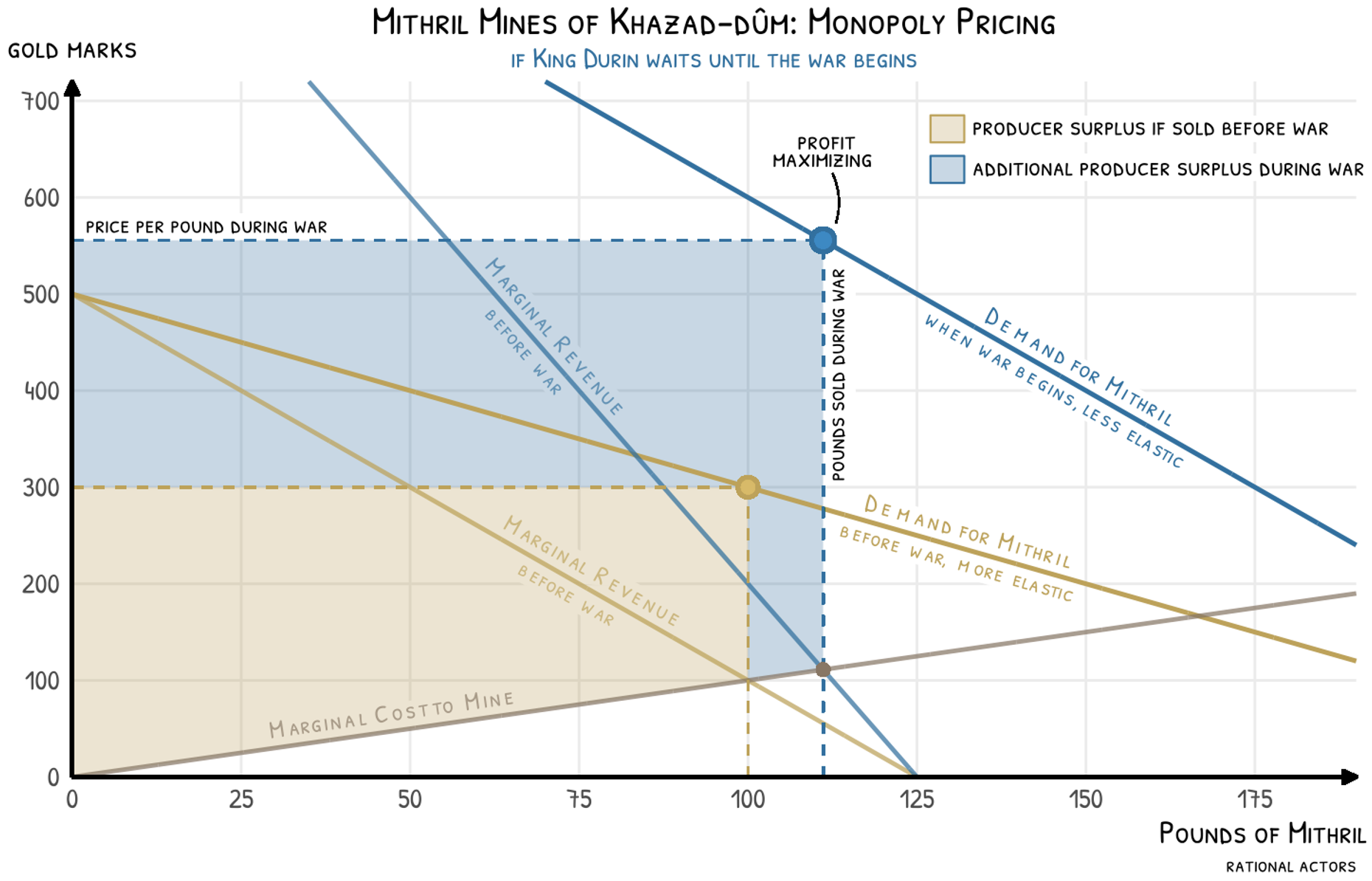
By waiting for buyers to get desperate, the dwarves can maximize profit at much higher prices. And through a small increase in quantity sold, they greatly increase producer surplus.6
Inelastic demand lets profit-seeking monopolists charge much higher prices and markups.7 This happens because as monopolists ask themselves, “How high can I run up these prices without scaring off too many customers?” the answer is “Very high!” The monopolist can’t truly name the price. Their choice is still constrained by demand. But the constraint is much less restrictive when buyers will pay almost anything.
So, if King Durin is self-interested, waiting for buyers to get desperate makes perfect sense. And self-interested doesn’t even begin to describe King Durin at this point. He’s unapologetically greedy.
Prince Durin: “Have you gone mad?”
King Durin: “The whole world’s gone mad, my son. But it is to us to grip it by the throat.”
1 Here, we are assuming there are many potential buyers of mithril. If there were only one buyer of mithril instead, this market would be more accurately described as a bilateral monopoly and would require a different theory.
2 Computing the dwarves’ profit from mithril mining would involve accounting for fixed costs in addition to the variable costs captured by the marginal cost curve.
3 This exchange between King Durin and Annatar, as well as the seemingly underdeveloped markets of Middle-earth, suggests the dwarves could actually price discriminate in the sale of mithril. This means they could charge different prices to different groups of buyers.
4 In this model, that quantity is 250 pounds of mithril.
5 Using functions, demand used to be QD = 250 – 0.50P and is now QD = 250 – 0.25P. At any given price, the wartime demand curve is less elastic due to a smaller multiplier on the price term. This shift doubles the choke price of demand from 500 gold marks to 1,000 gold marks.
6 The large increase in price and relatively small increase in quantity are due to the change in elasticity of demand, where the demand curve becomes much steeper. If, instead, buyers demanded mithril in much greater quantities but were willing to pay relatively similar prices, then the monopolist’s quantity would increase greatly without a large increase in price.
7 These markups also lead to massive deadweight losses, as the increased markups leave a big swath of customers unserved despite their willingness to pay a price above marginal cost.

More from The Lord of the Rings: The Rings of Power:
- All
- The Lord of the Rings: The Rings of Power


1 Here, we are assuming there are many potential buyers of mithril. If there were only one buyer of mithril instead, this market would be more accurately described as a bilateral monopoly and would require a different theory.
2 Computing the dwarves’ profit from mithril mining would involve accounting for fixed costs in addition to the variable costs captured by the marginal cost curve.
3 This exchange between King Durin and Annatar, as well as the seemingly underdeveloped markets of Middle-earth, suggests the dwarves could actually price discriminate in the sale of mithril. This means they could charge different prices to different groups of buyers.
4 In this model, that quantity is 250 pounds of mithril.
5 Using functions, demand used to be QD = 250 – 0.50P and is now QD = 250 – 0.25P. At any given price, the wartime demand curve is less elastic due to a smaller multiplier on the price term. This shift doubles the choke price of demand from 500 gold marks to 1,000 gold marks.
6 The large increase in price and relatively small increase in quantity are due to the change in elasticity of demand, where the demand curve becomes much steeper. If, instead, buyers demanded mithril in much greater quantities but were willing to pay relatively similar prices, then the monopolist’s quantity would increase greatly without a large increase in price.
7 These markups also lead to massive deadweight losses, as the increased markups leave a big swath of customers unserved despite their willingness to pay a price above marginal cost.