The Town is Too Small
Schitt’s Creek: S2, E5 “Bob’s Bagels”
Market Power: Monopoly
Johnny Rose is actively searching for new business ideas. Bob and Roland give him a hard time about his morning muffin, but Johnny claims that his breakfast helps him generate ideas for new ventures.
Johnny: “I’d kill for a bagel, but I haven’t seen one bagel since I got to this town. Back at Rose Video, I used to get my assistant to bring me a bagel every morning. So, I might think a bagel shop is something this town could use.”
Bob: “I love a good bagel, Johnny. Do you think that idea really has legs?”
Johnny: “No, it’s just an example, Bob.”
But doesn’t the idea have legs? After all, the hypothetical shop would have a monopoly on bagel sales in Schitt’s Creek. And Johnny does not seem to have a wealth of other ideas to pursue instead. His opportunity costs couldn’t be much smaller. A name has already been picked out: Bob’s Bagels.
As a monopoly, the city’s demand for bagels would be equivalent to its demand for bagels from Bob’s. The shop would then have the power to choose the price.1 Monopolies maximize profit by considering the tradeoff between lowering the price to lure additional customers and having to accept that lower price from all customers, even those willing to pay much more.2 The sweet spot, the price-quantity combination that maximizes profit, occurs where marginal revenue equals marginal cost.
Suppose that each additional bagel costs $1.00 to produce: marginal costs are constant. Then, given the demand for bagels in Schitt’s Creek, Bob’s Bagels would maximize profit as follows:

Using its pricing power, Bob’s Bagels charges $3.00 for bagels that cost only $1.00 to produce. There’s a $2.00 (or 200%) markup. Each month, the shop produces and sells 600 bagels and collects $1,800 in revenue. And with only $600 in expenses to produce those bagels, so far so good!
But these calculations are missing a crucial part of the operation. The only costs considered so far are variable costs: costs that add up with each additional bagel produced. Think of things like flour, yeast, sesame seeds, and blueberry cream cheese. Wages to employees and electricity fall in this category too. These costs are all captured by marginal cost.
Bob: “If you were to open a bagel shop, what would be the first thing you’d need to do?”
Johnny: “Well, offhand, I honestly don’t know. I suppose I’d start by finding a space and then I’d probably source out a bagel oven and, um, a bagel baker.”
Wages to the baker? Those are variable costs too.3 But the shop will also have significant fixed costs: costs that do not change with each additional bagel produced. Johnny would need to pay rent for a space. He would need to acquire an oven. And hopefully, he would pay himself a salary.4 None of these costs are included in the model yet, because they don’t budge when Bob’s produces one more bagel.
Total cost equals variable costs plus fixed costs. For Bob’s to be profitable, total revenue must exceed total costs. Or, per bagel, the price must exceed average total cost. Producing and selling 600 bagels at $3.00 each is the most profitable outcome, but how much profit is generated?
The graph below visualizes this by adding an average total cost curve under the assumption that fixed costs are $1,500 each month.5
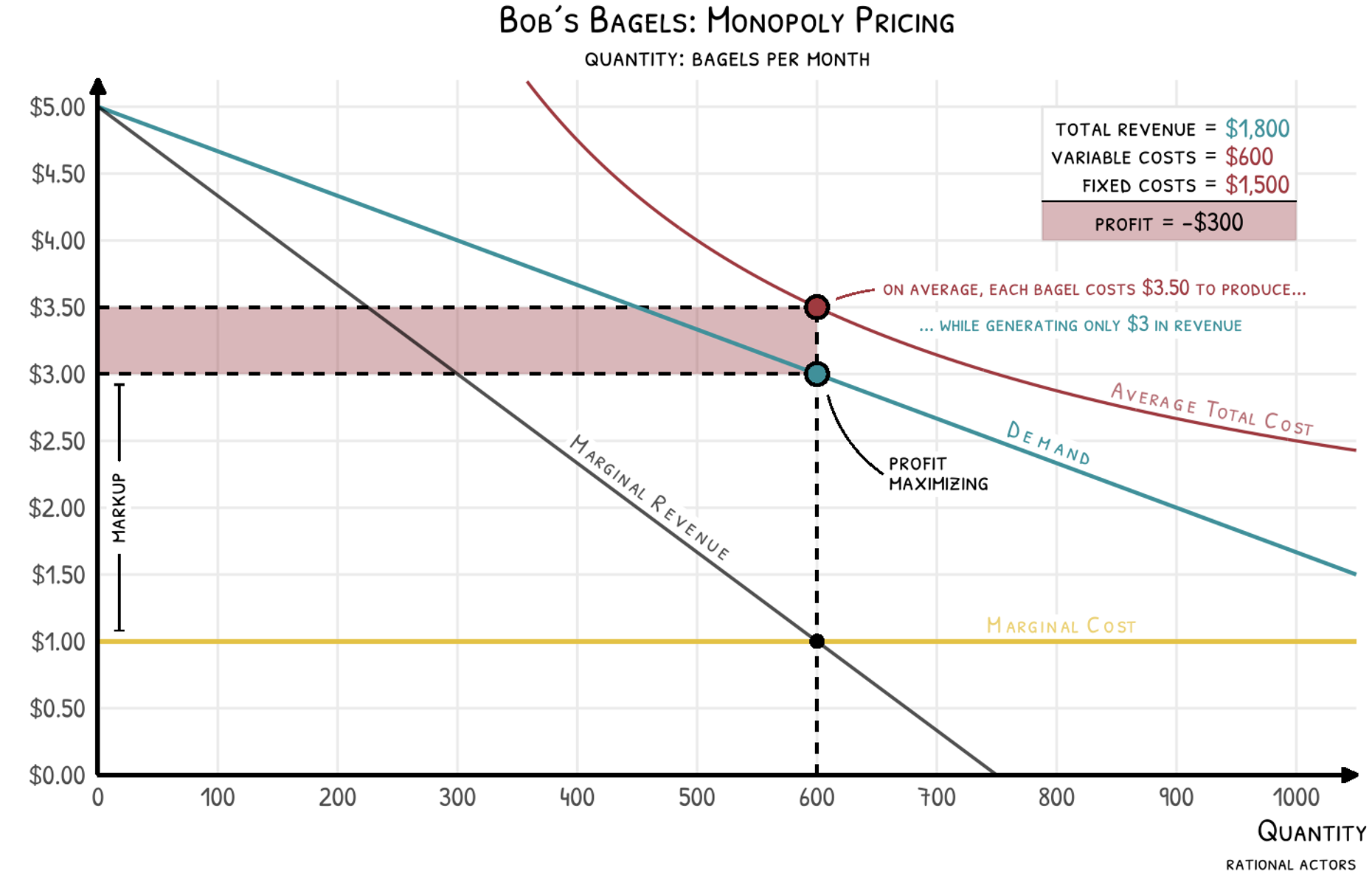
In the best-case scenario, Bob’s collects $3.00 from each customer who orders a bagel but has $3.50 in expenses for the average bagel produced. Across 600 bagels, that means $300 in losses every month. Trying to sell more bagels requires a price drop, making profit even worse. Raising the price leads to a drop in bagels sold, lowering profit as well.
The real issue? There isn’t enough demand for bagels in Schitt’s Creek.
Johnny: “It’s tough enough coming up with a business idea let alone a money-making idea in a town this small.”
There’s a bagel shop down the road in Elmdale. How is it profitable? Suppose that Elmdale has double the population of Schitt’s Creek. At any given price, twice as many bagels are demanded in Elmdale compared to Schitt’s Creek. The results:
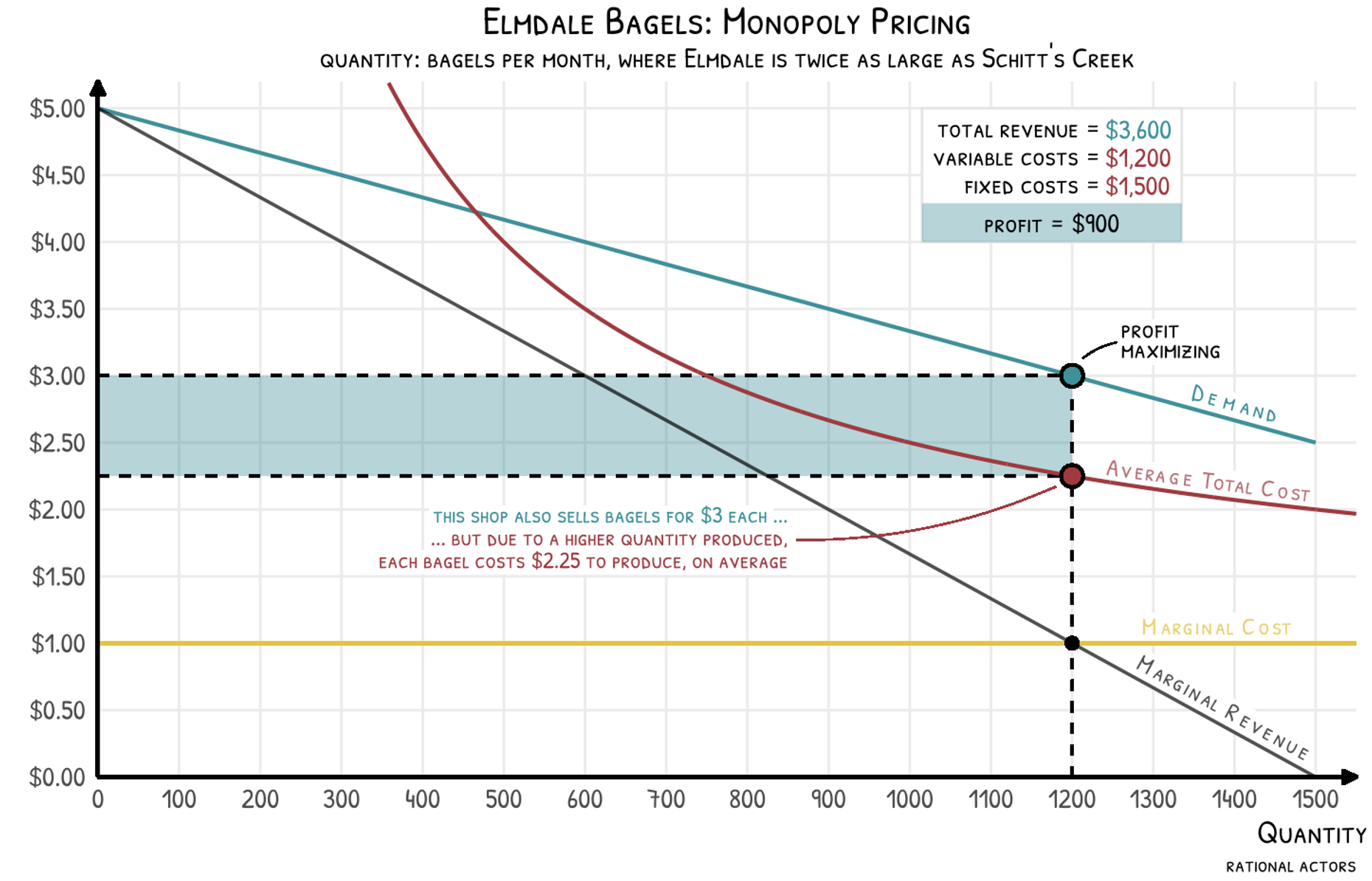
Even selling $3.00 bagels, Elmdale’s shop is profitable because the city’s size provides enough demand for the shop to cover both its variable costs and its fixed costs. By producing and selling twice as many bagels as Bob’s, the Elmdale shop can get average total cost down to a profitable level. The high volume spreads the fixed costs over more bagels.
Why are there no bagels in Schitt’s Creek? The city is too small to support a bagel shop. But if a city of 20,000 can support a bagel shop that produces 1,200 bagels, why can’t there be a bagel shop in a city half that size that simply produces half as many bagels? The return on 600 bagels isn’t worth the fixed cost to make the product exist in the first place. Schitt’s Creek might also have one resident who loves mangoes. But its grocery store is unlikely to stock a few mangoes for that one person. The fixed costs of stocking mangoes won’t be covered.
This logic explains why big cities can offer such a wide variety of goods and services, even ones that appear quite niche: Ethiopian restaurants, dog daycares, and oboe lessons. These products only exist in places that have the population for these enterprises to cover their fixed costs. Access to a large number of potential customers turns on-paper ideas into thriving enterprises.
Johnny: “Bob, you know, this bagel shop idea was just an idea. You know, it’s not even an idea. It’s just an illustration of a theoretical idea.”
1 This is in contrast to firms in highly competitive markets, who charge market prices as the result of competition between sellers.
2 This is true unless the monopolist engages in price discrimination, charging different prices to different customers.
3 Here, we’re assuming they would have to pay the baker more to bake more bagels. And though most food service workers aren’t paid per item produced, asking for more bagels surely requires more work hours from the baker and more hours means more pay.
4 For many producers, fixed costs also include permits, maintenance of retail space, and marketing.
5 Thus, TC = 1,500 + Q and ATC = 1,500/Q + 1. Because we have assumed constant marginal costs, average total cost is strictly decreasing in Q and converges to $1.00. If instead marginal costs were increasing, average total cost would start to increase beyond the quantity at which average total cost equals marginal cost.

More from Schittʼs Creek:

1 This is in contrast to firms in highly competitive markets, who charge market prices as the result of competition between sellers.
2 This is true unless the monopolist engages in price discrimination, charging different prices to different customers.
3 Here, we’re assuming they would have to pay the baker more to bake more bagels. And though most food service workers aren’t paid per item produced, asking for more bagels surely requires more work hours from the baker and more hours means more pay.
4 For many producers, fixed costs also include permits, maintenance of retail space, and marketing.
5 Thus, TC = 1,500 + Q and ATC = 1,500/Q + 1. Because we have assumed constant marginal costs, average total cost is strictly decreasing in Q and converges to $1.00. If instead marginal costs were increasing, average total cost would start to increase beyond the quantity at which average total cost equals marginal cost.