Raw Milk
Schitt’s Creek: S2, E8 “Milk Money”
Supply and Demand: Illegal Goods
After drinking Bob’s milk, Johnny offers to pay him back. He is blown away by how much Bob asks for.
Johnny: “Seven dollars?!”
Bob: “It’s raw milk we’re talking here. It’s all natural, unpasteurized, straight from the cow’s breast to your mouth.”
At that price, Johnny is thinking he might have a new business idea. Or at least he might have a way to earn some income while he thinks of something better. He and Twyla decide that the raw milk business is booming, though their only evidence is the high price. Johnny also seems entirely undeterred by the legality of this idea.
Johnny: “Where do you get it?”
Bob: “Oh, Johnny, I’m not giving up my supplier. Unpasteurized milk is illegal.”
That’s right. It’s illegal to sell raw milk in Canada, with fines in the thousands of Canadian dollars.1 One may presume that the prohibition of raw milk sales eliminates the market for raw milk entirely, but black markets develop for all kinds of illegal goods and services. How can we model them?
For a potential seller of an illegal product, prohibition and enforcement creates expected costs. Maybe the seller is not caught today, but over time they would expect to be caught at some point and pay a fine. The probability of being caught increases as the number of transactions increases. A seller who distributes 1,000 gallons each day has more exposure to law enforcement than a seller who distributes 10 gallons each day. So, the cost associated with possible fines increases with each additional gallon produced.2
Compared to a legal market, the black-market supply of raw milk has the following features:
- A decreased supply. For any per-gallon price, less milk is supplied. At $7 per gallon, perhaps 350,000 gallons would be supplied if raw milk is legal but only 50,000 gallons are supplied if distribution is outlawed.3
- Less elastic supply. As prices increase, the quantity of raw milk supplied in the black market does not grow as quickly as it would in a legal market. High-volume sellers in the black market are too exposed.
The figure below visualizes the equilibrium outcome in the black market for raw milk compared to the outcome in a legal market.
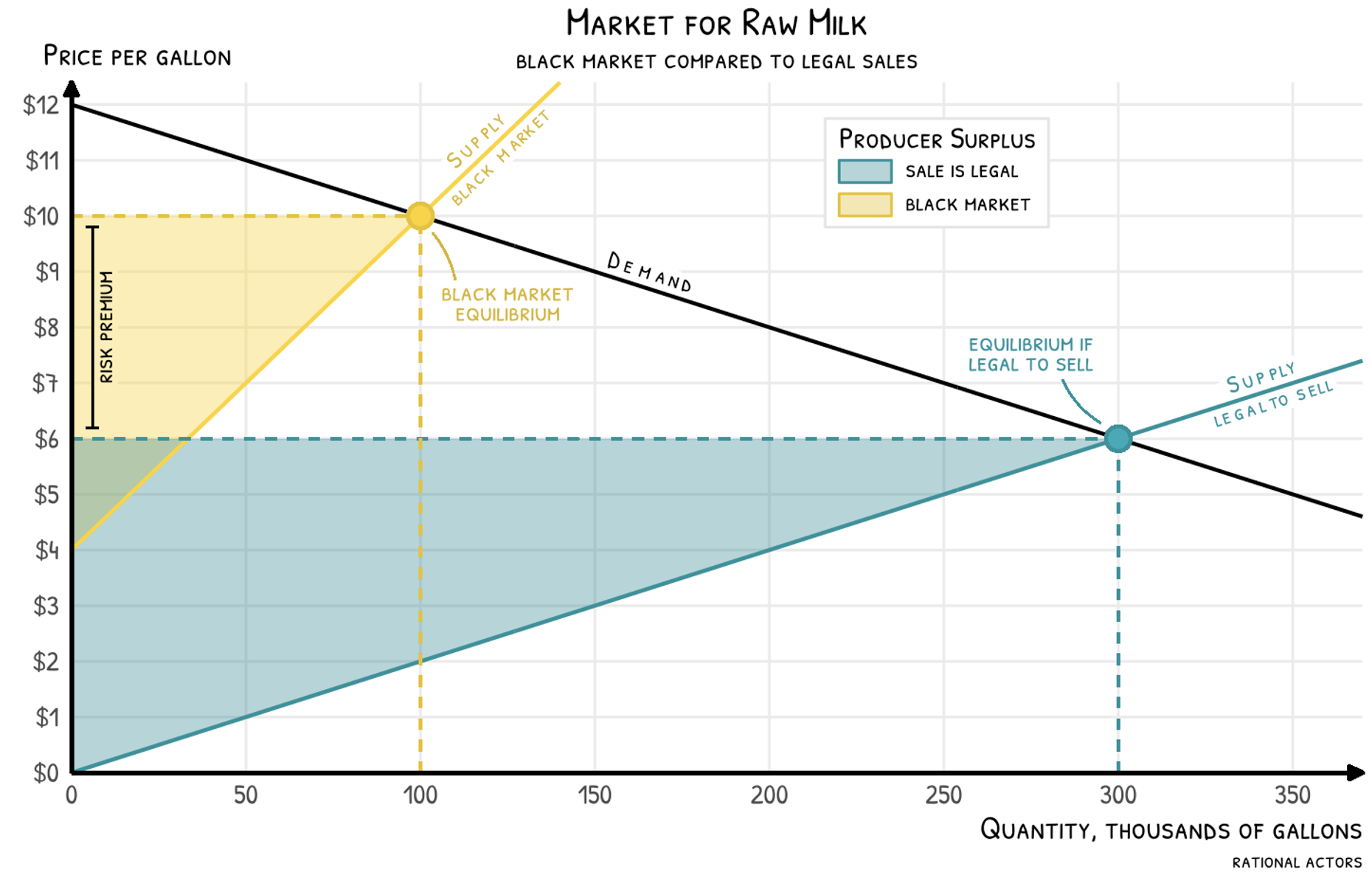
The reduced supply of illegal raw milk leads to a higher price and lower quantity in equilibrium. The higher price is a risk premium for the sellers in the black market. It compensates them for accepting risk.4
When Johnny says that the raw milk business is booming, he’s only correct in the sense that sellers are well-compensated via a high price. But he’s incorrect in two important ways: (1) the sale of black-market raw milk is costly due to enforcement and potential fines, (2) because sellers reduce their distribution and prices rise, the volume of raw milk sold falls drastically.
If we look at total revenue, raw milk on the black market is a $1 million industry in this example. But total revenue tells a misleading story. It doesn’t account for production or distribution costs, including potential fines. Producer surplus tells a different story, because it measures the difference between total revenue and the cost of producing and distributing marginal gallons of raw milk.5 There’s only $300,000 of producer surplus in the black market. But if raw milk were legal to sell, there would be $900,000 of producer surplus despite raw milk selling for only $6 a gallon.
The high price Johnny sees in this market does not actually imply that sellers in this market are thriving. It might signal an underserved market if the high price comes from overwhelming demand. But in this market, the high price is the result of reduced supply.6 The price must be high for any sellers to accept the risk and added costs of selling a prohibited product. It doesn’t signal opportunity, it signals risk.
So, should Johnny try to sell raw milk? It depends on his risk tolerance.
Twyla: “You would make a terrible drug dealer, Mr. Rose.”
Alexis: “You’re thinking about becoming a drug dealer? I mean, I get it. It’s fast money and no one would ever suspect you.”
Johnny: “I’m thinking of selling raw milk.”
Alexis: “Oh, I don’t think that’s right for you.”
Johnny: “But selling drugs is?!”
1 In the United States, the legality of raw milk sales varies from state to state, and many states have restrictions that prevent large dairy farms from selling raw milk. This description of laws in Canada and the United States is current as of 2026.
2 In other words, the costs associated with selling illegal products are variable costs and make each additional unit of the product sold more costly on the margin.
3 Or perhaps 300,000 gallons are supplied in the black market instead of 350,000 in legal markets. The drop in quantity supplied at each price depends on both the probability of being caught and the size of the penalty if caught. The harsher the penalty, the larger the decrease in supply.
4 This is similar to compensating differentials in labor markets, where wages increase with risk, compensating workers for dangerous occupations.
5 Producer surplus is total revenue minus variable costs, where variable costs is the sum of marginal costs for each gallon produced and distributed, including legal costs.
6 If anything, prohibition may also decrease demand. Even if consumption is legal, buyers may incur search costs to acquire hard-to-find products or may hesitate to purchase products the government has deemed unlawful.

More from Schittʼs Creek:


1 In the United States, the legality of raw milk sales varies from state to state, and many states have restrictions that prevent large dairy farms from selling raw milk. This description of laws in Canada and the United States is current as of 2026.
2 In other words, the costs associated with selling illegal products are variable costs and make each additional unit of the product sold more costly on the margin.
3 Or perhaps 300,000 gallons are supplied in the black market instead of 350,000 in legal markets. The drop in quantity supplied at each price depends on both the probability of being caught and the size of the penalty if caught. The harsher the penalty, the larger the decrease in supply.
4 This is similar to compensating differentials in labor markets, where wages increase with risk, compensating workers for dangerous occupations.
5 Producer surplus is total revenue minus variable costs, where variable costs is the sum of marginal costs for each gallon produced and distributed, including legal costs.
6 If anything, prohibition may also decrease demand. Even if consumption is legal, buyers may incur search costs to acquire hard-to-find products or may hesitate to purchase products the government has deemed unlawful.