The Gang Speculates
It’s Always Sunny in Philadelphia: S4, E2 “The Gang Solves the Gas Crisis”
Supply and Demand: Speculation
The gang is always hatching new schemes. This time, they have noticed the recent increases in gas prices. Mac wants to leverage the gas price increases, and he has an idea.
“The plan is simple, okay? We go to a bank. We talk to a loan officer. We get a hefty loan to buy a bunch of gasoline. We take that gasoline. We store it in the basement. We wait a few months. When the gas prices skyrocket, we sell it, make a huge profit.”
This scheme is an example of arbitrage: buying a good in a market where it has a low price and reselling it in a market where it has a higher price. And because this plan involves buying and selling at different time periods (as opposed to geographical locations or to different groups of customers), this is a special case of arbitrage: speculation. Speculators usually focus on arbitraging financial instruments or other things with lower storage costs. Speculation is risky because it amounts to betting on future prices. But the gang is daring.
Is this a good plan? It depends on the gang’s ability to project the future price of gas. We can model the situation in which this scheme works well using supply and demand. For simplicity assume the demand for gasoline will stay the same over time. Therefore, the gang is projecting future decreases in supply that would further increase gas prices.
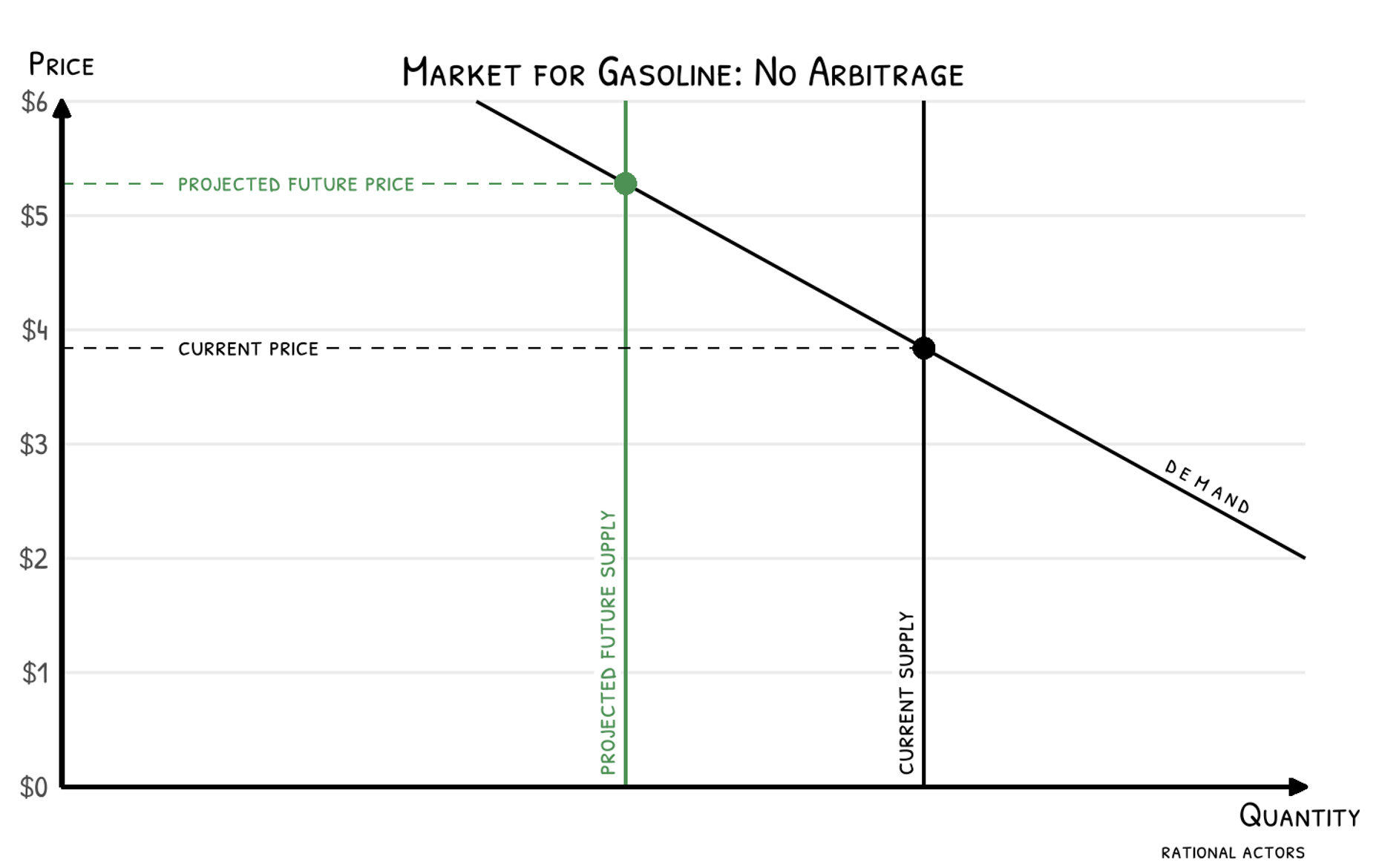
If, indeed, supply decreases, gas prices will rise and open the possibility for the gang to resell their gasoline at a higher price than they paid for it. They would then make a comfortable profit if their storage costs are not too high and they are able to successfully convince consumers to buy their gas.
In their meeting with a loan officer, Dennis explains that the price of gas has increased substantially over the last year and if that trend continues, their plan will clearly be profitable. When the loan officer rejects their application for a $300,000 loan, they use Dee’s life savings instead. Soon, they are pumping 300 gallons of gasoline into large black barrels for storage.
Their plan is to then save those 300 gallons for a future date with a higher price and sell the gas then. We can model the effects of their scheme on the market by adding to the previous graph.
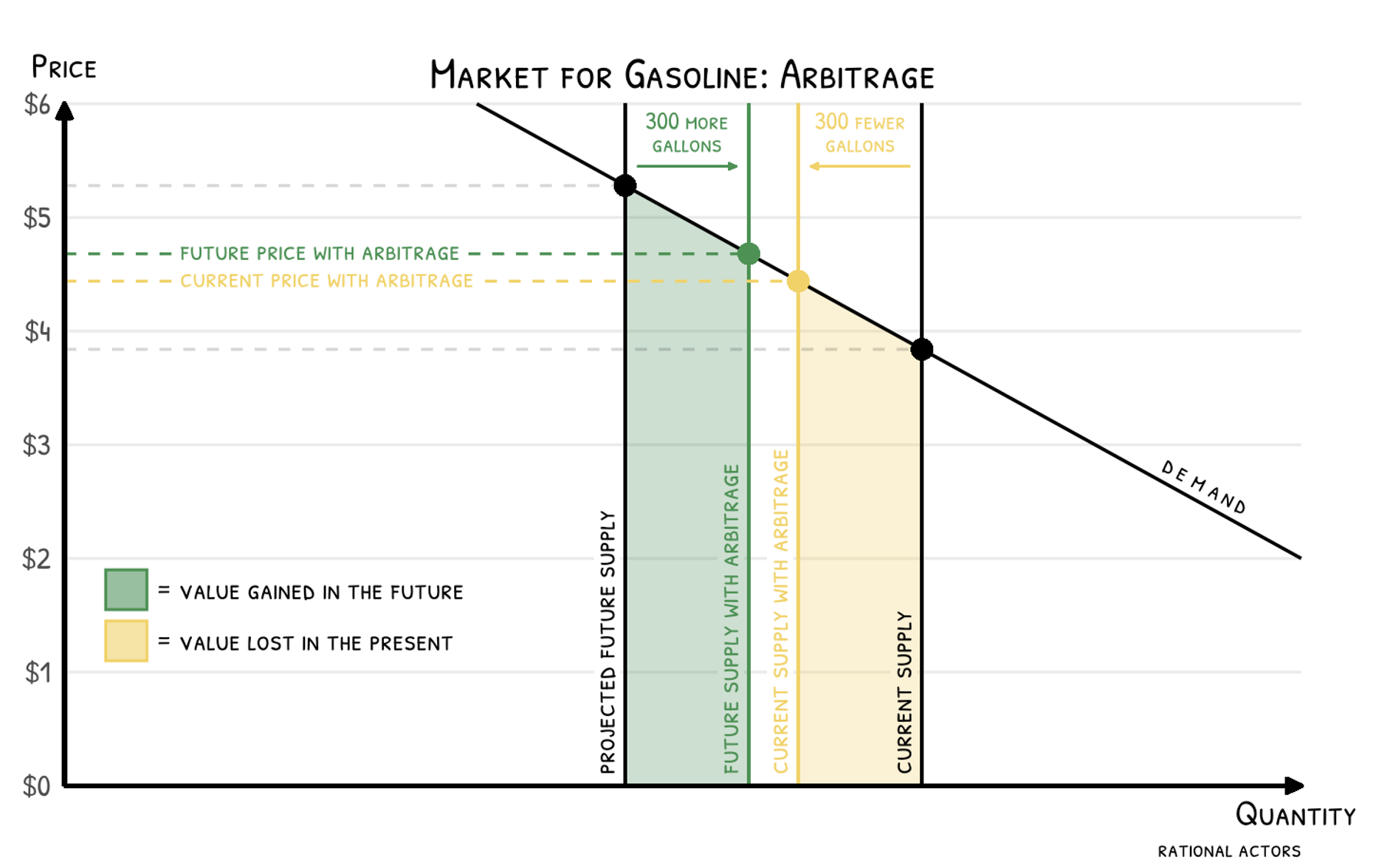
The 300 gallons of gas they pump in the present decreases market supply by 300 gallons.¹ The first prediction is that current gas prices will start to rise. And sure enough, this happens. Mac and Charlie catch on immediately.
“Gas has gone up $0.07 since this morning.” -Mac
“He puts up a new thing on the sign every time we pull in there.” -Charlie
But that’s entirely predictable. It’s a feature of their plan. The second part of the plan involves supplying their 300 gallons later when the market price is higher. This move would increase supply and drive down future prices. In other words, speculation reduces variability in prices over time.
And in this example, the gang’s plan is actually beneficial to society as defined by the overall change in value.² When they hoard 300 gallons in the present, that’s 300 gallons that go unused. But if they provide those 300 gallons back to the market later with a higher price, the gallons are used, and the value is greater at that time due to the higher price.
These conclusions all rest on accurate projections of future prices. Speculators who accurately predict future price movements reduce the variability of prices and add economic value. But speculators who make poor projections do exactly the opposite. Which kind of speculators are Mac, Charlie, and Dennis? To the data!

This episode aired on September 18, 2008. At the time, the national average gas price per gallon was $3.84.³ Dennis projected that gas prices would continue to rise over the next year as they had the year prior. If he was correct, the national average would spike all the way to $5.28 by September of 2009. And as is typical for the gang, their projections prove comically incorrect. Within a few months, prices plummeted to $1.61. In fact, gas prices did not return to $3.84 until April of 2011 and have never reached $5.28 as of August 2025.
As a result, the gang was actually buying high and selling low. That’s poor speculation. Assuming the gang holds onto their 300 gallons for one year, then resells at $2.58, how profitable was their scheme? Let’s add it up.4
Future revenue: $2.58 x 300 = $774
Investment cost: $3.84 x 300 = $1,152
Storage costs: $0 (they have space in the basement of the bar)
Transportation costs: $2.41
Opportunity costs: unclear, but their second-best use for this money was likely poor, and how much interest was Dee really collecting on that savings account anyways?
Profit = -$380.41
The biggest problem for the gang? They never actually resold the 300 gallons. Charlie swallowed a good deal of the gas. The rest burned up inside a crashed van. So, their attempt to speculate led to increasing prices at a time when prices were already high, ruining the interior of Dennis’s precious Range Rover, and wasting precious gasoline. But at least they learned something, right?
“You’re about to experience the hard knocks of a free market, bitch.”
¹ One may quibble that their purchase of 300 gallons does not decrease supply. It increases demand. But the effects of both are the same. Both cause the price to increase and cause less gas consumption to occur, since even though the gang bought 300 gallons, they don’t use it.
² Value here is defined by consumer surplus plus producer surplus. Note that this conclusion depends closely on the modeled elasticity of supply. Here, I use perfectly inelastic supply curves under the assumption that during the time frames in which the gang first arbitrages gasoline by filling the barrels, stations respond by only increasing prices and not increasing production. If you take a longer-term view with more elastic supply curves, it’s possible that speculation reduces value.
³ Source: https://fred.stlouisfed.org/series/GASREGW
4 Assume the gas station is 2 miles from Paddy’s Pub and they make four round trips in Dennis’s 1993 Range Rover, which gets only 12 miles to the gallon.

More from It’s Always Sunny in Philadelphia:
- All
- It's Always Sunny in Philadelphia
¹ One may quibble that their purchase of 300 gallons does not decrease supply. It increases demand. But the effects of both are the same. Both cause the price to increase and cause less gas consumption to occur, since even though the gang bought 300 gallons, they don’t use it.
² Value here is defined by consumer surplus plus producer surplus. Note that this conclusion depends closely on the modeled elasticity of supply. Here, I use perfectly inelastic supply curves under the assumption that during the time frames in which the gang first arbitrages gasoline by filling the barrels, stations respond by only increasing prices and not increasing production. If you take a longer-term view with more elastic supply curves, it’s possible that speculation reduces value.