Paddy’s Dollars
It’s Always Sunny in Philadelphia: S5, E3 “The Great Recession”
Game Theory: Networks
Due to the recession, business has slowed at Paddy’s Pub. And to make matters worse, a shanty town is taking shape on the street outside the bar. But Dennis has an idea to stimulate economic activity.
“I got an idea for a stimulus plan for the bar that’s gonna blow your freakin’ mind … I’m proposing that we print our own currency, okay? … And we call it Paddy’s dollars. Now, we distribute that out to people for free initially, and then they become customers and then they bring in new customers.”
So far, so good. But Dennis and Mac insist that not only will this bring in customers, the issuing of Paddy’s dollars will also create a “self-sustaining economy.” Their plan reaches a dead end when all the Paddy’s dollars get redeemed for free drinks and end up back in their own hands.
“How does this work, Mac?” - Dennis
“The money keeps moving in a circle.” - Mac
“But we don’t have any money. All we have is this. How does this work dude?” - Dennis
Dennis is correct. They have no money. At least not in any sense of what money actually is. Mac knows that the money must keep moving in a circle but doesn’t recognize that the Paddy’s dollars are not moving at all. They turn out to be coupons for free drinks, not money.
Money is defined more by what it does than what it is. Because from a literal perspective, Paddy’s dollars are eerily like US currency. Both are green pieces of paper with faces on them. So, what makes US currency money and Paddy’s dollars not so much?
One feature of money is that it is a medium of exchange: people accept it in trades for goods and services.1 This makes money a network because it increases in value as more people use it and accept it as a form of payment. When you walk into a bar for a drink, your chosen form of currency is valuable if that’s the currency the bar accepts for transactions. And the bar’s owners are more likely to accept that currency if they anticipate that their suppliers, their landlords, and their grocery stores accept that currency too.
We can use this idea to model how currencies are (or are not) widely adopted. Suppose that people choose a currency with the sole purpose of maximizing their ability to exchange with others. Exchanges can only occur if both use the same currency. And suppose there is no cost to adopting a currency.2 Here, money’s only function is to facilitate transactions.
Will an individual person adopt Paddy’s dollars? This depends on the fraction of others that are expected to adopt them. Suppose someone expects that 40% of others will use Paddy’s dollars. And suppose that they meet nine other people they wish to transact with that day. If their objective is to maximize the number of successful transactions, should they use Paddy’s dollars or not? To the probabilities:3
- Probability that five or more will use Paddy’s dollars = 27%
- Probability that four or fewer will use Paddy’s dollars = 73%
If five or more use Paddy’s dollars, then the individual would be better off using Paddy’s dollars, so there’s a 27% chance the individual will adopt Paddy’s dollars. But the same type of logic applies to all people. So, if it’s expected that 40% of people will use Paddy’s dollars, only 27% will actually use them. This cannot be an equilibrium. Individuals will soon catch on to the low usage of Paddy’s dollars and rethink their strategies.
Notice that a 60% expectation does not lead to an equilibrium either. With an expectation that 60% of people will use Paddy’s dollars, the probability that the individual will be better off using them is 73%. So, more than 60% of people end up using Paddy’s dollars. This cannot be an equilibrium either. Equilibria occur where the actual percentage of users equals the expected percentage of users.4 There are two predictable equilibria:
Equilibrium 1: It’s expected that nobody will use Paddy’s dollars, so nobody does, proving the expectation correct.
Equilibrium 2: It’s expected that everybody will use Paddy’s dollars, so everybody does, proving the expectation correct.
Any expectation of use that is between 0% and 50% leads to a usage rate that is lower than the expectation: not an equilibrium. And any expectation of use that is between 50% and 100% leads to a usage rate that is greater than the expectation: not an equilibrium. But actual usage crosses over from too little use for an equilibrium to too much use for an equilibrium at the 50% mark. And that’s where the third equilibrium lies.
Equilibrium 3: It’s expected that 50% of people will use Paddy’s dollars, so individuals are equally likely to be better off with Paddy’s dollars or without. They flip coins to decide. And as a result, 50% of people use Paddy’s dollars, proving the expectation correct.
This description is modeled graphically below.
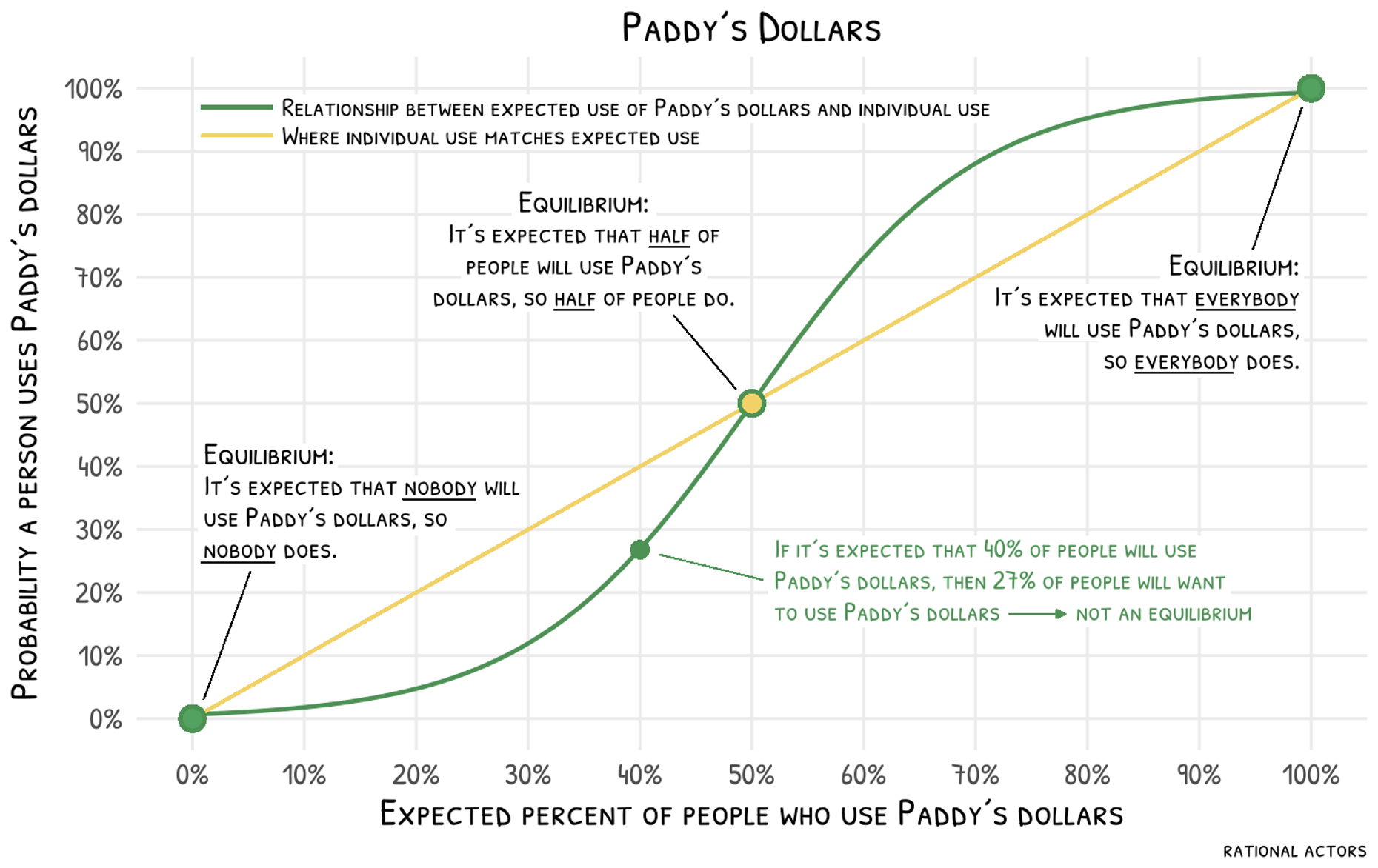
To have an equilibrium, actual use of Paddy’s dollars must match the expectation. That happens where the green line and yellow line cross. If the green line is below the yellow line, too few people have adopted Paddy’s dollars to have an equilibrium. And if it’s above, too many have adopted.
But what if the expected use of Paddy’s dollars really is 60%? It’s not an equilibrium according to the model, because 73% of people will actually use Paddy’s dollars, but then what? Eventually, people realize that a higher percentage of people use Paddy’s dollars, so they revise their expectations.
Suppose they revise their expectations to the correct level: 73%. This is still not an equilibrium. If it’s expected that 73% of people will use Paddy’s dollars, then it will benefit 94% of people to use Paddy’s dollars. Eventually, people catch onto the 94% usage rate and then increase their own usage again. This story converges to one of the equilibria: everyone uses Paddy’s dollars. And this equilibrium is stable because conditions that are out of equilibrium converge towards it.
Meanwhile, the 50% usage equilibrium is unstable. As soon as expectations reach 51%, use converges to 100%. Even slight disturbances to a 50% use equilibrium lead actual usage elsewhere. This process is illustrated below.
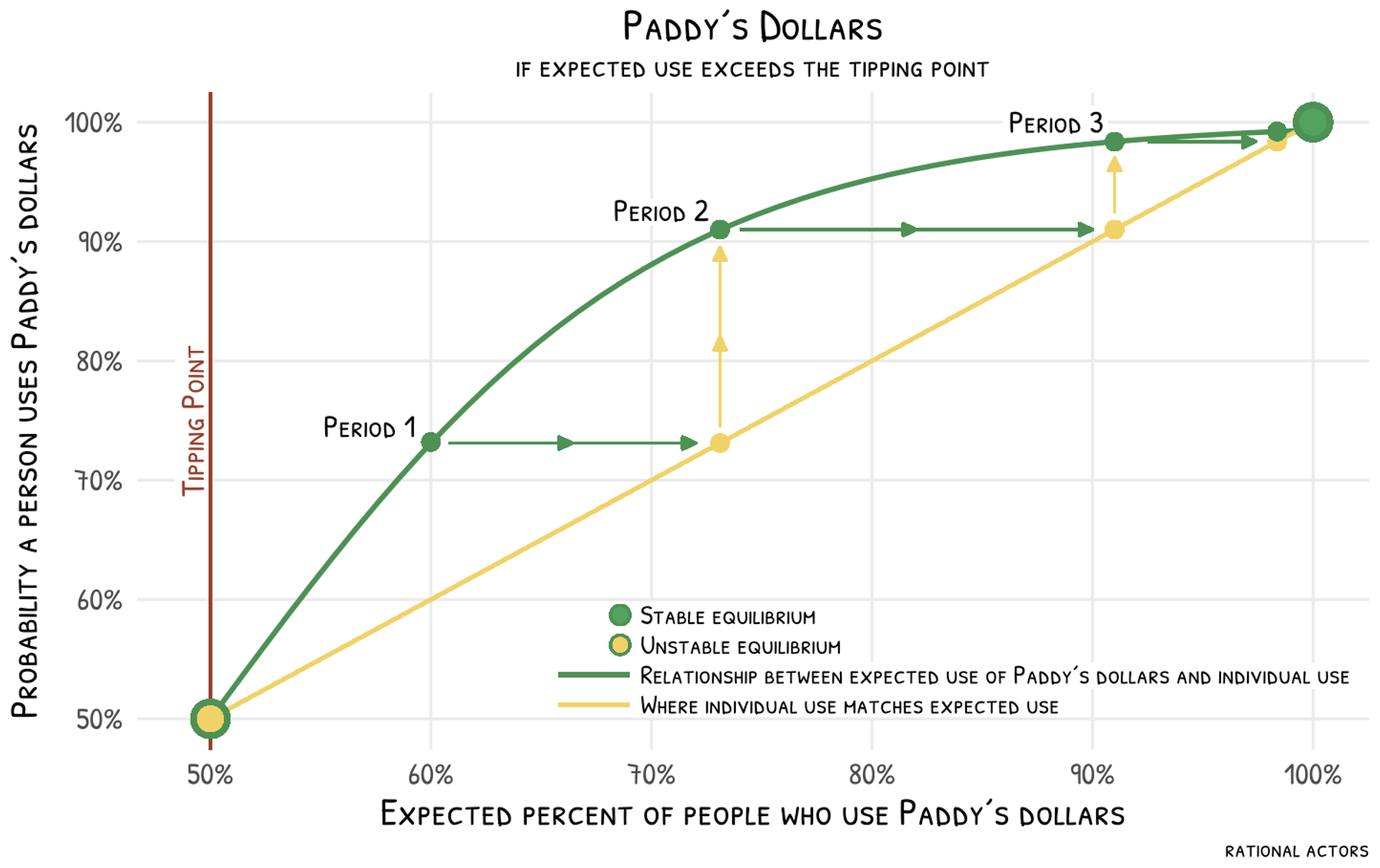
And this logic has practical implications for Dennis and Mac. To get full adoption of Paddy’s dollars, they don’t need to get everyone to use them. They only need to get to 51% or even 51% expectations. There is a tipping point. Once expectations cross 50%, the currency will take off and reach full use.
Of course, they didn’t reach the tipping point. The recipients of the Paddy’s dollars had very low expectations about the percentage of people they would meet who would transact in Paddy’s dollars. So, they used them merely as coupons at Paddy’s rather than as general currency.
Even 40% expected use would not have been enough for Paddy’s dollars to make it. With 40% expected use, only 27% will use them. As expectations adjust, an ever-decreasing percent of people actually use Paddy’s dollars. Soon after, not a soul is transacting in Paddy’s dollars. Because nobody else is. And once this becomes the reality, there’s no reason to expect it to change. It’s a stable equilibrium.

Money, due to its network features, has two possible destinations: universal use or obsolescence. Its fate depends on its ability to reach the tipping point. To get there, one must create high initial expectations. This applies broadly to networks. Are you hosting a party? Convince your invited guests that everyone is gonna be there. Starting a ride-sharing service? Lower your prices early on to attract a large customer base.
And if you’re creating your own currency, you must somehow convince the masses that most of the others are also going to transact in this currency. If there’s already a widely adopted currency that serves this role, well, good luck to you.
“I don’t understand how the US economy works, much less some sort of self-sustaining one.”
1 Money has two other necessary features: (1) store of value: it must maintain its value over time if not used immediately for transactions (2) unit of account: it has numerical values that allow for comparisons of value where instead of pricing everything in relative terms (1 martini = 2 beers = 4 lemonades), goods and services can be priced in units of currency.
2 This is different from other network goods. Take video games for example. They are network goods because an individual player gets more joy from the game as the number of other players in the game increases. However, the video game must be purchased at some cost. And the video game may have features that don’t depend on the number of other players such that a user could get some joy out of it independent of others’ use.
3 This probability comes from a binomial distribution. With nine draws from the distribution and a success rate of 0.4, the probability of getting five or more successes is 26.7%. We are also assuming that draws from the distribution are independent from each other.
4 This is referred to as a self-fulfilling expectations equilibrium.

More from It’s Always Sunny in Philadelphia:
- All
- It's Always Sunny in Philadelphia

1 Money has two other necessary features: (1) store of value: it must maintain its value over time if not used immediately for transactions (2) unit of account: it has numerical values that allow for comparisons of value where instead of pricing everything in relative terms (1 martini = 2 beers = 4 lemonades), goods and services can be priced in units of currency.
2 This is different from other network goods. Take video games for example. They are network goods because an individual player gets more joy from the game as the number of other players in the game increases. However, the video game must be purchased at some cost. And the video game may have features that don’t depend on the number of other players such that a user could get some joy out of it independent of others’ use.
3 These probabilities comes from a binomial distribution. With nine draws from the distribution and a success rate of 0.4, the probability of getting five or more successes is 26.7%. We are also assuming that draws from the distribution are independent from each other.
4 This is referred to as a self-fulfilling expectations equilibrium.