We’re Crab People Now
It’s Always Sunny in Philadelphia: S5, E3 “The Great Recession”
Supply and Demand: Normal and Inferior Goods
Times are tough. Frank, Charlie, and Dee are out of their jobs at Paddy’s Pub due to the recession. Frank and Dee’s venture into door-to-door knife and vacuum sales flopped. And that brings them to their last-ditch effort to find an income source. That’s where they find Charlie on the banks of the Delaware River with his best idea yet.
“These are crabs! Fresh, local Delaware runoff crabs.” – Charlie
“Those don't look anything like crabs. They look like sea scorpions. Isn't there some kind of, like, sewage runoff around here?” - Dee
“Yeah, there's a pretty bad sewage runoff, but, you know, crabs is sewage-proof!” – Charlie
“And depression-proof. People gotta eat. We’re gonna sell these on the street.” - Frank
They are crab people now, or at least, that’s the plan. But is it a sound plan?
It depends on whether crab meat is a normal good or an inferior good. Normal goods get boosts to demand when consumer income goes up and drops in demand when consumer income goes down.11 One could quantify this by measuring a good’s income elasticity of demand: the percent change in quantity demanded divided by the percent change in consumer income. Negative values for income elasticity of demand suggest a good is an inferior good, because quantity demanded decreases as consumer income increases. Positive income elasticities suggest normal goods but can be further classified. If the income elasticity is between 0 and 1, a good is a necessity. As consumer income changes, quantity demanded doesn’t fluctuate wildly. But if income elasticity is greater than 1, the good is a luxury good. Consumer income greatly affects the purchasing patterns for consumers of luxury goods. Consumer income is the crucial variable here, because times are tough for everyone, not just for these three. But inferior goods have the opposite relationship with consumer income. As income drops during a recession, consumers increasingly turn to these inferior goods. Think secondhand clothing, cans of beans, store-brand goods, and other budget-friendly items.
To see why this distinction will be important for the fate of the crab people, let’s model the market for crab meat in Philadelphia. For simplicity, assume that this market consists of whole crabs of relatively similar quality. The supply of crabs, demand for crabs, and resulting market price prior to the recession is provided below.
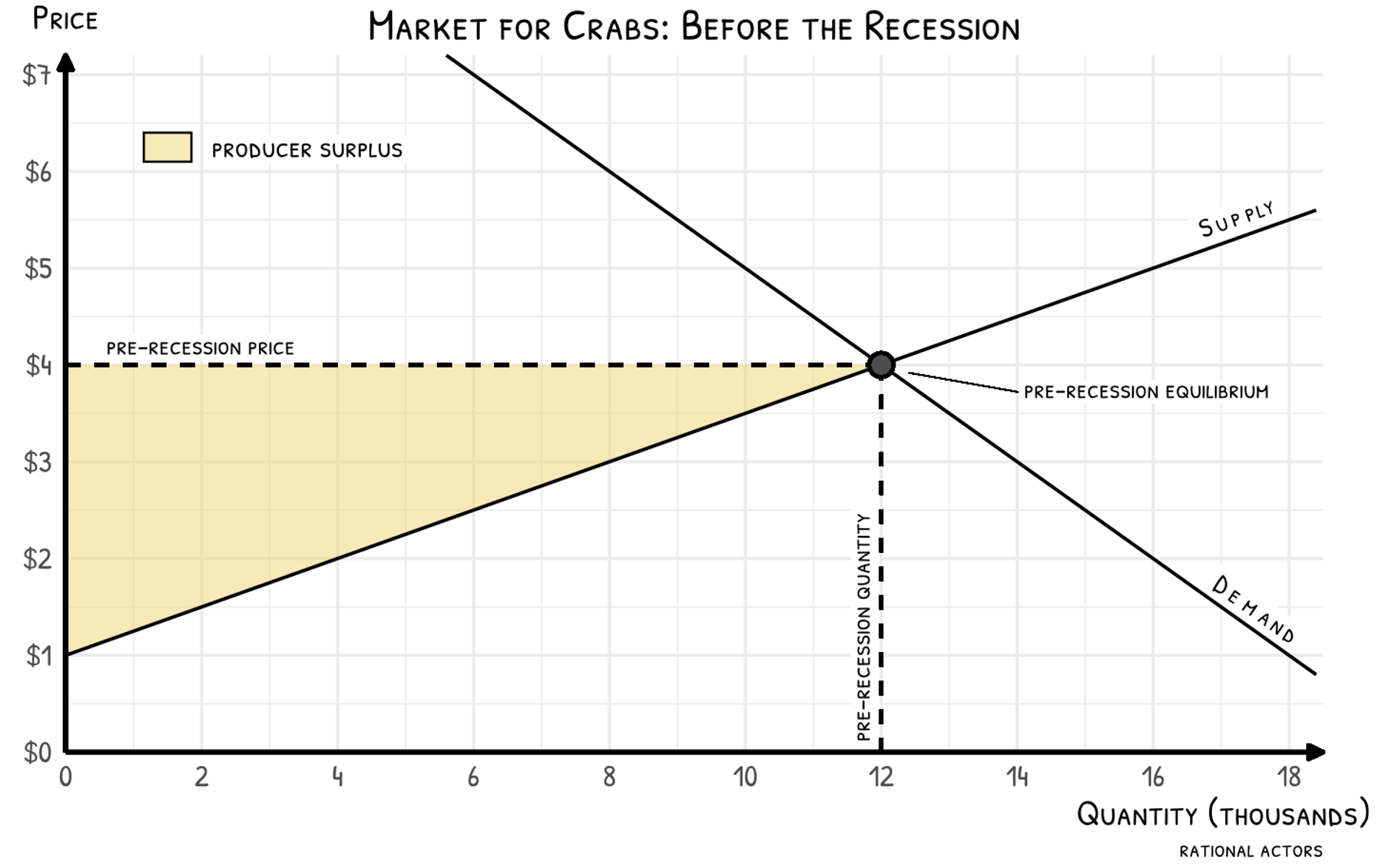
At $4 per crab, consumers demand 12,000 crabs each day and producers provide exactly that quantity. For many of these producers, the crabs they sell cost significantly less than $4 to bring to the market.22 This is the marginal cost. The height of the supply curve represents marginal costs rather than the fixed costs of crab fishing. Therefore, producer surplus differs from profit. As a result, there exists significant producer surplus in this market: $18,000 to be exact.33 This is the area of the yellow triangle, which represents producer surplus since the height of the supply curve measures marginal cost and all crabs sell at the market price.
In the best-case scenario for the gang, crabs are an inferior good. And during a recession, where income declines and layoffs are rampant, consumers would turn up to buy crabs in increasing numbers. For inferior goods, demand increases when consumer income falls. The consequences of a demand increase in the market for crabs can be seen below.
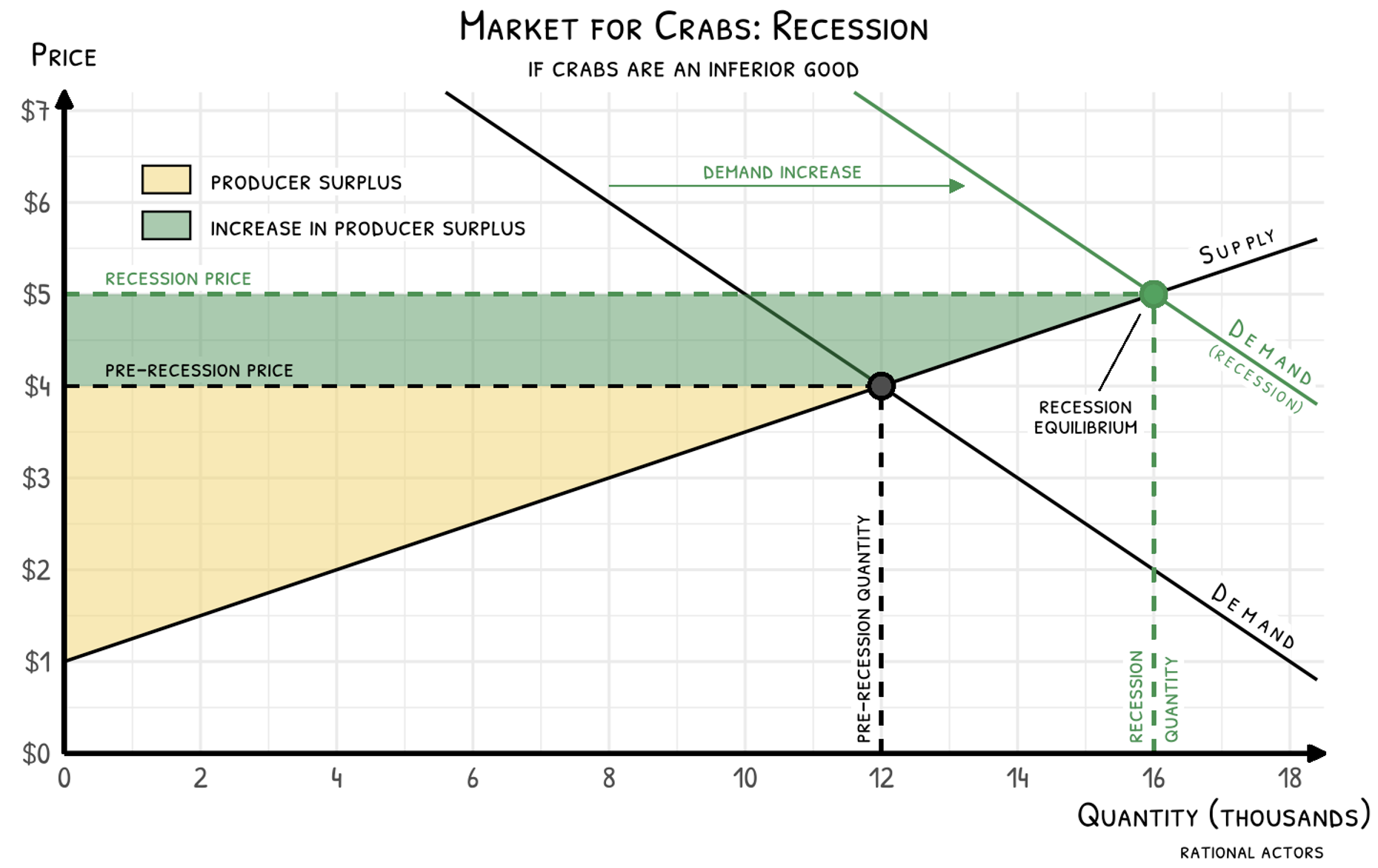
In the scenario where crabs are an inferior good, the boost to demand drives up market prices. The higher price gets existing producers moving. Longer hours, more crab pots. It may also get new producers into the market who see the $5 price as now profitable where $4 was not.44 This depends on whether the market has free entry. And this may not be the case for the crab market, where potential new sellers would need access to fruitful fishing spots and would need to be able to cover significant upfront costs. But if it had free entry, the higher price would induce additional sellers, expand supply, and bring market prices back down. This is a feature of highly competitive markets. Maybe this is what Frank and Charlie have in mind! Either way, the result is higher-priced crabs and greater quantities. That’s a big boost to producer surplus.
The problem for these three? Crabs are probably not an inferior good. A hallmark of an inferior good is a relatively low price among competing goods. Secondhand clothes are an inferior good because they are more affordable than new clothes. Canned corn is an inferior good because it has a lower price than fresh corn. Crab meat probably does not follow this pattern. Other sources of protein, like chicken and pork, are far more affordable.
Frank is correct that “people gotta eat”, but they don’t gotta eat crab. And as a result, demand for crabs probably falls during a recession.
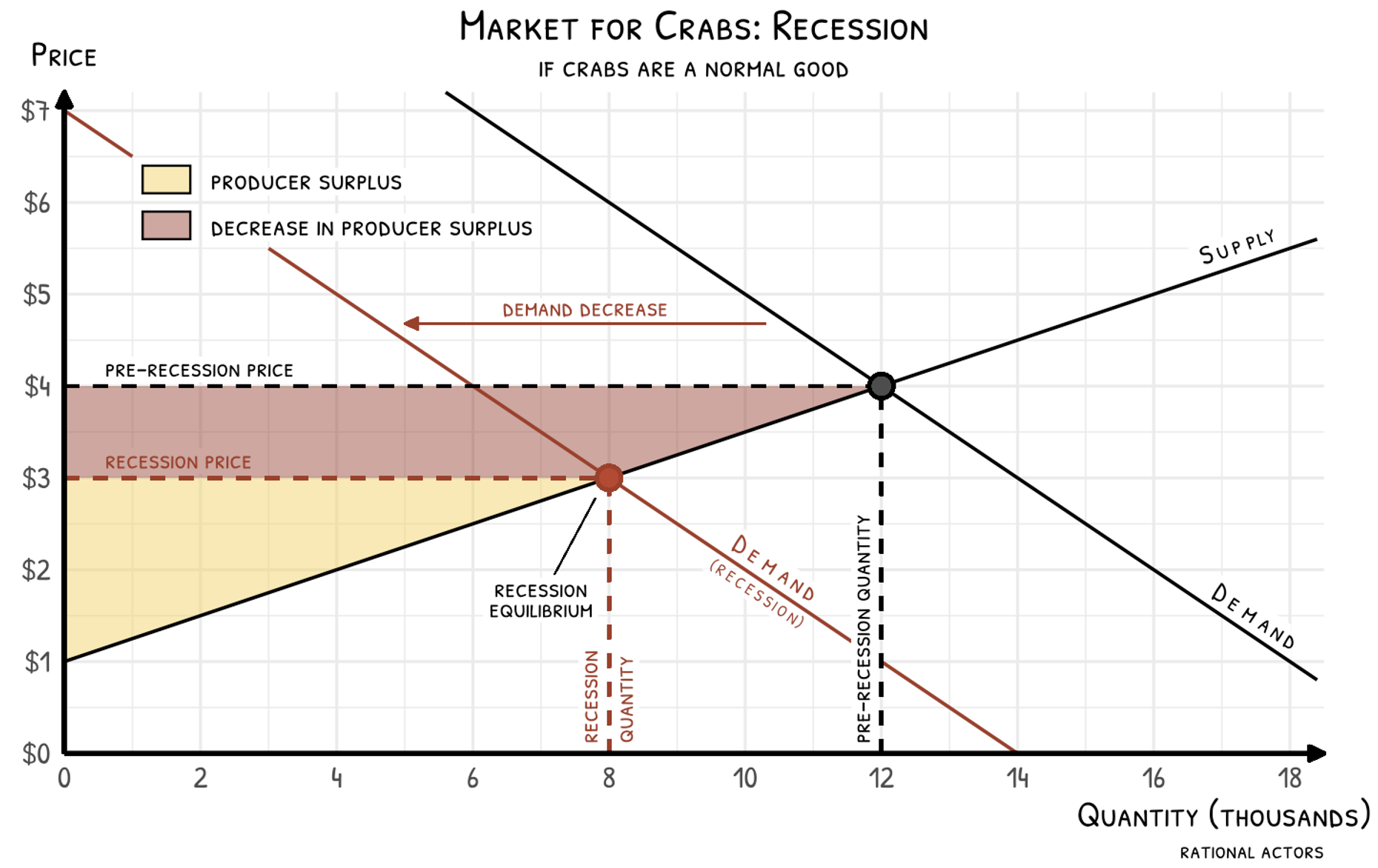
This drives down market prices, as crab sellers try to get rid of their daily catch in a world where buyers are looking elsewhere for protein sources. So, this may not be the time for a new crab fishing venture. Instead of selling $4 crabs, the price is competed down to $3. And producer surplus begins to vanish as the reward to selling crabs decreases and wiser sellers than Frank and Charlie cut back on crabbing.55 In a market with free exit, some crab fishing operations may no longer be profitable at the lower price and will exit the market. As sellers exit, the supply of crabs decreases, bringing the market price of crabs back up to previous levels. But this may be a slow process, as sellers may not immediately exit.
Their plan to sell food on the street also has some operational hurdles in addition to the issue of selling reduced-price crabs. It likely requires vendor permits and licenses. And unless crabs really are sewage-proof, they may get stuck here. Like many of the gang’s schemes, this one could have used some more thought. And some more economics.
“Well, you start putting plans under microscopes, nothing’s gonna make sense, all right?”
1 One could quantify this by measuring a good’s income elasticity of demand: the percent change in quantity demanded divided by the percent change in consumer income. Negative values for income elasticity of demand suggest a good is an inferior good, because quantity demanded decreases as consumer income increases. Positive income elasticities suggest normal goods but can be further classified. If the income elasticity is between 0 and 1, a good is a necessity. As consumer income changes, quantity demanded doesn’t fluctuate wildly. But if income elasticity is greater than 1, the good is a luxury good. Consumer income greatly affects the purchasing patterns for consumers of luxury goods.
2 This is the marginal cost. The height of the supply curve represents marginal costs rather than the fixed costs of crab fishing. Therefore, producer surplus differs from profit.
3 This is the area of the yellow triangle, which represents producer surplus since the height of the supply curve measures marginal cost and all crabs sell at the market price.
4 This depends on whether the market has free entry. And this may not be the case for the crab market, where potential new sellers would need access to fruitful fishing spots and would need to be able to cover significant upfront costs. But if it had free entry, the higher price would induce additional sellers, expand supply, and bring market prices back down. This is a feature of highly competitive markets.
5 In a market with free exit, some crab fishing operations may no longer be profitable at the lower price and will exit the market. As sellers exit, the supply of crabs decreases, bringing the market price of crabs back up to previous levels. But this may be a slow process, as sellers may not immediately exit.

More from It's Always Sunny in Philadelphia:
- All
- It's Always Sunny in Philadelphia