No Balance Anymore
Game of Thrones: S4, E7 “Mockingbird”
Supply and Demand: Market Efficiency
The Hound and Arya Stark continue their trek across Westeros when they come upon a farm.
The Hound: “Could be food.”
Arya: “Could be soldiers.”
Why would weary travelers not immediately rejoice at the sight of a farm? Surely, there would be food there. If they have a few silver stags, and these two do, food should await.
But all they find is a dying man, likely wounded by marauding soldiers. The Hound tells the man why he has Arya in tow: he’s taking her to The Eyrie to sell her to her aunt. His response says a lot about the current state of the Westerosi economy.
Dying Man: “A fair exchange, that is. Always held to the notion of fair exchange in all my dealings. You give me, I give you. Fair. A balance. No balance anymore.”
The man laments the loss of something. To see what, consider the market for roast chickens. This market must have had “balance” in peacetime before the Riverlands were flooded with soldiers. Back then, both sides of a transaction gave something and both sides received something.
Currency changed hands for goods and services, and prices emerged in the market through repeated interactions of buyers and sellers. Supply and demand best captures what was happening. An equilibrium price emerges such that the number of chickens supplied equals the number demanded. Any other price leads to market shortages or market surpluses and the price adjusts.11 Surpluses bring prices down as sellers compete with other sellers to offload the chickens nobody seems to want to buy. Shortages bring prices up as buyers compete with other buyers to get chickens that always seem to run out. It happens with nobody in charge. No decrees from a king, maester, or council are necessary.
At this market price, say 5 silver stags, many chicken buyers benefit because they are willing to pay even more. That’s consumer surplus. But also, many sellers benefit because their cost of producing a single chicken is less than 5 silver stags. That’s producer surplus. Both sides benefit from their transactions, and some sense of balance exists.22 That’s not to say that producer and consumer surplus are equal in any individual transaction or at the market level. They likely would not be. But these transactions are mutually beneficial nonetheless.
The graph below visualizes these outcomes in a market where prices rule.

But the mutual benefit of these transactions is not the main takeaway. The real magic of a well-functioning market is that the price organizes economic activity in a desirable way. A market price of 5 silver stags and the 500 chickens transacted at that price maximize total surplus: the sum of producer and consumer surplus. Why is total surplus maximized? Think about how people respond to the market price.
First, people want to eat chicken. Some are desperate for it, and some would be fine with boar or venison instead. And there’s never enough chicken in Westeros for everyone. Who gets chicken? With allocation by prices, the answer is straightforward: those willing to pay a high enough price.33 It also requires ability to pay, which may leave poorer Westerosi people eating bowls of brown. This realization may justify income redistribution in Westeros, so that the split depends more on taste for chicken than on financial means. Those who love chicken tend to get it.
The price system also organizes workers and industries. Who will produce chicken in Westeros? With free market pricing, it’s those who can do so at low enough costs.44 Crucially, this includes opportunity costs! So, the people raising chickens are those who do so efficiently relative to their skill at other jobs. Here, the 500 chickens are produced in a way that uses fewer valuable resources, conserving them for other productive purposes.
The graph below visualizes how the market price creates a dividing line for who does and doesn’t eat chicken and who produces and doesn’t produce it.
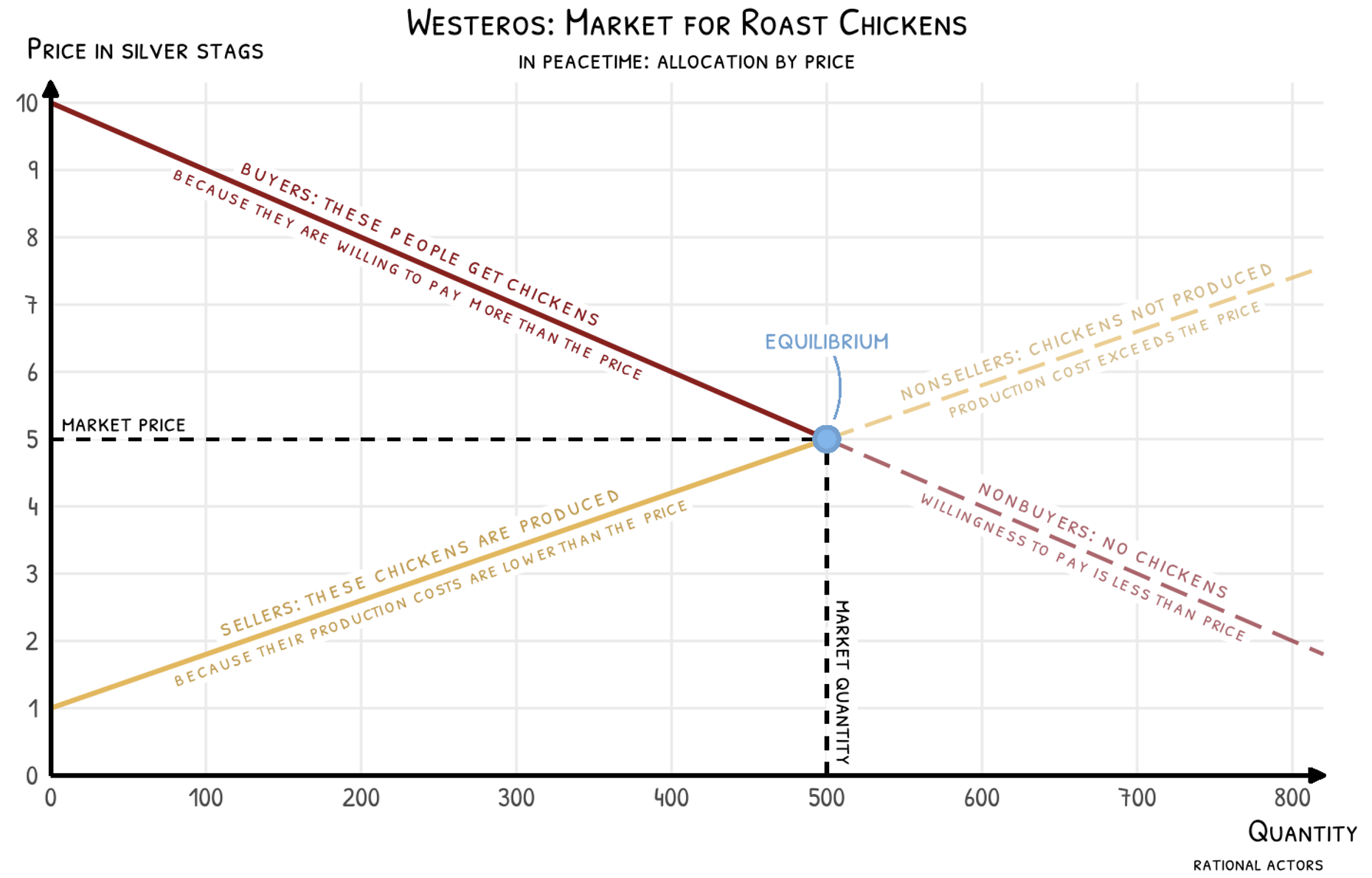
Generally, markets like this with free exchange and a market price are highly efficient, because the price guides economic behavior in a desirable way.55 The efficiency argument relies on the assumptions that a market includes many buyers and sellers, no externalities exist, and property rights are secure. These were the Westerosi markets the dying man remembers.
But now war has come to most of Westeros, and conditions are especially dire in the Riverlands. Chickens are now allocated to consumers by physical force and willingness to inflict violence on others. These conditions suit The Hound, as seen in the first episode of the fourth season. But it’s bad news for women, children, and old men. And when travelers come upon an inn or a farm, they no longer wonder if their silver stags will cover the price. Instead, they wonder if they can overpower or even kill the people inside.
The big and strong eat well past their fill while others starve.66 In allocation by price, won’t the Westerosi lords and ladies eat well past their fill while the common folk starve? Perhaps, but redistributing financial means is feasible, while redistributing physical might is not. And at least with the price system, high willingness to pay partly reflects strong preferences for chicken. It’s no longer clear that chickens go to those who like the taste the most. This world also wastes valuable resources. Farmers must hide their supplies. Soldiers fight for food, injuring and killing each other. Handing over a few silver stags would spare everyone a lot of trouble.
Even worse, this world provides no incentives for producers. Raising a flock of chickens invites raiders. The supply of chickens will shut down almost entirely. There may soon be no food left to be allocated, and winter is coming.
A flourishing Westeros requires secure property rights. Without them, the market will fail to efficiently allocate scarce goods via prices. And then the scraps will be fought over to the death. Soon after, the goods that consumers greatly desire will be nowhere to be found.
Dying Man: “Wish it were wine.”
The Hound: “So do I.”
1 Surpluses bring prices down as sellers compete with other sellers to offload the chickens nobody seems to want to buy. Shortages bring prices up as buyers compete with other buyers to get chickens that always seem to run out.
2 That’s not to say that producer and consumer surplus are equal in any individual transaction or at the market level. They likely would not be. But these transactions are mutually beneficial nonetheless.
3 It also requires ability to pay, which may leave poorer Westerosi people eating bowls of brown. This realization may justify income redistribution in Westeros, so that the split depends more on taste for chicken than on financial means.
4 Crucially, this includes opportunity costs! So, the people raising chickens are those who do so efficiently relative to their skill at other jobs.
5 The efficiency argument relies on the assumptions that a market includes many buyers and sellers, no externalities exist, and property rights are secure.
6 In allocation by price, won’t the Westerosi lords and ladies eat well past their fill while the common folk starve? Perhaps, but redistributing financial means is feasible, while redistributing physical might is not. And at least with the price system, high willingness to pay partly reflects strong preferences for chicken.

More from Game of Thrones:
- All
- Game of Thrones

